
by Paweł Skała-Piękoś
For a long time, fluent, competent form was a social marker of class. Whoever could write in the dominant language, summarise difficult texts, sound academic, edit their own thought, and move through institutional codes started higher up: not always because they understood more, but because they had a better command of the format in which understanding is recognised.
AI does not erase this difference or abolish hierarchy. It does something narrower and more unsettling: it lowers the price of one of hierarchy’s most important currencies. When fluent form becomes cheap, hierarchy does not disappear; it reprices the gate. The old title loses power, but the need for a title remains; the coat of arms stops deciding, so other things take its place: the diploma, the address, the way one speaks, reach, finally access to an AI model. Modernity likes to tell itself a myth of egalitarianism, dangerous precisely because it rests on real premises, and worth distrusting for the same reason: taken to the end, it cannibalises itself.
So the question is not whether the technological revolution already underway will abolish hierarchy. It will not. The mere possibility that AI infrastructure may concentrate around a few companies punctures the idealisation. The question is different: what will the new currency of rank be, and will it better recognise ability, responsibility, and work, or give old advantages a new language?
Let me clear the ground first, or everything that follows sounds like a cheap hymn to equality. A difference between people is not yet an injustice, and not every hierarchy is automatically an evil. If the one standing higher is a politician genuinely set on protecting the weaker, then power does not undermine what they do; it lets them shield people who would otherwise be defenceless. Rank can be an instrument of function. The trouble begins where function becomes an instrument of rank. Under its influence, the same person changes their aims: instead of protecting the weaker, they protect their own position, using those they represent as the excuse. Only when function loses out to rank does the moment arrive for a moral indictment.
The fuel changes on three floors
The fuel is changing across three floors at once, and we usually watch only one. At the top, fuel stops being a metaphor: it is electricity, silicon, raw computing power, fought over above our heads by states and a few companies rather than by people. This is not my thread here, but the floors below depend on it.
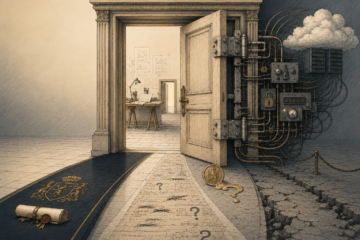
The middle floor is infrastructure and access: models, data, distribution channels, the default ways of asking questions. These are the new gates, and they make AI an awkward case, because two opposing forces press against each other. On one side, the form just mentioned is getting cheaper, so someone with neither the language nor an editor can now enter the game. On the other hand, what William Blake called the doors of perception may open, but their hinges, locks, and default paths are concentrating in a few hands; the old coat of arms returns in the guise of access to the model, above all in the power to shape how the model itself processes information.
If the most important cognitive infrastructure ends up concentrated in a few companies, and a society’s whole symbolic labour starts passing through their closed gates, we get an arrangement in which we are formally free but in fact work on someone else’s land. Only, unlike under serfdom or slavery, the land is not a field but a model, a cloud, an API, a ranking. This is a real risk Yanis Varoufakis calls technofeudalism; the analogy stands without his wider diagnosis.
That leaves the bottom floor, where I want to dwell longest. The three floors mesh mainly from the top down: without cheap energy, no cheap power; without power, no accessible infrastructure; without infrastructure, even the best individual workshop has nothing to work on. But the dependency is not total: a strong architecture of thinking can route around a weak infrastructure through an open model and its own hardware, while a state’s energy advantage stays barren until something turns megawatts into directed compute. Where the bottom floor slips free of the top, a recoinage can let someone new in. The hope is not that AI hands everyone a key; it is that, under the right conditions, it can become a crowbar against inherited gates.
What the architecture of thinking is, and why its value rises
By the architecture of thinking I do not mean a mysterious trait of personality, nor a secular coat of arms for the “more intelligent.” I mean a set of functions: who can ask a good question, who has material of their own, who recognises the limit of their knowledge, who tells a fact from a hypothesis, who builds themselves a channel of correction, who checks the result, who takes responsibility for what they publish. My working speculation is that in the coming decades this configuration, not intelligence as a prestigious little number, not erudition, not fluency, becomes one of the chief social currencies. Whoever has it uses AI as a cognitive partner; whoever lacks it gets a machine for producing confident, fine-sounding gibberish.
But a list of functions is not yet a currency. A currency of rank circulates, is recognisable, is unevenly held, and comes from somewhere; so the speculation must face three hard questions, whose answers decide whether this architecture frees anyone or merely restructures the old elites.
First: how do we even recognise “a good architecture of thinking” once its old identifying marks have lost their weight? The old currency was easy to read at a glance: accent, vocabulary, the smoothness of a sentence told you someone’s origins within ten seconds. This architecture is not visible on the surface of a text, because the surface is now produced by everyone. It shows only in the trace of the process: whether someone can show how they know what they claim, say “here I was wrong, and that is why I changed my mind,” and name what they do not know. That is harder to fake than fluency, because a fluent sentence, even a whole array of them, can now be generated without understanding. And yet the process too can be staged, so it cannot be read off a single performance. In a world where everyone can sound intelligent, the useful signal is who can change their mind under pressure without turning that change into another performance.
The second question spoils that hope, which is why it matters more: is the architecture of thinking heritable? It is, though in a form harder to recognise as privilege. A home where a parent asks the child, “How do you know that?” and “What would count against it?”, where it is said at the table that one may be wrong without losing face, where one is shown how to check and whom not to believe, loads this architecture into the child before the child has touched a single AI model. The old advantage reproduced itself openly: accent and diploma were visible, and so could be indicted. The new one is transmitted more covertly, as a habit of asking questions that looks innate but is in fact the learned capital of the home.
This is exactly the operation the old aristocracy performed on manners, passing off what was learned as natural. Only now the operation moves a floor deeper, from form to the way the mind works. A child from a home where the correction of one’s own thinking was never practised gets from AI the same tool as a child who practised it daily. The difference lies not in the model but in the channel through which a person learned to work with their own error. One may use AI as an oracle, another as a sparring partner; someone else may reject it altogether: out of well-judged caution, fear, defence of old prestige, or for want of the conditions needed to learn the tool. What is decisive is not whether someone uses the model, but whether they have the capacity for correction that lets them use it, limit it, or refuse it.
The third question touches institutions, and not only as verifiers: who is to teach this new currency, and how; to whom is access given; and only then, how is it tested? The old currency had its sieves: exam, diploma, peer review, interview; all tested a product: text, solution, answer. This architecture is harder, because it is not a one-off product but a capacity that has to be watched over time.
Treated only as something to detect in individuals, it becomes another class filter. The real test of maturity for a society is whether it can teach work with error, source, argument, model, and correction beyond the elite few raised in the right home. The right to be wrong without losing face can no longer remain a private luxury; it must become part of civic infrastructure.
This is the real reason the architecture of thinking may prove to be not a liberation but the subtlest form of inheritance we have yet seen: harder to see, because hidden in the process; harder to indict, because it looks like talent; harder to test, because it escapes the examinations we have. Its emancipatory potential is real: thinking is harder to counterfeit than a smooth sentence. But potential is not a mechanism. A door is not a road. Without institutions that learn to recognise this capacity and hand it out beyond the home, it becomes one more coat of arms, this time one whose bearer sincerely believes they earned it by hard work.
The limits of the existing dispute over hierarchy
In the argument about hierarchy, we usually see three sides. Each has its own problems.
The most visible variant of the right today has largely written itself out of this question, and that act of capitulation is part of the argument. You cannot frighten open defenders of hierarchy with the news that hierarchy is returning: that is their programme, not their nightmare. This right too often stops asking whether rank still transmits anything at all; position, strength, discipline, inheritance, victory begin to work as ends in themselves. A functional right, defending hierarchy only insofar as it carries responsibility, competence, and an obligation towards institutions, still exists but rarely sets the tone. Its symbolic example, for me, remains Senator John McCain: a man easy to disagree with, but whose sacrifice for public service would be hard to deny.
Liberals too often retreat into politeness. They lack the push to say outright that institutions need to distinguish quality: that there is a difference between better and worse medicine, a better and worse court, a text that reduces uncertainty and one that merely sounds good. The shame before that sentence looks like modesty but is an evasion, because a society that cannot distinguish quality does not thereby become free. It becomes blind, and blindness very quickly needs a new master to do its distinguishing for it. But we liberals are capable of the opposite error too: of falling so in love with distinguishing quality that, under the proud name of meritocracy, we begin to take existing rank as proof of function, instead of checking whether function still lives in it. Then the language of competence stops being an instrument of correction and becomes an elegant protection for a hierarchy that no longer has to explain itself.
The left falls into a subtler error. A morally sound anti-hierarchical reflex can heat up until every inequality, sometimes every significant difference, starts to look like violence, and the question vanishes of whether a given hierarchy serves a function or merely protects itself. Worse, the reflex itself turns into a currency of rank: moral purity becomes a coat of arms; the correct canon of reading, a diploma; fluency in spotting another’s privilege, a new form of polish that opens the doors to seriousness exactly as an accent once did. The milieu that most loudly indicts hierarchy is breeding one of its own, with a different currency but the same grammar: whoever knows the right words and the right authors starts higher up. An anti-hierarchy that can no longer tell functional hierarchy from domination does not abolish the master; it teaches him a new accent.
I write this from Central and Eastern Europe, a region that knows both errors at once: inherited rank posing as the natural order, and an anti-hierarchical language that, in the name of equality, could destroy institutions and the people able to distinguish quality. This is not an argument against the left as such. It is an argument against the blindness that poses as virtue. That blindness is more dangerous on the side that believes itself immune to hierarchy, because it cannot see its own.
The stakes
The question of the stakes is not new, but it returns under new conditions. Whether a given rank answers to the function it is meant to serve is a question you can put to a politician, a newsroom, a university, a platform, an AI company, though the material differs each time. Does a position in the new channel still show that its advantage transmits something: knowledge, responsibility, the capacity for correction? Or does the advantage begin to protect itself, write the rules in its own favour, and present its own interest as the natural order?
AI is neither democratic nor feudal by nature. It can act as a priest when it stabilises an answer, a jester when it breaks a frame, and a landlord when it controls entry. It is a field on which it is being decided whether the new hierarchy proves more testable than the old, or merely faster at closing itself, because digital infrastructure can scale domination at a speed the old aristocracy might have envied. The rising value of the architecture of thinking offers a real chance of a hierarchy tied to function, because the proof moves from an inherited form to a process that must be gone through, and to consequences that touch real people. Yet the same currency can take the shape of the old problem, if we let it be dealt out by the home rather than the institution.
And so the most honest question is not whether AI is good, or even whether the door is open. It is: who can reach it; who sets the defaults; who writes the rules; who checks the result; and who pays for the error. A recoinage always has its winners, its losers, and those who noticed too late that the coin they spent a lifetime collecting had just entered a phase of hyperinflation. This time the new coin is the way we think. Whether we manage to make it accessible, rather than quietly inherited, is the one thing in this whole story that is still genuinely undecided.
On method
This essay was written through an AI-enhanced process. It began in two places: my own notes on how AI reprices fluent form as a class marker, and a correspondence with Jan Hartman, a Polish professor of philosophy and ethics, about where the author ends and what is left to the author in the age of AI. That exchange sharpened the essay’s central question. The argument, structure, revisions, and final judgment are mine. I developed the original line of thought in Polish and used AI tools (ChatGPT 5.5 and Claude Opus 4.8) for critical assistance: to test formulations, identify redundancies, flag factual risks, refine transitions, and assist with transcreating the Polish text into English. My prompts and instructions asked the models to challenge the argument, propose alternative structures and formulations, suggest clearer phrasings, compare possible titles, check for overstatement, and help render the text in natural essayistic English while preserving my intended argument and voice.
***
Enjoying the content on 3QD? Help keep us going by donating now.