
by Michael Liss
[M]en by their constitutions are naturally divided into two parties. 1. those who fear and distrust the people, and wish to draw all powers from them into the hands of the higher classes. 2dly those who identify themselves with the people, have confidence in them cherish and consider them as the most honest & safe, altho’ not the most wise depository of the public interests. —Thomas Jefferson to Henry Lee, August 10, 1824
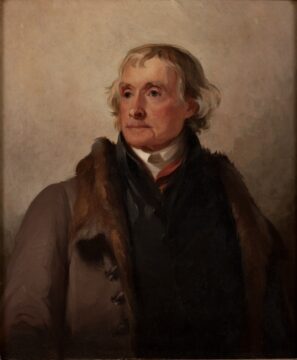
In the end, they were, like so many other citizens of this exasperating if often great and good land, men of impulse, of passion, of ambition and of regrets. Washington himself, a demigod in his lifetime, still left office soured by the partisan sniping, some of which was directed at him. Franklin, the twinkle-eyed inventor, patriot, diplomat, and elder statesman, one of the great figures of the 18th century, felt aggrieved over some attitude of Congress that he felt did not appreciate his point of view. John Adams, unceremoniously shown the door by the electorate in 1800, remained an outsider for the rest of his long life, periodically railing at the uncouth, the undemocratic, the unmeritocratic, and the uneducated. James Madison watched the beautiful Swiss-watch-like mechanism of his Constitution challenged by the reality of it being used by men who very often had little more than personal and tribal advancement in mind. And, of course, there’s Jefferson.
In Gordon S. Wood’s telling in his Pulitzer Prize-winning 1993 book, The Radicalism Of the American Revolution, this result was entirely rational. “A new generation of democratic Americans was no longer interested in the revolutionaries’ dream of building a classical republic of elitist virtue out of the inherited materials of the old world.”
Professor Wood died last month at 92, but left a legacy of scholarship (and honors) that few can match. Like probably every other history/political-science junkie in America, I had read Radicalism. I still had a copy, tucked carefully into the third space from the right on the bottom of the second shelf of the first big bookcase on your left as you walked into my study (in case you needed directions). Unearthed, it showed it had become a tad yellowed and a bit frail. It also looked like it needed to be re-read.
I can’t tell you why I thought that. Not to be a heretic, but I hadn’t really enjoyed it the first time through. Wood was literate, incredibly steeped in knowledge, innovative, and agile in thought. He had a compelling story to tell; I just didn’t like the way he told it.
I was wrong. Perhaps the passage of time taking me from a young man to an old one changed my thinking, but I was wrong. The idiosyncrasies of his style were still there, but the argument seemed stronger, and oddly prescient.
Radicalism has a good-if-conventional historical framework. If that were all, it would be just another book on the shelf. But it also has what was, for the time, a compelling, even “radical” idea—that despite a relatively low effusion of blood, the American Revolution was, in fact, an earthquake. It was a real revolution, and not just the “evolution” that many of Wood’s contemporaries and predecessors had come to describe.
Why “evolution”? Because aspects of many of the liberties that were later codified in the Constitution already were present in the Colonies by the 1850s, as were basic forms of self-government such as colonial assemblies. America might be an outpost of England, a little brother, but there was some kinship in the way people thought about governance, in their expectations about relationships between ruler and ruled, and how one’s status in the world should be defined.
For decades, the British Crown had used a lighter touch with many of its colonies. This wasn’t necessarily out of any humanitarian impulse. Rather, it was more driven by self-interest. The British Empire was far-flung and there were myriad economic and military challenges to maintaining it. Having a reasonably productive and reasonably quiet relationship with some of its colonies made sense—it took them off the board as trouble-spots and allowed the Crown to manage more serious challenges. This practice of what John Locke later called “Salutary Neglect” allowed the colonies more room for liberties and more political rights and developed in them a set of expectations. In 1763, that changed, after the end of the Seven Years War, which left the Crown with more territory in North America, but also more obligations to protect and pay for.
The government wanted the Colonies to pay—one might say share the burden, or even shoulder the burden, but whatever the nomenclature, the result was the same. Salutary Neglect was neglected, and Crown started applying its considerable muscle. It demanded more from its bumptious Colonies, and its escalating acts of autocracy—whether directed at Massachusetts through the Intolerable Acts, or as otherwise reflected in Jefferson’s recital of outrages in the Declaration of Independence—drew the colonists closer to action.
Here’s where Wood differs from many of his peers. In the prevailing analysis of the time, that action by the colonists would essentially be a conservative one. Slip off the Crown, with as little death and destruction as possible, and what you would transform into would be a functioning government which would not be monarchical. Enlightenment ideas would flourish, a political soul would be filled, but the average American, in his day-to-day life, would maintain many of the same social and economic relationships as before. These would be largely patterned after the class structures in England, the interrelationships and respective rights of men and women, between father and sons, and between those who were “gentlemen” and those who, regardless of what they did or how much they earned, were not.
That would be an evolutionary change. A “revolutionary” change would have more Danton and Robespierre in it—massive changes in leadership, social structure, and wealth distribution.
Wood puts forward a third way, and, in my second read, he does it well. Earlier colonial society displayed some of what would have occurred in England—co-dependencies, a strict, basically caste system, restrictive land use and inheritance policies, a combination of subordination from the monarch on down and theoretical duty from betters to lessers at every level. But moving from the early part of the 18th century toward the 1750s, these started to unravel, leading to 1776. Wood is very good on this. In exacting fashion, he shows how “After eighteenth-century Americans threw off their monarchical allegiance in 1776, they struggled to find new attachments befitting a republican people.” Despite what the “evolutionists” said, the newly minted citizens would not easily and certainly not entirely fall back into the old attachments. They tried seeking “new enlightened connections,” but they were “too idealistic and visionary.” So they fell back on basic human behavior of ordinary people, living their lives, earning their livings, enjoying their freedoms, and “pursu[ing] happiness in the here and the now.” A revolution like this works in two phases. The first is political, and that comes quickly. The second, altering social intercourse and economic status, might best be thought of like the melting of an ice sheet, invisible at first, but then the sheet gets discernably smaller, calving, breaking up. Slow, not always linear, but ultimately definitive.
What of “republicanism”? From Wood’s perspective, it had to be more than a mere election, it had to be a way of thinking. Republicanism, in this context, replaces the older English import of dependencies, of aristocracy leading to positions of leadership regardless of ability. It is a state of mind as well—the presumption that those who work lack the time and even the objectivity to exercise power, and the presumption that those who need not work are somehow imbued with almost supernatural capacities for leadership, probity, and competence. Such was the iron lock on social status and patronage system that would cause a successful Pennsylvania inventor and printer to sell his business at the age of 42. Ben Franklin wanted to rise to the level of “gentleman” and make himself more suitable for appointments and invitations. In his case, it worked out.
Any form of republicanism that would preserve that type of “gentleman’s” insider status would fall short, especially where, in many respects, much of the rest of the public were already protocapitalists. They were prepared to throw off the old shackles, and wanted more, were willing to work for it and spend it when they had it. They even thought themselves able to handle appointed or elected public office.
This common-man movement had huge implications for the type of country we were to become, and for the two-party system. The Federalists, who controlled the Executive Branch through George Washington’s two terms and John Adams’ one, found themselves on the road to extinction. For a time, they retained a stronghold in New England, but rapidly became a spent force. The voters, that hard-working, hard-drinking, upwardly mobile, ferociously ambitious group had little use for those who talked of classical virtues. Federalism collapsed for lack of a message with appeal—but also because Federalists clung to the certainty that they were right and that everyone else just wasn’t capable enough to understand that.
They weren’t the only ones. One of the great paradoxes of the American Revolution is that, in its success, it left behind some of its greatest talents, the very men who pledged their lives, fortunes, and sacred honor. This is not immediately intuitive. Washington, Adams, Jefferson, and Madison were all entrusted by the public with the new nation’s highest office. Nineteenth-century Americans revered the Founders; they celebrated the Declaration of Independence. Their pride grew with the country itself, which was ever gaining in population, land mass, economic strength, and military power. The one thing they did not offer was what many of the Founders craved—not honors for themselves, but the adoption of a system where the long-term governance was done by men steeped in Enlightenment values, men of intellect, of learning, of judgment.
The Founders had risked all to rid the country of an impulsive, destructive monarch. But their immense sacrifice and extraordinary effort had brought them a different City on a Hill than they envisioned. Democracy had made the average citizen an equal partner, but it had not made him an insatiable reader, a diplomat, a linguist, a classicist, a violinist, an architect, an author of timeless documents.
What these extraordinary men wanted was liberty and a classical ideal. To the extent the people were to be governed, it should be by someone who fit that ideal. Democracy binds, it empowers, it liberates, but what it does not do is create equals. Equals can only be made—through desire, education, inspiration, and time. The disinterested men of contemplation who might apply their intellect and judgment as in classical times, and do so without remuneration didn’t seem to exist, and, even if they did, there was no certainty any of them could get elected.
Such is democracy. And such was the situation even before the Constitution was ratified. Madison’s Federalist 10 was published in November of 1787, and he was prescient. It turned out men did group together in factions, in political parties, and in common interests. They did fight hard, sometimes cleanly, sometimes not so. They did not always debate into the night looking for compromise and a just result. In a democracy, they were answerable to voters who might care a lot less about right and wrong, and a lot more about winning.
One wonders whether the Founders ever really grasped what the future would be like before that future began to emerge. They weren’t expecting the messiness, the crassness, the embrace of sometimes mercenary Capitalist virtues. Nor, I think, would they have been prepared to recognize those qualities as largely inseparable from our future success.
Instead, as they left the stage, they stayed in touch with old friends and associates, and occasionally expressed themselves by letter. Jefferson was a prolific writer. Two struck me as particularly pertinent.
To the Dutch Minister, F.A. Van Der Kemp on March 22, 1812:
Unless the mass retains sufficient control over those entrusted with the powers of their government, these will be perverted to their own oppression, and to the perpetuation of wealth and power in the individuals and their families selected for the trust. Whether our Constitution has hit on the exact degree of control necessary, is yet under experiment.
And, January 11, 1825, to Van Der Kemp:
The solitude in which we are left by the death of our friends is one of the great evils of protracted life. When I look back to the days of my youth, it is like looking over a field of battle. All, all dead! and ourselves left alone amidst a new generation whom we know not, and who know not us.
I would end there, but for thinking that Gordon Wood perhaps deserves the very last word (literally):
No doubt that the cost that America paid for this democracy was high—with its vulgarity, its materialism, its rootlessness, its anti-intellectualism. But there is no denying the wonder of it and the real earthly benefits it brought to the hitherto neglected and despised masses of common laboring people. The American Revolution created this democracy, and we are living with its consequences still.
***
Enjoying the content on 3QD? Help keep us going by donating now.