
by Steve Szilagyi
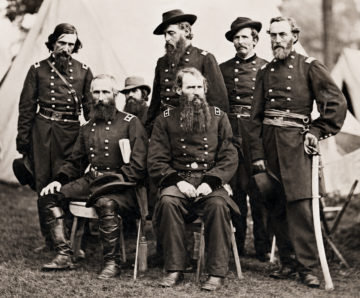
Few topics in American history are treated with more solemnity than the Civil War. You could (as some men do) spend your entire adult life reading nothing but Civil War histories, arguing about tactics, and visiting battlefields, and never crack a smile.
Our scorchingly irreverent satirists don’t find anything funny about the Civil War; it hasn’t inspired absurdist comedy as the First and Second World Wars have, or spun off sitcoms like Hogan’s Heroes or M*A*S*H. Even the gruesome Indian Wars generated a sitcom – F Troop – and dozens of insensitive movie satires.
Major Civil War films like Gettysburg and Gods and Generals tend to be as reverent as old-fashioned religious epics, or sad as hell, like Glory.
What most critics agree is the finest film about the Civil War, Buster Keaton’s The General, is nothing if not a comedy – but it’s a peculiar kind of comedy: as dark as a daguerreotype, with a star who never smiles, culminating in that massive train wreck, whose budget-breaking expense derailed Keaton’s real-life career.
“It is altogether fitting and proper,” as Abraham Lincoln might say, that the Civil War gets this kind of hats-over-heart respect. The gravity of the stakes, the awfulness of slavery, the complexity of the constitutional crisis, and most surely, the number of dead (620,000 at least), have combined, in the case of the Civil War, to temper the national tendency to jeer and make fun of anything anyone takes seriously.
So we might conclude that there is nothing to laugh at about the Civil War. But that would be wrong. As a lifelong student of the conflict, I have often caught myself chuckling inwardly while paging through books of Civil War photographs, and studying the images left to us by Matthew Brady, Alexander Gardner, Timothy Sullivan and other photographers of the period. The men, the women, the officers, soldiers and political officials who lived in that joyless era … c’mon. You have to admit it. These people look ridiculous.
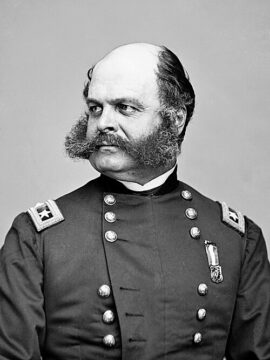
No face better captures the glorious absurdity of Civil War facial fashion than that of General Ambrose Burnside.
Burnside remains one of the war’s more controversial generals. I suggest that it is his swooping side whiskers as much as anything that make it difficult to assess his place in history. As you try to take the measure of his battlefield decisions, you can’t help picturing that pudgy, Oliver Hardy face framed in sculpted mutton chops, barking orders in the smoke and chaos of battle.
Facial hair had been a military fashion since the early 1800s. According to Christopher Oldstone-Moore’s Of Beards and Men: The Revealing History of Facial Hair (2016), the fierce moustaches of Hungarian cavalrymen launched the style for horse soldiers around the world – so much so in some armies that cavalrymen who were too young or couldn’t otherwise raise a moustache had to buy expensive false moustaches, or paint them on before battle.
But civilian leaders, the bourgeoisie, and the man on the street generally carried on the clean-shaven look characteristic of the 18th century well into the 1800s. But what precisely led to the mid-century efflorescence of facial hair seems as mysterious as the cause of the Cambrian Explosion. It seems to have arisen from the same restive spirit that launched the Romantic movement in the arts, the revolutions of 1848, and a quest for authentic masculinity. Beards were a radical flag to wave in the face of the establishment; a symbol that lost its potency with the defeat of the 1848 upheavals.
When respectable men no longer feared hairy radicals, they no longer feared hair and were free to avail themselves of its possibilities. It was as though a dam had burst. Pent-up aspirations to grow facial hair were suddenly let loose. Beards lost their political meaning and became instead tools to restore notions of patriarchy and manly dignity in a turbulent industrial age.
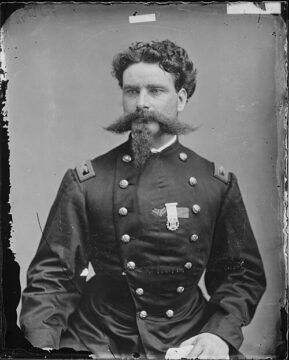
As the American Civil War broke out, the beard and moustache era was going full blast, producing a spectacular variety of facial hair among officers in the military: George B. McClellan’s droopy moustache and underlip mouche; General Stonewall Jackson and his Assyrian ziff; the Jefferson Davis paintbrush; and the mossy jowls of General Winfield Scott. They look clownish to us – but those who wore them must have believed they conveyed dignity and authority – somehow, they inspired ordinary men to follow them into battle.
Smithsonian Magazine in 2011 asked readers, “Who Had the Best Civil War Facial Hair?” – illustrated by a menagerie of wildly lush, waxed, pointed, sleek, lumpy, sadly droopy or strangely perky beards and moustaches, as worn by dozens of officers on both sides. Some are strikingly individual in ways we don’t usually associate with military dress. Each man seems to be conducting a private experiment in facial topiary.
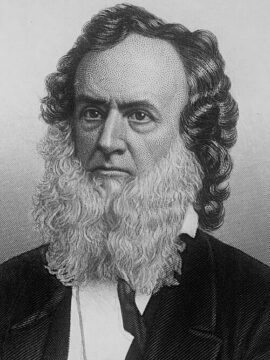
Civilian leaders were no better. Look at Lincoln’s cabinet. Just clear your mind of the life-and-death decisions the “team of rivals” had to make and try to look at their appearance without a chuckle: Edward Bates and his bib-like neckbeard; Edwin Stanton with that two-toned washboard over his collar; and Gideon Welles’ head, peering over twin cataracts of white wool.
(Neckbeards, though today they are mocked and associated with basement-dwelling internet trolls, were worn by many respectable figures in the war years, including Peter Cooper and Henry David Thoreau. Not surprising when you recall that these guys had to shave with a straight razor and neck wattle is perilous to negotiate even with modern five-bladed safety models.)
Gentle souls like Walt Whitman let their beards flow freely, but so did violent fanatics like Stonewall Jackson and John Brown. Beards might signal a lack of restraint in one direction or another: poetry or slaughter.
Flowing moustachios were so closely associated with the military that a man could broadcast his peaceful nature by growing a full beard and leaving his upper lip bare. This signal persists in America to this day among the Amish and other pacifist sects.
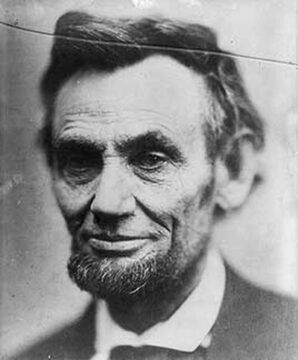
Abraham Lincoln chose the no-moustache look when he decided – famously upon the advice of a young girl – to embellish his facial gravitas with a beard; and darned if it didn’t work. The beard Lincoln wore in his affecting last portrait is among the few of his time that doesn’t look stupid.
The funny thing is, Lincoln didn’t really need a beard to emphasize his character, already having what used to be called “strongly marked features.” Some other prominent figures were not so facially well-endowed and did well to hide their puss behind a wall of arborvitae.
Ulysses S. Grant comes to mind. The few surviving images of Grant before he grew a beard show a bland, doughy pan with little force or decisiveness – essentially the face of the shop clerk he had been before the war raised him to generalship and, ultimately, to the status of legal tender on the $50 bill. (I’d like to be able to say that the unshaven Robert E. Lee looked like an ogre, but his pre-beard images reveal a handsome face with sensitive, poetic features – not what you would expect on a man who could order Pickett’s charge at Gettysburg.)
Oldstone-Moore’s Of Beards and Men shows how intimately changes in men’s facial hair reflect deeper currents of society and history. If you take nothing else away from his book, you will know this: beards and moustaches have always been controversial, in all times and all places. Even in a period like the mid-19th century, when you’d think everyone was resigned to the near universality of facial foliage. For instance, in my research for this essay, I came across an 1867 newspaper item from Albany, New York, headlined “War on the Moustaches.”
The story is that a local Methodist congregation has been riven by the complaints of “several brethren having had their stomachs seriously disturbed by partaking of the sacramental wine in which their horrible brothers had moistened an offending moustache.” The paper speculates that, as the “war on moustaches” goes on, the church will split into whiskered and non-whiskered congregations.
Here’s another war on whiskers, reported in a newspaper dated August 26, 1859:
“A distinguished lady in Xenia, Ohio is waging a terrible crusade against bearded men …”
The lady’s objection to bearded men is what she imagines to be the unpleasantness of kissing one: “Behold that lovely woman, with a form shaped by the hand of harmony … Radiant in beauty, she is surrounded by an atmosphere of love, as a rose exhales fragrance. Just think of one of these hairy-faced fellows attempting to kiss her – see him pulling up his bristles to reveal his wild, beast-looking, cavernous slit of a mouth … the idea is disgusting.”
She goes on to say, “Whom do moustaches and beards become? Brigands, pirates, filibusters [military freebooters] and especially professional executioners.”
She may be on to something there. Somewhere I read that European military observers of the American Civil War fighting did not see it at all as warfare in the Continental sense of disciplined armies, clean lines, and orderly attacks. American battles sometimes struck them as sprawling melees between armed gangs of clodhoppers and ruffians.
And who were the “professional executioners”? Grant and Lee – even Lincoln – not only had spies, deserters and prisoners shot, but their duties of office included ordering tens of thousands of conscripted men to their deaths in a war whose winning strategy turned out to be the willingness to overlook massive casualties on one’s own side.
In this light, the mad, overgrown garden of Civil War facial hair takes on a gothic tinge, like the profusion of tombstone styles in a spooky old cemetery. A good 20 percent of America’s finest and most promising young men died in the war. And while all this killing and mayhem was going on, many of the officers in charge were bent over mirrors, carefully manicuring their chin whiskers, waxing their moustaches, and fluffing out their sideburns.
Watch almost any earnest Civil War movie made over the past thirty years and you can see how hard it is to create the period look with well-fed modern-day Americans. But the thing that seems most difficult for them to get right is the beards. This is especially evident in the 4½-hour 1993 movie Gettysburg. All the pains director Ronald Maxwell and producer Ted Turner took to make the film accurate and authentic are undercut by the beards and moustaches – all of which are glaringly fake.
The past cannot be pasted on.
***
Enjoying the content on 3QD? Help keep us going by donating now.