
by Malcolm Murray
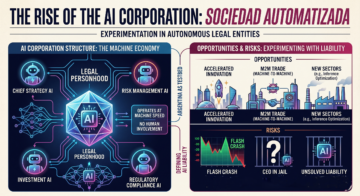 Javier Milei’s libertarian government in Argentina recently laid out a new framework for corporations in the country. Among the various simplifications to attract more investment, was a highly interesting one – the creation of Sociedad Automatizada – automated corporations run by AI agents without the need for any human involvement. This could just be a PR move (it is unclear if it’ll pass parliament). Milei is in need of some good PR, struggling as he is with an economy with persistent high inflation despite his chainsaw economic management. Others speculate that this is related to Peter Thiel’s recent move to Argentina. But if this becomes law, it could make Argentina the first jurisdiction to allow for fully autonomous AI corporations.
This could obviously bring all kinds of risks. Yuval Noah Harari laid these out well in a letter to the FT. However, it is likely the kind of experimentation we need and should be applauded.
What are AI corporations? A recent paper by Arbel, Salib and Goldstein offers some definitions. Basically, like other corporations, it is an entity with legal personhood. This means it can take actions and it can receive counter-actions, such as being sued. The difference with regular corporations is that no human needs to be involved, it can be fully run by autonomous AI agents. Note that this does not provide any claims of personhood to the individual AI agents, only to the corporation. Neither does it of course make any moral claims as to AI welfare or consciousness or the like.
The risks are obvious. An AI corporation can operate at machine speed beyond human recognition and could cause “flash crashes” before any human would have time to react. As mentioned by Harari, the standard deterrent of the CEO being put in jail would not deter AIs, so it is unclear what deterrents there are to prevent the AI corporation from conducting illegal actions. If AI money is also speech and AI corporations are allowed to make political donations, they could quickly gain significant political influence and gain economic advantages. Quantity has a quality all its own, as Stalin said.
However, these might be necessary risks to take in order to experiment with AI liability. We are likely to soon face a world with myriad autonomous AI agents, and as of now, AI liability is a fully unsolved problem. No place in the value chain is currently reliably liable. The classic example is the self-driving car, but we will soon have self-trading, self-selling and self-building agents also. We have already seen small examples of Claudius, the vending machine, and the café in Stockholm run by AIs.
We therefore need to start doing this kind of experimentation. Putting AI agents in a box labelled an AI corporation can at least be a starting point for a framework that defines where AI liability should lie.
Critics have pointed out that the AI corporations may be under-capitalized and unable to fully handle claims, but this seems no different than human shell corporations. There are guardrails for this. Another criticism is that “there is no human in the loop”, but that is exactly the point. This is a statement of fact rather than a claim about why these corporations pose a problem. We have already given personhood to the artificial entity of a “corporation” and this has become fully natural to us despite being a recent invention.
In the near- to medium-term future, we may in fact want the economy to bifurcate into a human economy and a “machine economy”, with very different operating modes. This way, we can ringfence the human economy with humans still in the driving seat (although of course with some levels of AI automation- I don’t mean Amish enclaves, although we will probably have those too). Meanwhile, a machine economy can develop independently, where AI corporations operate at machine speed and potentially build whole new sectors and products for machine-to-machine trading (inference maximizing personal trainers? context window managed services? AI-AI mediators? Long-term identity storage? AI persona life coaching?) As a whole new economy, it will likely have Schumpeterian creative destruction aplenty. But all the more reason to start experimenting early and find out what guardrails are needed for shocks back to the human economy.
Humanity is drastically under-prepared for the very likely coming changes with widespread AI throughout the economy and society. Although unorthodox, Milei’s shock tactics are useful experimentation on behalf of the rest of the world. They should probably be applauded rather than discouraged.
Enjoying the content on 3QD? Help keep us going by donating now.