
by John Ambrosio
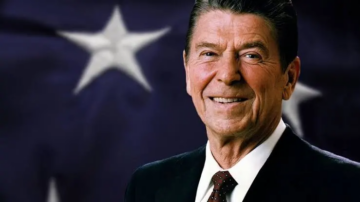 In 1984 when Ronald Reagan was re-elected president of the United Staters I asked myself: how is this possible? How was it possible that an ignorant but affable B-rated actor who continually confused his role in Hollywood films with historical reality and his own experience, and whose mental capacity was clearly on the decline, get re-elected president? How did his “Morning in America” campaign advertisement, a vision of a mostly white America imbued with traditional values, religiosity, and patriotic nostalgia, and his promise to “make America great again” by restoring a 1950s idealized and fictionalized past, convince voters to re-elect Reagan in a landslide?
I ask myself a similar question today: how could a convicted felon who has been found liable for sexual assault, and who incited a mob of his supporters to try to violently overturn a free and fair election get re-elected president of the United States? More than 77 million Americans, a slight majority of voters, supported Trump despite his deranged rants, racist rhetoric, and his relentless attacks on immigrants, the judiciary, journalists and the mainstream media, transgender people, and the “enemy from within.” How did a grifter, con man, failed businessman, and Mafia don, who promised to “make America great again” by deporting immigrants and lowering prices, persuade voters to re-elect him?
While there are numerous theories that seek to explain these electoral outcomes, there is something deeper going on here that is not captured in the conceptual and analytical frameworks typically employed to analyze national politics. It is the ocean in which we all swim, the ambient condition that underlies contemporary political life and the particular forms that ideological conflict takes in the U.S. today.
Wendy Brown, the renowned political theorist and author of Nihilistic Times, provides a different way of thinking about and understanding our current predicament. She argues that the rise of anti-democratic populism, extreme political polarization, and post-truth politics in the U.S. is a consequence of pervasive nihilism. Not nihilism understood as “an individual attitude of darkness, despair, or cynicism in which nothing in the world, including life itself, is thought to have meaning,” but as a symptom of a deeper problem stemming from a “historical, cultural condition of modernity specific to the crumbling of religious authority spurred by the Enlightenment.”
In other words, Brown argues that the rise of reason and scientific truth, what Max Weber calls the “disenchantment of the mysteries of the world,” has displaced religious and traditional authority as the foundation for values, but “it cannot replace what it destroys.” That is, science can “tell us how things work,” but it cannot tell us “how we should live,” what we should value, or why we should value it. In the absence of an absolute authority that can deliver and provide a shared grounding for values, Western societies have been cast adrift in a nihilistic age in which values have been detached from their moorings in religion, tradition, and morality, so that the value of values, and of truth itself, has become culturally and politically devalued.
This predicament produced a “crisis of meaning” that emerged in “the space between an era of values delivered by God (or nature) and the broad acceptance that meaning and value are human creations, judgements, ascriptions.” That is, in a liminal space in which values derived primarily from religious authority have declined significantly and the “God view,” the view from nowhere, the notion of value-free interpretation has been widely rejected and replaced by situated and embodied perspectives shaped by culture, narratives, and lived experience.
In this context values “proliferate and diversify” and “become malleable, fungible, instrumental, and easily trafficked for purposes beyond themselves.” That is, values become free-floating signifiers which, emptied of meaning, can be arbitrarily attached to objects, people, practices, and even cultural preferences. Nihilism, according to Brown, abounds in
commerce, politics, religion, and in the ostentatious branding of everything and everyone with superficial iterations of cultural or social values. When values become capital enhancing, as they are today for individuals, corporations, nonprofits, cities, and states alike, and when they are attached to objects ranging from investment choices to coffee choices to athletic heroes, their trivialization and instrumentalization reach a nadir even Nietzsche did not anticipate. Inscribed as hash tags, bumper stickers, yard signs, ephemeral group identities, or advertising bait, values lose their depth and endurance, their relationship to a Weltanschauung, their wholesale governing of conduct and conscience, their capacity to shape the moral order.
For Nietzsche, nihilism “was born with modernity, not with its waning.” That is, nihilism is not a symptom of the decline of modernity, but is inherent in modernity itself. Modernity contains the seeds of its own dissolution, which have germinated for centuries. But the devaluation of values has accelerated and proliferated in an age of digital technologies and the “neoliberal economization of value and values.” The morbid symptoms of nihilism, Brown writes, are manifest today as
ubiquitous moral chaos or disingenuousness but also as assertions of power and desire shorn of concern for accountability to truth, justice, consequences, or futurity, not only in ethics. Nihilism is revealed in the careless, even festive, breaking of a social compact with others and with succeeding generations that is manifest in quotidian speech and conduct today, especially but not only on the right. It appears in witting indifference to a fragile planet and fragile democracies. It manifests too as normalized deceit and criminality in both high and low places, and as a mass withdrawal into the trivial, immediate, and personal.
On an individual level, nihilism takes the form of “de-sublimated aggressions, petty preoccupations, rancorousness, self-absorption, and a desire for immediate satisfaction.” While these aspects of nihilism are present throughout U.S. society, including on the left, Trump is perhaps the posterchild of nihilism, which is evident in his callous disregard for truth, for the rule of law, for the consequences of his actions, for the welfare of others, and for the viability of the planet and future generations. It is also apparent in his preoccupation with trivial things, like building a ballroom and an arch, his malignant narcissism, his insatiable need for praise and immediate gratification, his incessant bullying and angry outbursts, and in his utter indifference to values other than greed and the maximization of personal wealth.
In the current political context, nihilism has taken the perverse form of a cult of personality around Trump in which the values of truth, integrity, responsibility, and accountability have been emptied of value and meaning. Truth is whatever Trump says it is. Language has become so degraded, so hollowed out, that Trump’s political rhetoric has no relation to empirical reality. Through endless lying and gaslighting Trump tries to convince people not to believe what they see and hear, that his fabricated reality is real and that he is the sole source of legitimate authority and truth. He refuses to take responsibility for anything that does not contribute to his narcissistic need for praise and self-aggrandizement or to be held accountable for the disastrous consequences of his erratic behavior and destructive policies.
One of most dangerous features of nihilism is that it “disinhibits aggression,” freeing conscience from “commitments to fairness, inclusion, the rule of law, and future generations.” While the U.S. has become an increasingly polarized and violent society, Trump’s fantasies of enacting violence against his perceived enemies, his verbal attacks and insults against anyone he dislikes or who disagrees with him, and his abject inability to be shamed, are all signs extreme nihilism, as is his capricious use of economic coercion and extortion, and his unprovoked use of military force. Nihilism gives people like Trump, who has psychopathic tendencies, license to act out their violent impulses.
We live in an age dominated by instrumental rationality, a mode of thought that separates means from ends, labor from what it produces, bureaucrats from the overall purpose of an organization, “entertainment from information, and politics from personality.” This results not only in the trivialization of news and politics, it also enables people to rationalize whatever means are required to achieve their desired ends, so that lying, cheating, political violence, and even criminality are considered legitimate means if the stakes are high enough. For MAGA Republicans, “brazen lying” can be rationalized as a “moral imperative” when the alternative is “perceived as unbearable.” Losing the midterm election to Democrats, who will surely impeach Trump and investigate his epic corruption if they win a majority in the House, would likely qualify as unbearable.
This is precisely the case with Trump and his MAGA allies, for whom no lie is too big, no deception too great, no act of cruelty or lawlessness too extreme to achieve their desired ends. This is evident in the Trump administration’s utter contempt for democracy, the separation of powers, the rule of law, and in the policy of encouraging immigrants, both undocumented and those with legal status, to self-deport by making their lives as difficult and miserable as possible, especially those rounded up in ICE and CBP sweeps and incarcerated in prison camps, and by using unrestrained violence against anyone who resists their inhumane policies.
One of the most ubiquitous and visible aspects of nihilism is how it hyper-politicizes and trivializes values so that “everything becomes iconic of contesting political worldviews,” in how “churches, schools, and private lives are all politicized. What you consume, what you eat, who you stream or follow, how you dress–are all politically inflected.” As values “proliferate, diversify, and cheapen,” Brown writes,
peoples and nations will be inevitably splintered and riven. Our nomenclatures for this condition–“culture wars” or political polarization–mistake effect for cause…the hyper-politicization of values reaches to consumption practices, family forms, home décor, gun ownership, school curriculums, sports preferences and athletes, ecological practices, fashion, sexual practices, gender representation, diet and exercise.
This is evident in the way Trump and his MAGA allies invest popular culture with partisan value, in how movies, cable and broadcast television (especially late night shows), children’s programming, books, and toys, as well as art, music, leisure activities, and cuisine have all become sites of contested political worldviews. Culture is the terrain on which politics is being fought today, not only because politics follows culture, but because culture has become a primary source and foundation for values in our nihilistic times.
As previously mentioned, the culture wars roiling U.S. politics can be understood as a manifestation of the “predicament of meaning-making” in which one side claims the authority of religion and tradition as the source and foundation for values, while the other embraces a kind of secular religious belief in reason, scientific truth, and human progress. In this way, the culture wars represent not only a political struggle over the future of multiracial democracy, but a fierce struggle over the legacy of the European Enlightenment and its failure to provide the Western world with the security, prosperity, and peace it promised.
Reason and scientific truth have created technologically advanced societies that are on the brink of self-destruction, of nuclear war, and climate and ecological disaster, and which have failed to stem the rising tide of authoritarianism and fascism. This condition has produced enormous fear, uncertainty, and insecurity which has been sublimated into a politics of grievance and nostalgia that reflects a loss of faith in reason and human progress, which is why rejecting science, including vaccines, is central to the politics of the far-right in the U.S.
Anti-Enlightenment forces want to return to a time when religious authority was absolute and individuals were absolved of the moral responsibility of having to choose how to live and what to value. It’s a retreat into an imagined community in which the existential fear generated by modernity is cast aside for epistemological and moral certainty. It’s a manifestation of what Herbert Marcuse called the fear of freedom. While national politics in the U.S. is being played out on the terrain of demographic conflict, on another level the underlying issue today is a rejection of modernity itself, a retreat into faith over reason, willful ignorance over knowledge and expertise, of emotion and impulse over dialogue and deliberation.
There is a kind of pleasure in giving oneself over to a fundamentalist or absolutist authority, in being relieved of the responsibility of having to choose, of having to make independent moral judgements and find one’s way among the plethora of competing sources of truth in the confusing and complicated world created by modernity, of thinking for oneself.
The retreat into traditionalism, as evidenced by the “tradwife” movement, is a symptom of our nihilistic times, which is driven by a desire to wall off and bury feelings of insecurity and moral confusion. This desire is also reflected in the unprecedented number of people, especially young men, who are converting or expressing a growing interest in religious practice today. We may be witnessing a kind of re-enchantment of the world, a reassertion of religious authority despite, or perhaps in reaction to, the growing secularism of many Western countries.
These are powerful emotions that are unlikely to be susceptible to evidenced-based rational argument. When combined with instrumental rationality and an apocalyptic or messianic view of the world, it represents a potent and extremely dangerous political worldview. Whether this is an accurate assessment of the costs and benefits of modernity is beside the point. The fact is that a significant number of people in the U.S., especially evangelicals, see it this way, which is why many of them are actively seeking out signs that the end times are here, who want to hasten its arrival so they can ascend to heaven, leaving the rest of humanity behind to suffer the consequences of their lack of faith.
People who share this apocalyptic worldview could provide the political base for what Naomi Klein and Astra Taylor call “end times fascism,” the far-right ideology that has become, in an “age of emergency,” a “monstrous, supremacist survivalism.” That is, in which tech billionaires like Mark Zuckerberg and Peter Theil are preparing to survive the end of the world, the coming apocalypse, in modern arks and bunkers while they accelerate the burning of the planet, confident they will be saved in a kind of secular Rapture.
In a digital age, nihilism has accelerated the breakdown of trust in institutions and grand narratives of human progress, contributing significantly to the weakening of social cohesion and political stability. The great unraveling we are witnessing today, in which the center is no longer holding, cannot be understood without taking account of the reality of how pervasive nihilism shapes social and political life.
What is particularly worrisome and dangerous is that nihilism “dovetails nicely with the governing rationality of neoliberalism and authoritarianism.” That is, with a rejection of the public good and liberal democracy. Fascism’s impoverished vocabulary and elementary syntax, its debasement of language, its hollowing out of meaning and value, is itself an expression and accelerant of nihilism. Authoritarianism and fascism thrive in a context saturated with the pernicious and socially corrosive effects of nihilism.
How can we combat the darkness of nihilism, the trivialization, commercialization, and hyper-politicization of values? One way, Brown suggests, is by educating desire, by recognizing the desires of people, their yearning for a secure and dignified life, and redirecting their desire toward a compelling vision of a new political order that gives people “something to believe in and hope for.” Rather than tell people their desires are confused, ill-informed, wrongheaded, or self-destructive, we should recognize the legitimacy of other people’s desires, whether or not they are consistent with our own, always with the caveat that they do not denigrate or harm anyone, and channel them toward a vision of society in which they can be realized.
Following Weber, Brown argues that values “‘emerge from complex attachments and desires, and if nihilism represents a crisis of desire, an impasse in loving this life and this world, then education of feeling or attachment becomes fundamental to building a post-nihilist future.” In other words, we value what we desire and have a passionate attachment to, which could include nature, non-human creatures, art, music, literature, people, and a vision of a future society.
Is it possible to educate desire for, and a passionate attachment to, an ethical principle or virtue, an ideal, or an imagined future? I would argue that people must already possess an emotional and psychological need for it, whether consciously or unconsciously. We desire and form passionate attachments to what we need, to what gives us pleasure and joy, to what addresses, in some way, deeply-felt emotions or trauma, that enable us to go on with our everyday lives.
The pedagogical principle of beginning where students are, that learning should always build on what students already know, on their prior knowledge and understanding, and on what they want to know, is relevant here. From this perspective, educating feeling and passionate attachment must begin with the desire people already have. Education is about identifying and drawing out passionate attachments that students possess, what they value, and harnessing them to help students develop other desires and attachments, to learn to value more things.
We must recognize the limits of what rational argument can achieve in this context. This does not mean we should abandon reason and scientific truth, but understand that relying on this approach alone is insufficient. As Brown points out, Weber
reminds us that rational arguments and compelling evidence by itself does not counter popular fears and frustrations, attachments, and yearnings. Rather the task for those invested in a more just and sustainable order is to kindle and educate desire for such an order and to build desire into a worldview and viable political project.
We can push back against institutionalized nihilism, against the dominant rationalities of our time that separate means from ends, that trivialize, commercialize, and hyper-politicize values by refusing to accept hollowed out political discourse that is disconnected from explicitly articulated values that are instantiated in a shared vision of the future.
This was evident recently in Hungary, where the fight against widespread government corruption was the centerpiece of the opposition movement that toppled Victor Orbán, by Reverend William Barber’s “Moral Mondays” protests, which explicitly link progressive politics and religious values, and by Martin Luther King Jr.’s call for a “radical revolution of values” that begins “the shift from a thing-oriented society to a person-oriented society.” A few Democrats, such as James Talarico and Chris Murphy, are infusing their political rhetoric and appeals with moral language, both secular and religious. Following these and other examples, we can begin to revalue values, such as honesty, integrity, responsibility, and accountability by putting them at the center of political discourse and projects that reinvest them with value and meaning.
Pervasive nihilism has fueled a deepening social and political crisis in the U.S. and helped create a highly polarized and grossly unequal society in which a significant portion of the electorate believes that blowing up liberal democracy is the only viable option left to leading a dignified life. In the end, crises always present us with opportunities for change. In this case, the opportunity is to reinvest political life with values that actually mean something.
Enjoying the content on 3QD? Help keep us going by donating now.