
by Tim Sommers
Ever heard of Heraclitus? I bet you’ve heard of his river. It’s on a million posters.
I’m not one to judge, but I would go so far as to say this quote is bandied about pretty thoughtlessly.
For example, this is the ocean and not a river. Not to mention not a great spot for stepping in.
But at least the ocean has water in it. This is just a random field.
And this guy seems to be trying to avoid stepping in – he’s in a boat after all, but from the looks of that yaw, he’s going in eventually.
Alice Walker wrote a book called:
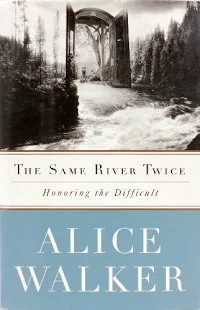
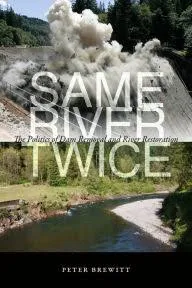
In fact, there are at least eight books with that title. This is my favorite because it’s about dam removal and, so, literally a case of it not being the same river twice.
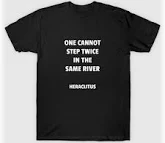
When you can buy the t-shirt,
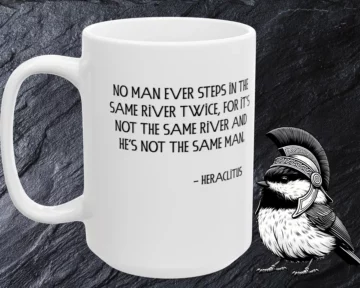
or the mug or even a onesie, with the same quote,

I’d say we’ve reached cultural saturation.
As a philosopher I am professionally obligated to start with the source of the river quote. It’s probably well-known only because Plato paraphrased it in the Cratylus: ““Heraclitus, you know, says that everything moves on and that nothing is at rest; and, comparing existing things to the flow of a river, he says that you could not step into the same river twice”. Likely the more accurate version is from 12B in the standard compendium of pre-Socratic philosophers which has Heraclitus saying “on those stepping into the same rivers, ever-different waters flow.”
Now, the important question. Is this true? Well, the Heraclitus version is true. If a river is flowing, by definition, if you step into the same spot there will be some water there that is different. But that’s neither catchy nor deep. Plato, as always, wants to go deep and he gives the punchline before the setup. Heraclitus is comparing all existing things to the river – always changing.
Except, are they? How in flux is everything? I guess if physicists know what they are talking about then there’s a quantum flux, which means everything – including black holes – are in a state of flux. (But is the flux itself unchanging?) Anyway, Heraclitus didn’t have physics in mind 2500 years ago. That can’t be what he meant. And having grown up where the Missouri river dumps into the Mississippi, I must say that rivers, while always changing in some ways, are very rarely changing in a way that would lead anyone to say this is not the same river. Nor was it difficult, growing up, to organize a picnic to the same river twice. So, I would say using words in the ordinary way we use them, of course, you can step into the same river twice.
Again, I think we are supposed to understand Heraclitus as saying something deeper, that it is the essential nature of basic things to undergo change constantly. Zeno, a near contemporary of Heraclitus, said things are, in their essential nature, unchanging and, in fact, motion is impossible. He had like 30 or 40 arguments for this view, which is more than Heraclitus, who basically had a catchphrase. Here are a couple of Zeno’s arguments.
In order to walk out of the room you are in right now you have to walk halfway to the door. But to walk halfway to the door you have to walk half of the way to the halfway point. And to get there you have to walk, well, now it’s one-eighth of the way to the door, and so on literally to infinity. Therefore, motion is impossible. No?
So, Achilles accepts a challenge to race a tortoise, but in his arrogance he lets the tortoise get a head start. Fatal error. Even though Achilles runs faster, no matter how quickly he moves from A to B it will take some amount of time during which the tortoise will move from B to C, so that Achilles will get closer and closer, but never catch up to the tortoise. (Don’t buy that? This actually happens around a black hole. From the point of view of an outside observer, at least, an object approaches the event horizon closer and closer without ever passing through it.)
By the way, supposedly, Diogenes the Cynic refuted Zeno by getting up and walking away from him.
Zeno says things are unchanging. Heraclitus says they are always changing.
It seems more fair to say that most things are changing in some ways and a few things don’t seem like they’re changing, or at least very much. So, what’s going on here?
The claim that you can’t step into the same river twice is either trivially true because we count every feature of the river as essential to its identity or, in the everyday sense, it’s false because at least for some period of time enough of what makes the river that river persists to make it possible to step into at least a couple of times. And, more obviously, it’s just not true that motion is impossible.
If it is the case that the quote is trivially true, but basically false, why all the posters? I think people think these questions are deep. Zeno is deep because, in the face of everything we know, he insists that there is some sense in which change is an illusion. And Heraclitus says, no, despite the illusion of persistence, everything is always changing. Some things, maybe everything, but it’s too soon to tell, changes. But many, many things, like rivers frankly, don’t change so quickly that we become confused about their identity.
So, what does deep mean here? I am not the best person to answer this, but here are some possible answers I have collected over the years. Maybe, deep means (1) expressing something hard to express, (2) about more than one thing at the same time, (3) having multiple layers of meaning, (4) beyond ordinary, (5) open-ended or having more than one interpretation, or (6) asking questions rather than giving answers (Milan Kundera on novels.).
Analytic philosophy, my kind of philosophy, is officially not thrilled with depth. If any analytic philosopher was deep, however, it was Wittgenstein. I think he was being deep when he said, “If a lion could speak, we could not understand him.” But he seems overconfident about this one to me. Lions eat antelopes. I have eaten antelope. Why couldn’t we talk about that? Here’s the end of his first book, the Tracuatus Logico-Philosophicus: “(6.54) My propositions are elucidatory in this way: he who understands me finally recognizes them as senseless, when he has climbed out through them, on them, over them. (He must so to speak throw away the ladder, after he has climbed up on it.) He must surmount these propositions; then he sees the world rightly. (7) Whereof one cannot speak, thereof one must be silent.”
Unfortunately, Wittgenstein repudiated this whole book later, so I don’t know where that leaves us.
One last try, this parable, Couriers, from Kafka always seemed deep to me.
“They were offered the choice between becoming kings or the couriers of kings. The way children would, they all wanted to be couriers. Therefore there are only couriers who hurry about the world, shouting to each other—since there are no kings—messages that have become e . would like to put an end to this miserable life of theirs but they dare not because of their oaths of service.”
What does it mean? Why is it deep? Well, it’s about God isn’t it? Maybe, that’s what people really mean by “deep”?
Like Nietzsche, no fan of Socrates or of Socrates’ version of philosophy, I prefer those others, including other Greeks, who were not so deep. “Oh, those Greeks! They knew how to live. What is required for that is to stop courageously at the surface, the fold, the skin, to adore appearance, to believe in forms, tones, words, in the whole Olympus of appearance. Those Greeks were superficial — out of profundity.” (Nietzsche, The Gay Science)
But wait, did he just say that their lack of depth made them…deep?