
Leann Davis Alspaugh at Acroteria:
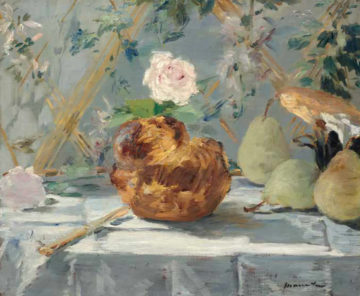
Impressionism has become as cozy and comfortable as a favorite shirt. We know and love its Parisian vistas with bourgeois ladies and gentlemen, its sunlit gardens, and those waterlilies. We have even grown accustomed to, if not always at ease with, Post-Impressionism and its lurid colors and ladies of questionable virtue. But every so often it helps to be reminded that at one time, Impressionism was the avant-garde, the very term an insult leveled by affronted critics who saw its artists as grotesques and its artworks as evidence of impending societal collapse.
Consider just three works in the first gallery of “The Impressionist Revolution” at the Frist Art Museum, Nashville: Édouard Manet’s Brioche with Pears (1876), Camille Pissarro’s Place du Théâtre Français: Fog Effect (1897), and Pierre-Auguste Renoir’s bronze Mother and Child (1915/1928). Almost the only quality that these works share is materiality—the crusty brioche, the Parisian pea-soup fog, the evidence of the artist’s hand across the bronze surface. The daring rejection of the Academy in so many idiosyncratic ways was like a spray of absinthe in the face of the critics.
More here.
Enjoying the content on 3QD? Help keep us going by donating now.