
by Derek Neal
My first experience with the shared bikes that are now ubiquitous in cities around the world was in Nice, France in 2013. We were out late one night early in the semester, I and the other foreign exchange students, wondering how to get back to our dorm from the city center. It was an hour on foot; no busses were running. One student, an Italian who had been there longer than the rest of us, suggested the “Vélos Bleus.” There were not enough bikes for everyone, so we rode two persons to a bike, seven or eight of us spread out along the Promenade des Anglais, the dark Mediterranean Sea to our left, the beach dotted with a few remaining late-night revelers, and palm trees and ornamental streetlights to our right. When I recall this scene in my mind’s eye, what I visualize is something properly cinematic, a group of young people who are open to the world, to experience, who have not yet rooted themselves to a place or an identity, symbolized in the image of bikes gliding smoothly across the pavement, with us, the cyclists, laughing and shouting, intoxicated both by the alcohol we’d drunk and the feeling of speed, the wind in our hair and the physical intimacy of two people on a single bike, the natural high that results from movement.
There is an affinity between cinema and bicycling in the same way that there is an affinity between cinema and trains, or cinema and automobiles. If the purpose, at the most basic level of cinema, is to show moving images, or motion pictures, then it’s evident why the first film to captivate the public imagination was the Lumière Brothers’ 50 second short of a moving train, why the first “phantom ride” (when the camera is attached to a moving object) was shot from a train, and why, in later cinema, car chases became a fixture. We might mock a movie franchise like The Fast and the Furious, but seen another way, storytelling through moving automobiles is pure cinema, and we could also think of artistically celebrated films, like those of William Friedkin, which feature extensive car chases (The French Connection, To Live and Die in L.A.), and one film, Sorcerer, whose entire plot is built around the premise of a truck carrying explosives through the jungle, meaning that it must move steadily, with any stop or start risking death. Cinema wants to show movement, and while the link to trains and automobiles is clear and well developed, bicycles also belong as a quintessential cinematic subject, and here we might note the Italian neo-realist film Bicycle Thieves (1948), at one time considered the greatest film ever made.
There is also a historical continuity between cinema and bicycling, as both contemporary film and the bicycles we ride today have their origin in the late 19th century. It is almost as if the two call each other into being—if we have the ability to create moving pictures, then we must create moving objects to film, like the bicycle, and if we create new technologies of motion, then we must create a means of aestheticizing them and raising them to the level of art. Once the bicycle becomes a subject of cinema, it is not enough merely to film it, a story must be created around it, as the object of the bicycle becomes a symbol of something beyond itself and captures the paradox at the heart of all technological creation; at once liberatory, as the machine allows for speed and freedom of movement, but also alienating, as the bike gives way to a rootless wandering. Here one thinks more readily of biker gangs and films like Kathryn Bigelow’s debut feature, The Loveless (1981), which is an entire movie built around the basic premise of a young Willem Defoe on a motorcycle, but I want to establish this link with the bicycle as well.
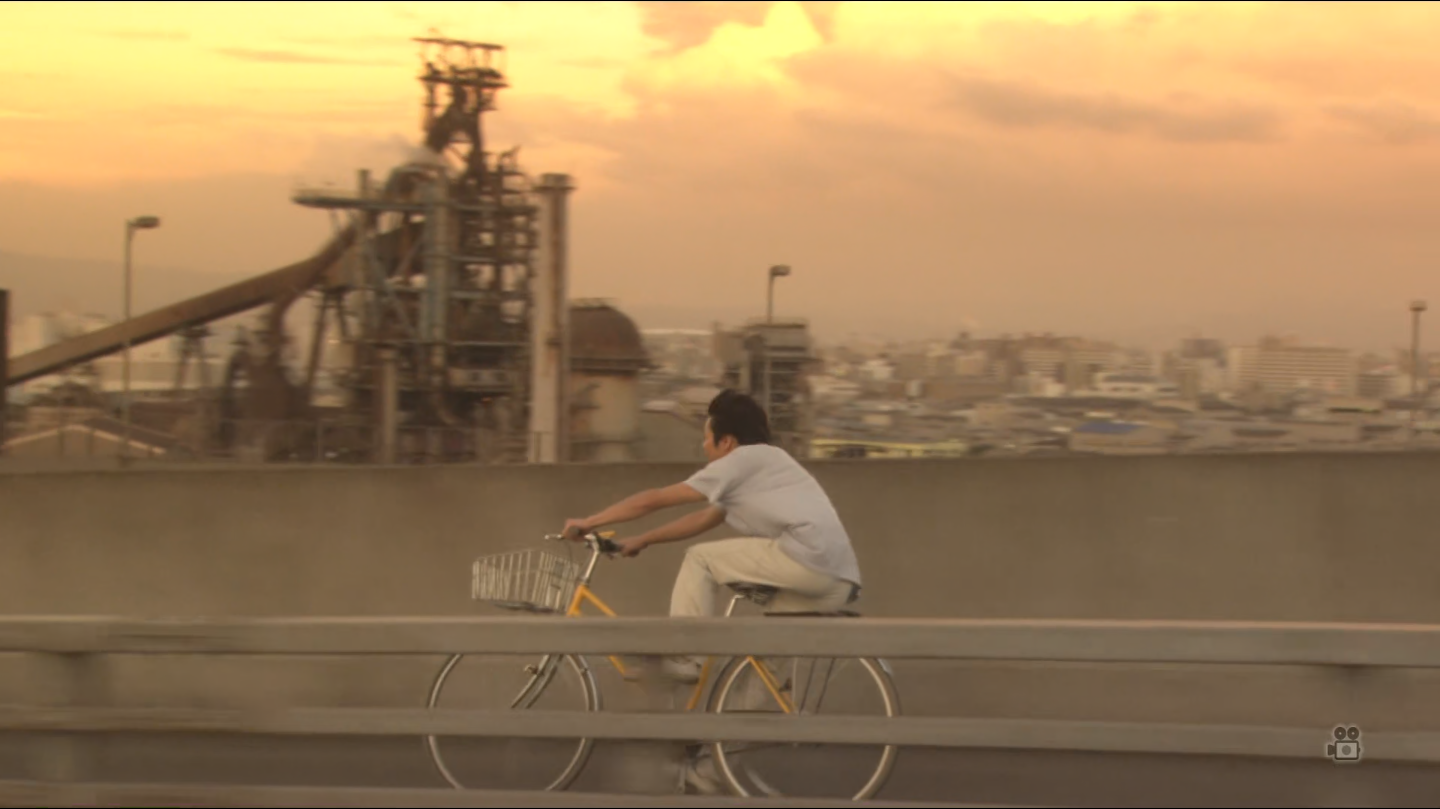
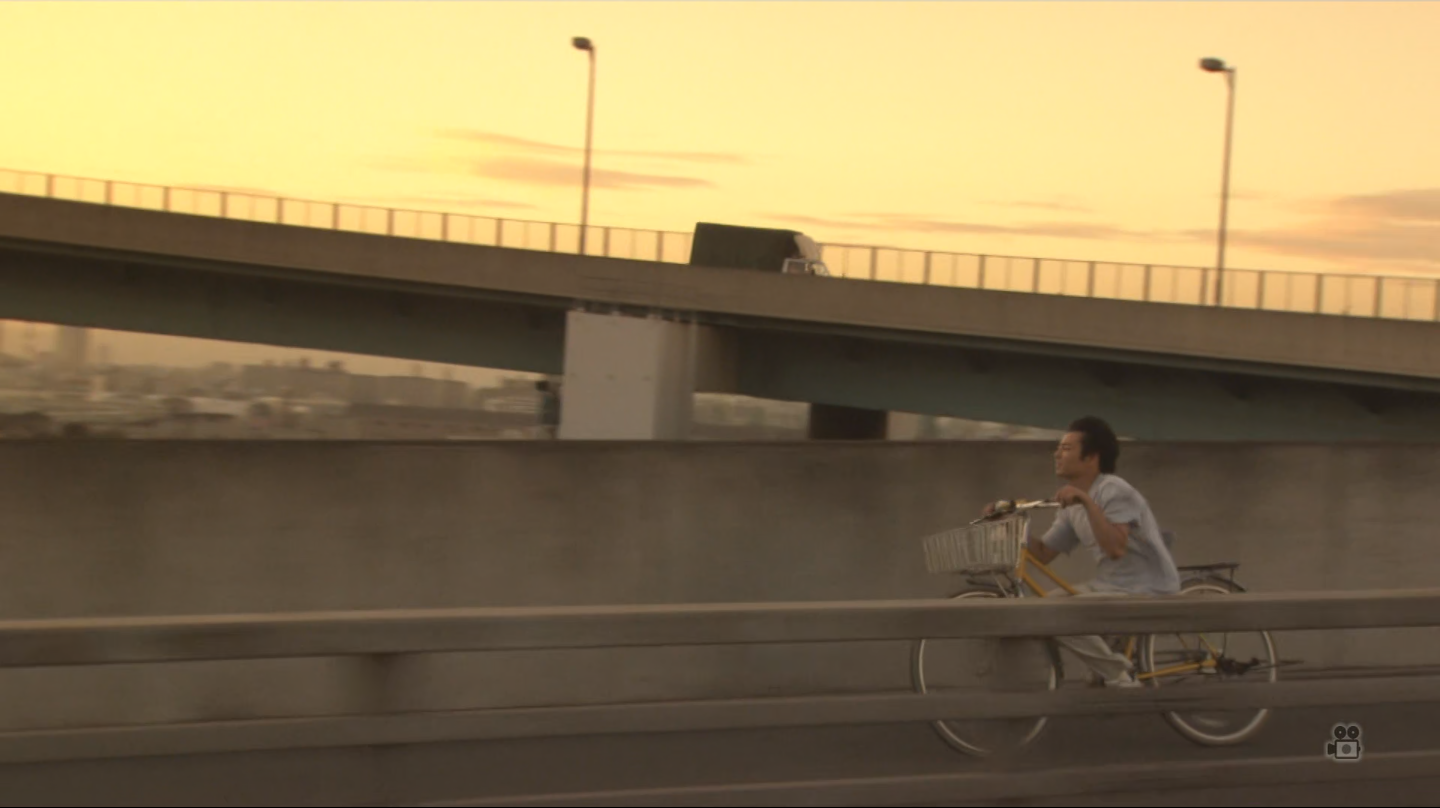
The film with which I’ll make my case is Yoichiro Takahashi’s Sunday’s Dream (1999). I discovered this little-known film, originally made for Japanese television and screened at Cannes in 2000, thanks to a user on X who uploaded a short clip of the main character riding his bicycle down a highway ramp. When I saw this shot—20 seconds of cruising downhill, an industrial plant in the background, the sprawl of the city and concrete, the main character becoming one with his bike, and an unreal, radiant sun bathing everything in an orange glow—I knew I had to watch the movie. In context, the scene becomes even more remarkable. The main character, Kazuya, has just been laid off from his job at the factory we see in the background. The factory is on a body of water, so Kazuya must travel by ferry to rejoin the mainland. Then he’s on his bike, flying down the highway without a helmet at an incredibly reckless speed. This all happens before the opening credits, in the first two minutes of the film; Kazuya’s ride takes on significance as it symbolizes his freedom from a job defined by dull manual labour, but at the same time, untethered from the thing structuring his days and giving purpose to his existence. Sunday’s Dream begins in a classic, almost foolproof way: the man who loses his job and becomes responsible for defining his own existence.
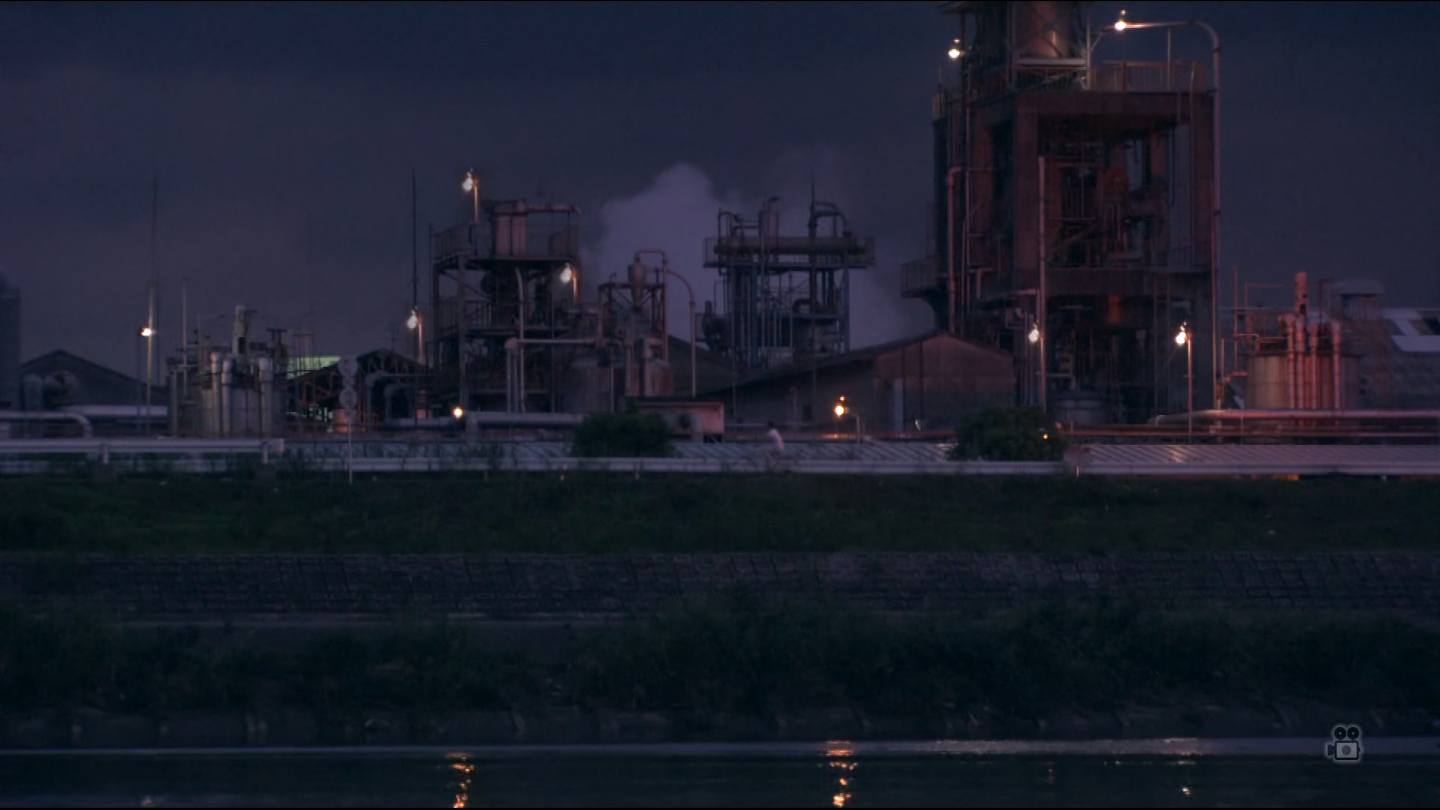
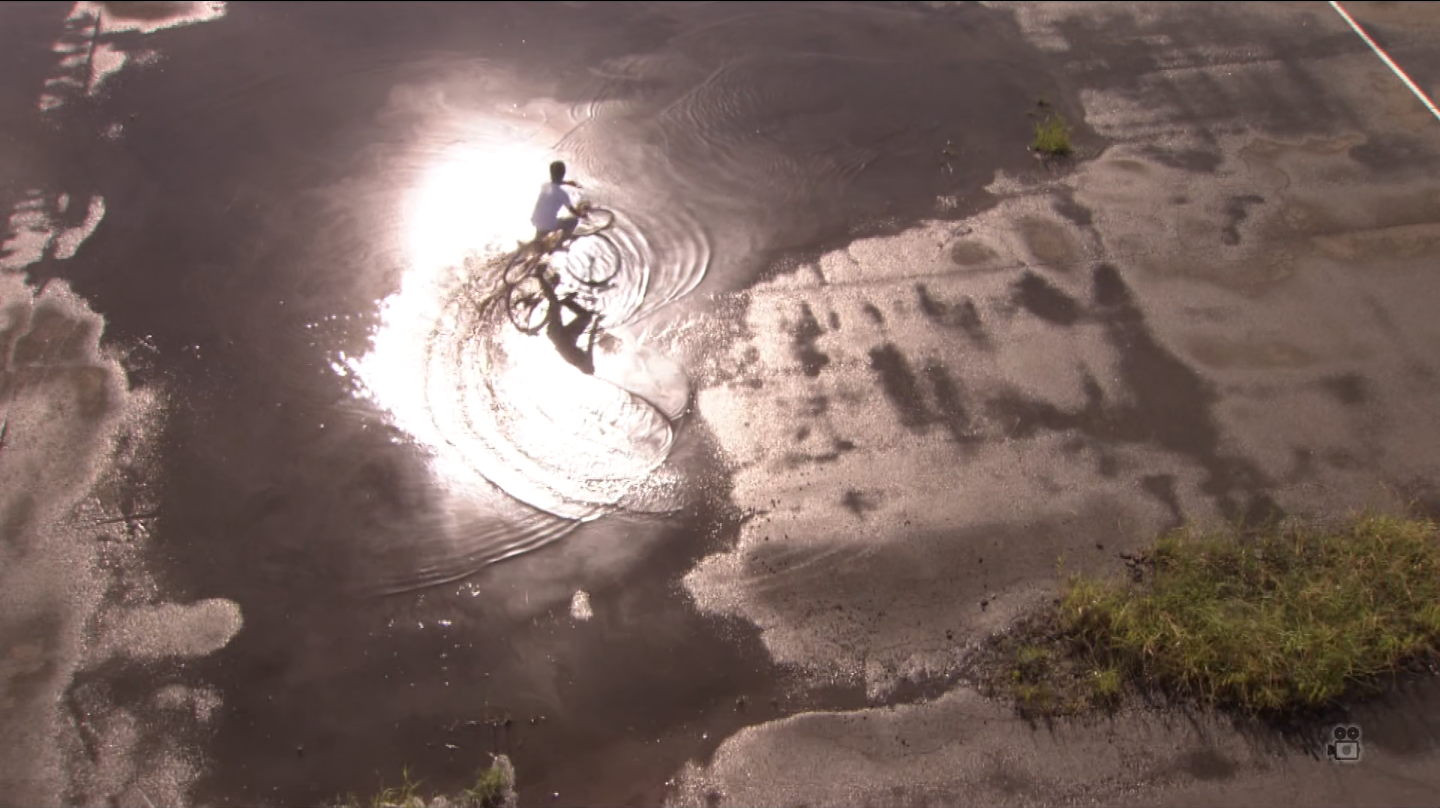
With too much time on his hands, few job prospects, and a new stepfather taking his place in his mother’s house, Kazuya drifts around the city on his bike. In one incredible nighttime shot, which is repeated later in the movie, we see Kazuya bike from one end of the screen to the other, then off screen, with the factory billowing smoke in the background. It’s a stunning visual representation of alienation, but to see it as only that would be reductive—in the first scene, we can just barely see that Kazuya is playfully standing atop his bike. Later, Kazuya mindlessly carves through a large puddle in a vacant lot, creating figure eights. The sun and the sky are reflected in the puddle, making it look as if Kazuya is biking through clouds, then passing through the sun; he’s filmed from above, creating a beautiful, transcendental shot, where the human and nature pass in and out of one another, facilitated by the bicycle. The director, Takahashi, repeatedly recovers these beautiful images and moments from environments that would normally be considered ugly or unworthy of aesthetic attention.
Kazuya eventually finds his way to a brothel where he develops a fascination for a prostitute named Sachiko. Kazuya is more of a boy than a man (Holden Caulfield comes to mind), and he invites Sachiko to the beach the following Sunday; surprisingly, she accepts. On the assigned day, however, it’s raining, and Kazuya is stuck inside with no way to contact Sachiko. In an inversion of Meursault in The Stranger, who kills a man because the sun is in his eyes, Kazuya kills a man because it’s raining. On one hand, this is a “senseless” act of violence, just as Meursault’s is, but on the other, if we follow the logic of the artwork, it makes perfect sense.
The film cuts ahead to Kazuya’s release from prison some years later, culminating in a final scene where Kazuya tracks down Sachiko and spends a Sunday afternoon with her. At first they go to the beach, but feeling out of place, leave and take a funicular up to a hill high above the city, where they find an abandoned building. As they ride the funicular, they begin a game of “word chain,” where one person says a word, then the other person uses the end of that word to say a new one. In translation, this doesn’t quite work, as we are presented with a string of words—limbo dance, watermelon seeds, cat, kitten, gold coin, and so on—that do not follow the rules of the game. Yet it’s effective as a cinematic storytelling technique that demotes language while prioritizing the moving image as its method of communication. Eventually, Kazuya and Sachiko ride his bike together, then Kazuya lets Sachiko ride alone and, in a strangely powerful declaration, she proclaims, “It’s a bike.”
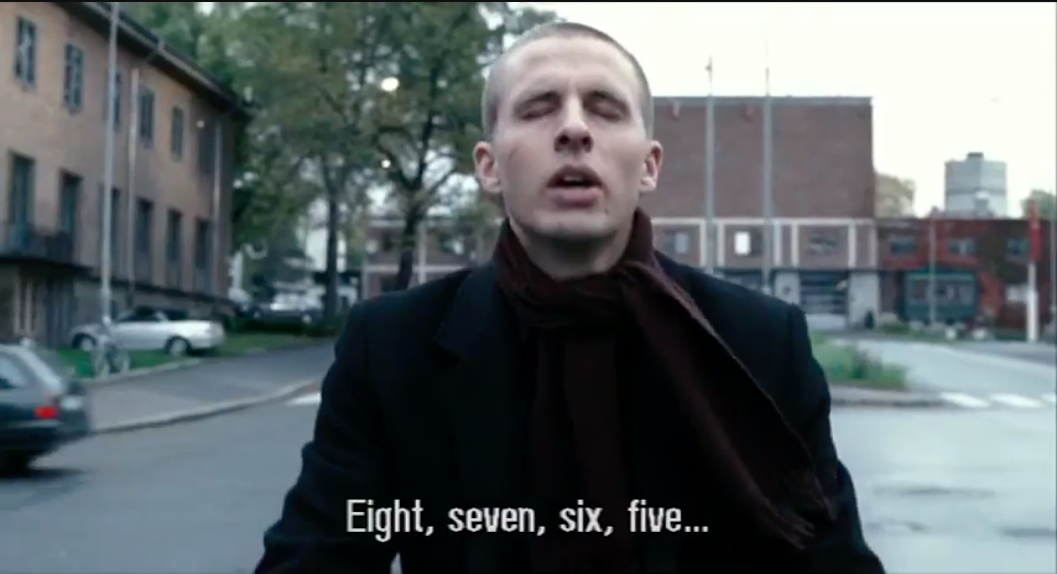
There are other movies that feature bicycles as a storytelling tool, although few to the extent of Sunday’s Dream. The two early films of Norwegian director Joachim Trier (Reprise and Oslo, August 31), for example, both feature a mentally ill protagonist—a writer divorced from life—who rides a bike in key scenes that seem to represent his tenuous grasp on existence. In Reprise, this character (Phillip) bikes gently downhill, closes his eyes, and counts down from five. Reaching zero, he opens his eyes, and a grin spreads across his face. This is crazy and suicidal, but in confronting death, the effect is clear: he feels alive. Now that he has the taste for it, he pedals faster and counts down from ten. Cars whizz by, honking, and the character begins to count more quickly before a cut at “one” holds us in suspense.
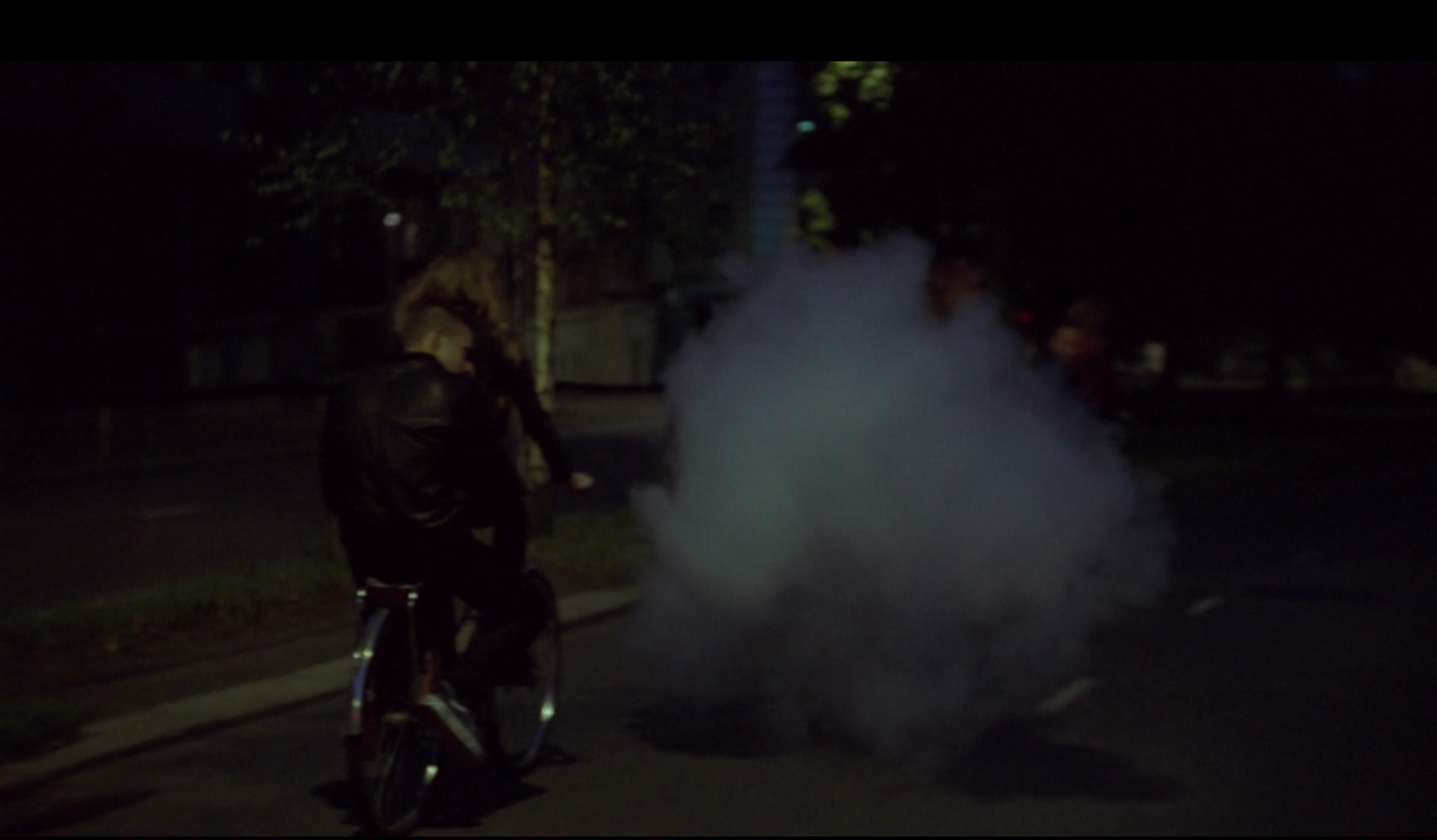
In Oslo, August 31, the main character (Anders) has recently been released from a rehab clinic for drug addiction. He attends a job interview but sabotages it, much like Kazuya does in Sunday’s Dream. In the evening, he attends a house party, falls back in with old acquaintances, and ends up outside a night club in the early hours of the morning, where he and three new friends hop on two bikes to ride to their next destination. Somehow they’ve procured a fire extinguisher, and as they ride through the silent streets, puffs of gas are released back towards Anders and the young woman he’s biking with. They disappear into the smoke, only to emerge again a second later. The juxtaposition from the previous scene, which featured a nightclub and a house party, is striking, and we suddenly enter a stillness that the bicycle paradoxically creates: on one hand, constant movement, but on the other, a still body gliding effortlessly through time and space. This dichotomy, of stillness and movement, of freedom and alienation, and ultimately, of life and death, is the message of the bicycle in cinema.
Enjoying the content on 3QD? Help keep us going by donating now.