
by Jerry Cayford
 California’s primary is in about two weeks, and it’s a mess. The panic is slightly subsiding, though, since Democrats have started polling in one of the top two spots in the race for governor. For months, Republicans were polling first and second, with eight Democrats trailing because they split the vote. The California Democratic Party chair even urged low-polling candidates to drop out so as not to be spoilers.
This can all look like an amusing soap opera. Will the Democrats shoot themselves in the foot, again? But studying it led me to literature I hadn’t found before, coming from a quarter I hadn’t expected: the Harvard Business School (HBS). An HBS study of American economic competitiveness shows that a surprisingly short path leads from an amusing soap opera to the gravest of questions: why is American society failing?
The Harvard Business School’s U.S. Competitiveness Project was a large-scale, eight-year investigation of the causes of America’s poor recovery from the Great Recession. Its final report, A Recovery Squandered: The State of U.S. Competitiveness 2019, looks at many factors that combine to determine the health of a society and its economy. The finding that connects their project to California’s primary is this: “the most important reason the United States has made so little progress during the long expansion [is]: deep dysfunction in our political system” (17).
California’s nonpartisan top-two primary system is a reform-that-is-really-half-a-reform of American states’ usual dysfunctional system. In top-two voting, all candidates compete in a single, nonpartisan primary, and only the top two qualify for the general election. This half-reform avoids giving voters a realistic choice outside the top two parties and, as we will see in the HBS report, thereby preserves the dysfunction of our politics. The full reform needed is “nonpartisan top-five primaries and ranked choice voting in general elections” (26), in which the top five candidates advance from the nonpartisan primary, and voters then choose among them in the general election by ranked choice (aka instant runoff voting). One of the HBS report’s authors, Katherine Gehl, expands on this reform in a 2023 article, “The Case for the Five in Final Five Voting.”
The Wider Crisis
Harvard Business School comes to electoral reform inadvertently, not as a choice but as a discovery in its survey of the business community. The U.S. Competitiveness Project, co-chaired by Michael Porter and Jan Rivkin, surveyed American business leaders working in a wide range of industries, almost 6,000 HBS alumni (along with some current MBA students and a cross-section of the public). They repeated this survey six times between 2011 and 2019. You can get a quick snapshot of the Competitiveness Project—and of America—from Figure 7 in the introductory chapter of A Recovery Squandered. It shows nineteen “elements of the national business environment” graphed by how America is doing compared to other countries (X-axis) and whether America is improving or deteriorating (Y-axis). (The scale of both axes is the net percentage of respondent positive/negative views.) Notice the dot in the lower left corner: “Political System” ranks worst for on-going deterioration, and only “Health Care” ranks worse compared to other countries.
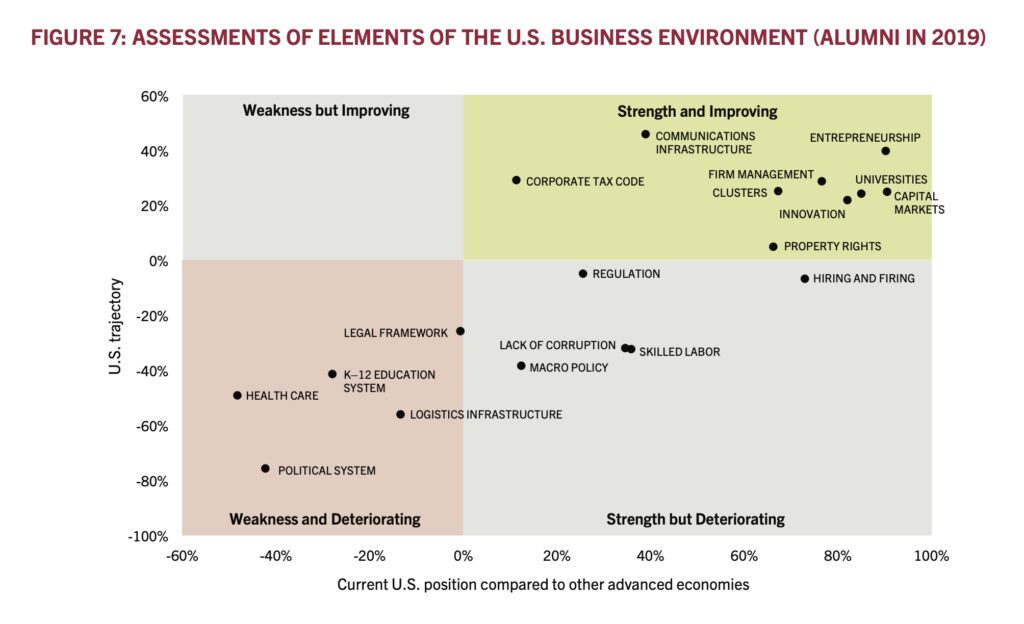
Three points from the report’s big picture deserve mention before we focus on the political system. First is the report’s thesis statement on our recovery from the Great Recession: “despite a decade of steady economic growth, the United States has done remarkably little to address underlying structural weaknesses in our economy and our society. The nation has squandered the recovery” (3). Second, the report points out that Figure 7 clarifies our enormous inequality and “lack of shared prosperity”: America’s strengths (in the upper right) almost exclusively pertain to and benefit large companies. “Middle- and working-class Americans, in contrast, cannot escape the ramifications of a weak educational system, political paralysis, crumbling roads and bridges, and costly, inaccessible health care” (9). Third, this level of dysfunction is by no means common or normal: “The United States was one of only four countries [out of 146] whose Social Progress Index declined in absolute terms between 2014 and 2019. The others were Brazil, Nicaragua, and South Sudan” (14). America is failing, and there is nothing slight or subtle about it.
The Politics Industry
The HBS report’s Executive Summary succinctly assembles the themes of its chapter on political dysfunction:
Chapter 2 zeroes in on a central reason America has made so little progress: our political system has been optimized by the two major political parties to advance their partisan interests rather than the public interest. (1)
Americans do not fully grasp the structural nature of our political system problem. Many believe that we have simply elected the wrong people. (1)
Survey respondents [show]…stronger support for widely publicized changes, such as campaign finance reform and efforts to counter gerrymandering, than for reforms that we believe are more powerful, such as nonpartisan primaries and ranked choice voting. (1)
I will discuss each of these themes in turn: the system optimizes partisan interests; most people don’t even know the electoral system is the cause of their problems; when they do recognize the need for electoral reforms, they see the popular ones instead of the important ones.
- “Partisan Interests”
A profound and original analysis lies behind the idea that our political system has been optimized for partisan advantage by the two major parties (an analysis elaborated in a 2017 interim report by Gehl and Porter and summarized in Appendix A of Squandered). Its view that politics is an industry like any other yields this key insight:
At the center of the politics industry are two private rivals who can only be described as a textbook duopoly: the Democratic Party and the Republican Party. Around this duopoly has arisen a large array of actors and organizations, including special interest groups, lobbyists, big-money donors, Super PACs, think tanks, consultants, and the media that bridges Washington, D.C., to the rest of the country. Together they comprise what Gehl and Porter call the “political industrial complex.” (56)
What Gehl and Porter present is a very different picture of American politics: “Most people think of our American political system as a public institution derived from the Constitution. Not so….[Rather], our political system has become a self-serving, self-perpetuating industry comprising gain-seeking actors who write their own rules” (56). If a “politics industry” seems like just manner of speaking, a sensible market approach to healthy political competition, the important point in Gehl and Porter’s analysis is that it is an unhealthy industry practicing unhealthy competition. Their characterization suggests we can apply to politics the tools of analysis we normally apply to industry, and particularly the analysis of unhealthy competition due to monopolies.
To digress for a moment, this framework implies the possibility of a useful partnership between two activist movements: electoral reform and anti-monopoly. Monopoly and its ills is a topic in the midst of an explosion of attention and influence with the rise of the anti-monopoly movement, developing and evolving quickly since the Great Recession. In comments on the anti-monopoly movement’s main blog, Matt Stoller’s Substack BIG, I have argued that political power is a product, manufactured and sold in a monopolized market. Harvard Business School brings to that thesis a depth of research and analysis that I could not.
Let’s now take this industry framework back to California’s messed up primary and its new rules. “The engines of unhealthy competition in the politics industry are the overlooked but all-powerful rules, structures, norms, and practices of politics” (56). In 2010, California adopted a top-two open primary. This reform raised voter turnout, made more races competitive, encouraged bipartisan cooperation, etc. Yet these improvements are all superficial (seen through an industry lens) and they do nothing to touch the real problem Gehl and Porter identify: “The politics industry is perfectly designed to serve the private interests of the actors in this industrial complex: to grow their power and revenues and to protect against threats to their hegemony. It’s not designed to serve citizens” (19). California’s top-two rule does not threaten the politics industry’s power because it preserves the all-important “spoiler effect.” The spoiler effect is what we are watching in the current crowded primary: voters having to sacrifice their real preferences in order to get to choose between the top two candidates. The spoiler effect protects the duopoly by disciplining voters to choose only what the two parties offer. It is why ranked choice voting (RCV) is essential for healthy competition: “RCV eliminates the powerful ‘spoiler effect’” (57).
- “The Wrong People”
A well-known obstacle to fixing any problem is confusion about where the problem even lies. Of the obstacles listed in the Executive Summary quotations above, the one that most simply guarantees continued dysfunction is that most people don’t see a system problem but instead imagine we are just electing the wrong people. I will digress again to present a recent example of this dynamic.
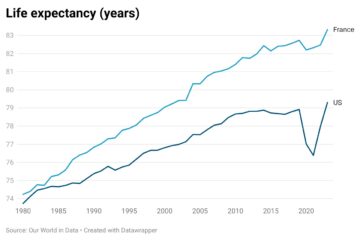
In Paul Krugman’s May 12 post, “What Happens When Americans Realize How Miserable We Are?” his subject is roughly the same as HBS’s. He looks at a number of measures of America’s failure to perform as well as other developed countries: life expectancy (the graph at the top of this article); traffic deaths; infant mortality rate. We used to be equal or better on these measures and are now worse. Our traffic deaths are three times France’s; infant mortality is worse even than China’s. Our homicide rate is four to ten or more times as bad as basically everyone’s. Beyond deaths, Krugman considers quality factors—work-life balance, paid leave, healthcare, walkable cities, public transportation—and notes, “my guess is that relatively few Americans realize how much we are falling behind other nations on basic aspects of a civilized life.”
In case you thought Squandered was just a snapshot of a few bad years, Krugman in 2026 confirms its portrait of American decline. But then he says this:
Why are American lives so often nastier, more brutish, and shorter than those of citizens of other advanced nations? That’s a complicated story, but much of it comes down to the fact that US politics has for decades been dominated by a party that is fiercely opposed to any concept of shared responsibility, of caring for our fellow citizens, and that foments a deep level of distrust that makes it ever harder to operate as a society.
Where Squandered has a genuinely complicated story to tell of dysfunction’s sources, Krugman says it comes down to our electing the wrong people: Republicans. And if “dominated by” seems to leave a systemic interpretation open, he doubles down in his next post, “The Apotheosis of Willful Ignorance” (May 13): “The rejection of science, like so much of the U.S. political landscape, has a lot to do with the influence of the fossil fuel industry,” as well as “the growing extremism of the Republican Party” and its “rejection of expertise.” But explanations like these are too small even to account for the U.S. political landscape, let alone the failure of American society. As Squandered shows us, “America is stuck because we have a structural political system problem” (18).
In “The Case for the Five in Final Five Voting” (2023), Katherine Gehl tries to turn our thinking from people to systems. All the minor improvements introduced by California’s nonpartisan top-two primary, for example, help voters select “the best winner,” which is the traditional goal of election theorizing. But finding the best winner, like finding who is to blame, is too small to solve our structural problem. It will not change the political industrial complex. Instead, she proposes “a new, more holistic, and results-oriented inquiry: ‘Which voting system best incentivizes elected officials to act in the public interest?’” This is the right question, based on Gehl’s work with HBS. As long as elected officials are operating within and constrained by a politics industry “perfectly designed to serve the private interests” of the system, it hardly matters whether those officials ideally reflect the values of their constituents. Before the “best winner” can matter, we must fundamentally shift power within the politics industry, or rather away from it.
Gehl’s question brings us back to the spoiler effect. As long as only the top two candidates have a viable chance of winning, most of the public will limit itself to choosing between them, enabling the duopoly to act in its own interests without fear of losing elections. Ranked choice voting—Gehl uses “instant runoff voting”—is the mechanism that enables voters to safely choose candidates outside the duopoly. Forcing the two parties to compete with outside candidates would break the duopoly control of our politics. Serving the public interest would become a viable career path, and the American political system could return to being a public institution, rather than a self-serving industry. The answer to Gehl’s holistic inquiry is Final Five Voting: to incentivize officials to the public interest, adopt nonpartisan top-five primaries and ranked choice voting in general elections.
- “More Powerful Reforms”
Our dysfunctional political system is “a central reason America has made so little progress.” And as we’ve seen, that phrase “so little progress” labels a vast and ominously growing sea of economic weakness and societal failure. The stakes in reforming our politics, then, could not be higher. Harvard Business School’s U.S. Competitiveness Project takes the problem seriously.
In seeking solutions, its researchers proceed from democratic principles to corresponding political reforms, and they examine seven major reforms aimed at fostering those principles. But effectiveness is also important, and they focus on “innovations found at the intersection of what’s powerful and what’s achievable” (22). Three of the seven reforms land most clearly at that intersection. Yet those three are not well known to the public. Media attention has brought popularity to “a laundry list of reforms…[that] will either not address root causes of system failure, or they aren’t viable—or both” (26). Appendix C lists the “40 most commonly proposed reforms” from among 800 or so suggestions by survey respondents. (Multimember districts and proportional representation, which are popular in parts of the reform community, do not appear anywhere in HBS’s report and are apparently not on business leaders’ radar.)
Political effectiveness and public awareness are not much correlated. “Of these seven reforms, four have been widely discussed in the public discourse and by political commentators: (1) eliminating gerrymandering; (2) campaign finance reform; (3) congressional term limits; and (4) lobbying bans for former elected officials” (22). The report acknowledges that eliminating gerrymandering and campaign finance reform “can be beneficial,” but finds that term limits and lobbying bans make little difference. And even those beneficial first two reforms receive attention disproportionate to their impact, possibly at the expense of stronger measures:
The most powerful reforms are in three other areas not known to most individuals, but far more powerful because they will change the nature of political competition, reduce partisanship, and raise the ability of our legislators to pass and implement real solutions to our pressing economic and social challenges.
- Nonpartisan Top-Five primaries…
- Ranked-choice voting (RCV)…
- Legislative rules reform. (22-23)
Elsewhere, Squandered refers to the first two of these as “two constituent parts” of the “Final Five Voting System” to be implemented “in tandem” (57); I treat them as a single reform.
Since I have recently been advocating an end to gerrymandering (via mathematical algorithm), I should note here that I agree with HBS that RCV/Final Five Voting is much more important. I have also argued that ending gerrymandering is a step toward Final Five Voting, a step suddenly made possible by today’s redistricting wars. Though less powerful than RCV, the reform that HBS found “resonated most strongly across all groups [was]…eliminating gerrymandering” (24), which garnered both the highest level of support and the fastest growing support over time (25, Figure 8). And this was years before the intense attention now trained on redistricting. There is a solid case for opportunism here: just as the Great Recession seared “Too big to fail” into the public’s consciousness, sending a flood of attention, money, and power into the anti-monopoly movement, so I believe the current gerrymander wars could be the galvanizing event for major electoral reform.
Be that as it may, Final Five Voting emerges as the single most powerful way to address political dysfunction, “the root cause of the decades-long inability of our government to make progress on America’s most pressing economic and social problems” (18). (Better legislative rules take a strong but secondary position.) Harvard Business School’s large-scale, multi-year project has given us, then—along with valuable information, analysis, and insight—a thesis vitally relevant to our public conversation about electoral reform: the stakes of that conversation are immeasurably higher than we usually recognize. To make this point, HBS not only documented the magnitude of America’s decline and crisis, but also spotlighted electoral reform as the very top priority in reversing our long slide. Not just easing polarization, gridlock, and other narrowly “political” problems. Not just making California’s elections sensible. Breaking the politics industry’s self-serving duopoly is how we address everything else as well.
Do you want to repair crumbling roads and bridges, lower infant mortality rate, or fix K-12 education? The single most effective remedy is “nonpartisan top-five primaries and ranked choice voting in general elections.” Are you trying to improve health care, life expectancy, or public transportation? Your method is “Final Five Voting.” The powerful message of HBS’s U.S. Competitiveness Project is that electoral reform is our main tool to end dysfunctional politics, strengthen U.S. competitiveness, and stop America’s decline. Want paid leave and walkable cities? Or—updating from 2019 to today—do you seek to compete with China on anything at all, unwind predatory monopolies, or develop more useful, less dangerous artificial intelligence? All of it. The basic aspects of a civilized life. The answer is the same. Put your effort into nonpartisan top-five primaries and ranked choice voting in general elections, aka Final Five Voting.