
by Mike Bendzela
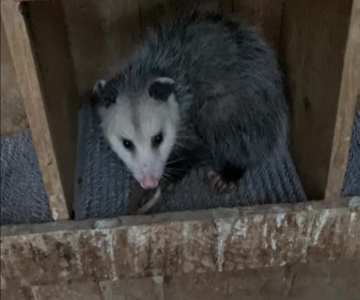
How did a marsupial end up in one of our hen house nesting boxes? That is the question, and as it sounds like the set-up to a joke, I’ll just say, “Because the hens egged her on!”
It is the tradition in (probably) all American dialects to drop the initial “o” and say “a ‘possum” instead of “an opossum” which is a bit of a mouthful. From now on I’ll drop the apostrophe used to indicate the omitted letter.
Speaking of mouthfuls: Possums have 50 teeth, more than any other mammal in this country, including a whopping ten upper incisors. Mess with a possum and she’ll let her jaw hang open so you can get a load of all those sharp teeth. She will not attack you, though, bless her heart.
I discovered the possum one evening when I went out to shut in the hens for the night and noticed the birds all hanging out in their fenced-in run; usually by dusk they’re all inside the house on their perches; but this time they were just standing there looking at me as I entered the gate. If birds could be said to exhibit body language — upright, stationary, alert — then they might have been saying to me, “We’re not setting claw in there!”
So I looked inside the house to see what was the matter: There was the possum, holding her ground inside a nesting box that had been cleared of eggs. I’m sure she must have found them delicious. I tried to shoo her out but she would not leave and just hissed and snapped her toothy jaws at me as I tried to get her to exit. I was surprised to find, as I was chasing her around the shavings-strewn floor, that she would not go near the open door: Was it all those hens standing outside staring in? Or did she just not want to leave the egg feast she has stumbled upon? In any case, I had to use a hoe to assist her out the door.
I was very disappointed that the animal didn’t “play possum” as I boosted her transit with the hoe. These beasts are famous for their thanatosis, which is the little coma they fall into when attacked. They might even exude a green, stinky fluid from the anus to assist in the illusion of death and decay. By this means they appear dead to potential predators, which might sniff at the “corpse” and walk off in a huff. But in all my dealings with these animals I’ve never been privileged to witness this phenomenon. This evening’s possum got the message and simply scurried out the door and under the chicken house.
Even though their house had been vacated by the interloper, the hens still would not enter. They knew the marsupial lurked under the floorboards. I didn’t know what to do: It was almost nightfall, past their bedtime, and trying to coax groggy hens into their sleeping quarters and onto perches is not an easy task, as I know all too well.
*
It’s a wonder Maine actually features a marsupial amongst its fauna, a sub-class of mammal usually associated with Australia, what with its kangaroos, koalas, and wombats, as well as its true possums. From grade school biology, we’re all familiar with the marsupials’ reproductive cycle: Mothers give birth to a passel of bean-sized infants, which then venture up to the rucksack situated on the mother’s front side and latch onto a teat therein, bringing to mind a picture of a tent full of infants grasping baby bottles. Once partially grown, they leave the pouch and scramble onto mama’s back, where they cling along for the ride until old enough to fend for themselves. What I wouldn’t give to witness this spectacle, but the possums around here are too shy and nocturnal to show off their child-rearing habits.
(One thing we didn’t learn in grade school biology: female possums have a forked vagina to accommodate the male’s forked penis.)
My previous close encounter with the marsupial occurred a few years ago, when I set a cage trap on the back porch to catch a stray cat. I baited the cage with a bowl of cat food and quickly discovered that a bowl of kibbles is a possum magnet. What a sight this creature was, with its white face and long, rat’s tail. This possum did not go into its fake death-throe, either, and I was able to simply transport the cage in my truck down near the river, open the cage door, and release the possum into nearby woods.
I caught my first glimpse of a possum one fall evening about fifteen years ago, when the beam of my flashlight illuminated a giant rat’s tail at the end of a furry body disappearing between the foundation stones of our barn adjacent to the orchard. Even having never seen one before, I immediately knew it had to be a possum because no rat I had ever seen had a tail that size. This nocturnal possum had discovered our acre of heritage apple trees and the nearly unlimited supply of drops the season supplied. The possum moved onto the property, alongside the deer, porcupines and squirrels with whom it was in competition. Because of the orchard, we now have permanent possums (as well as permanent deer and permanent porcupines).
Those hens — they continued to stand outside their house even though darkness was coming on. What would I do about them?
*
The possum’s long journey to the orchard and to one of the seven nesting boxes in our hen house in Maine is interesting when you think about it. The binomial name, Didelphis virginiana, or Virginia opossum, already suggests a long-ish journey. As old timers in this state might say, “You’re not from around here, are you?” The species has not been in Maine very long but longer than I’ve been here. My old field guide of North American mammals depicts it ranging as far north as southern New England, but with the warming climate it has moved north. With the expansion of human habitation in the New World, forests were cleared, which increased the diversity of comestibles this omnivorous mammal enjoys (think apples, chicken eggs, cat food), assisting its advance over the decades.
The possum is a recent traveler, indeed. It has been in North American for “only” a few hundred thousand years. Wiki says,
The Virginia opossum’s ancestors evolved in South America, but spread into North America as part of the Great American Interchange, which occurred mainly after the formation of the Isthmus of Panama about 3 million years ago. Didelphis was apparently one of the later migrants, entering North America about 0.8 million years ago.
Though geologically recent, the possum, it would seem, has more rights to the hen house than I do.
I hate to shoo the poor possum away. All she wants is what we all want; she just wants to live the good life.
She just wants to suck eggs.
*
About those standing hens: As night fell, I simply waited to see what would happen. Gradually — as gradual as those first South American possums traversing the Isthmus of Panama — those hens, one-by-one, tested the door stoop. Eventually, they all hopped into the house and ascended to their perches. Which just goes to show, as I regularly surmise: All Nature is a parable.
The moral in this case would be something like, “Intractable problems are better waited out.”
Note: I wrote this at a friend’s request. Our old time jam group had gathered to play G tunes one Tuesday night, a favorite one being “Possum Up a Gum Stump.” (This is one of the few upbeat, happy old time tunes that I like.) After this tune, I said, “That reminds me of something that happened recently,” and I showed everyone the possum’s portrait on my phone. One of the fiddlers, Donna, laughed and said, “You have to write about that!” Good advice.
***
Enjoying the content on 3QD? Help keep us going by donating now.