
by Jonathan Kujawa

Human intuition is a marvelous thing. With scant evidence, we can make assessments, judgments, and predictions that are often surprisingly close to correct. But our intuition can also lead us astray. Worse, an intuitive idea can be virtually impossible to give up, even when we know it is wrong. It is a worthwhile habit to challenge our intuition from time to time.
Mathematics is especially good at shaking the foundations of our intuition.
“There are more things in Heaven and Earth, Horatio, than are dreamt of in your philosophy.” ―Hamlet
Our lives consist of a finite span of time spent moving through a limited part of a three-dimensional world. Our intuition can fail when it comes to black holes, quantum physics, infinity, high-dimensional geometry, and other exotic situations. One of the formative experiences of my mathematical life was learning that there are different sizes of infinity.
And that is only the beginning. Even as an undergraduate math major, you learn about shapes that have an infinite perimeter, even though they have a finite total area. Or that the rational numbers are everywhere and nowhere on the real number line [0]. Or the Banach-Tarski paradox that says one solid ball can (theoretically!) be cut into pieces and reassembled into two solid balls just as large as the original one. Or the famous Monty Hall problem that shows our gut instinct about probabilities can’t be trusted.
As your mathematical reasoning muscles get stronger, you get better at knowing when to trust your intuition and when to trust the math. In math, what seemed impossible yesterday often becomes inevitable today. You almost get used to believing unbelievable things.
“Sometimes I’ve believed as many as six impossible things before breakfast.” ―Lewis Carroll
And yet, I continue to be surprised. And I didn’t have to go to infinity or to a black hole, either. This time, I was surprised by Prince Rupert’s Cube, a perfectly normal shape in our usual three dimensions. It starts with the following puzzle. Imagine you have two identical solid cubes. Is it possible to cut a hole straight through the first cube that keeps it in one piece, but also allows the second cube to pass through the first cube? If the second cube is even the slightest bit smaller than the first cube, then you can imagine carefully boring out a correspondingly sized hole through the side of a larger cube that lets the smaller cube pass through.
But the puzzle is about having two identically sized cubes. It must be impossible, right? That’s what my intuition said, anyway. My mathematician’s sense tingled that there might be something clever you could do by boring through at an angle. Even then, it seemed hard to imagine.
Remarkably, in the 1600s, Prince Rupert of the Rhine had the insight that it should actually be possible and made a wager that it was so [1]. The English mathematician John Wallis proved Prince Rupert was right. Not only is it possible, but the second cube can also actually be larger than the first cube. To be precise, in the 1700s, Peter Nieuwland proved that the second cube can be up to 6% larger than the first cube and still pass through.
Here is a paper model of a Prince Rupert cube:
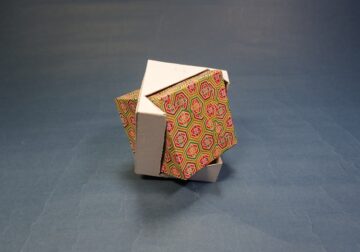
Of course, mathematicians being mathematicians, they immediately wondered what other shapes might have the property that one copy can be drilled straight through in a way that allows a second, identical, copy to pass through it.
To confirm it doesn’t always work, let’s consider the humble sphere. Because a sphere looks the same however you rotate it, you can’t repeat the trick of coming in at an angle. With that in mind, you quickly realize your only option is to drill a round hole straight through the side of the first sphere. And only if the second sphere is smaller than the first will that work.
Cubes have this Prince Rupert property, but spheres do not.
This is a down-to-earth geometry problem that Pythagoras himself would have appreciated. It is 350 years after Prince Rupert and we’re still learning new things about the problem.
Since this is a question of something being possible, the most straightforward thing to do when given a particular shape is to find an actual coring that does the job. The problem is that there are literally infinitely many different angles you could try. Remarkably, it was only in 2017 that Richard Jerrard, John Wetzel, and Liping Yuan proved that the other four Platonic solids also have the Prince Rupert property [3].
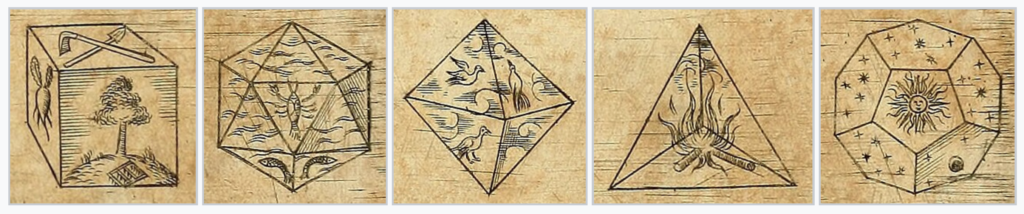
Over the years, researchers have tackled various polyhedra [4]. For example, we know that 10 out of the 13 Archimedean solids and 82 out of the 92 Johnson solids have the Prince Rupert property. In fact, practically every polyhedron we have tried has the Prince Rupert property. But, of course, there are many, many more that remain a mystery. David McCooey has a wonderful collection of polyhedra if you’d like to ponder the Prince Rupert property of one of them.
As the evidence mounts, your intuition might be that all polyhedra have the Prince Rupert property. Indeed, researchers conjectured a decade ago that every convex polygon has the Prince Rupert property [5]. Once again, our intuition fails us. A few months ago, Jakob Steininger and Sergey Yurkevich released a preprint in which they revealed the Nepenthedron:
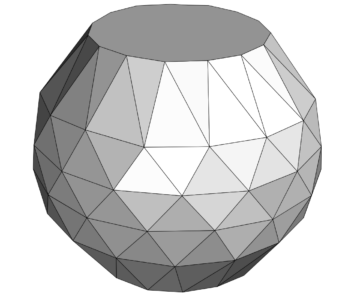
Steininger and Yurkevich prove in their paper that the Noperthedron fails to have the Prince Rupert Property. It doesn’t look so different than some of the polyhedra that have the property. Indeed, it looks less weird than many of the Archimedean and Johnson solids. My intuition definitely fails me here. I have no sense of why this guy fails when so many others succeed.
As with the original result of Wallis, and pretty much always in math, answering one question just raises new ones. The Noperthedron shows that not all convex polygons have the Prince Rupert property. This leaves the many-headed open problem of figuring out which ones do, and why.
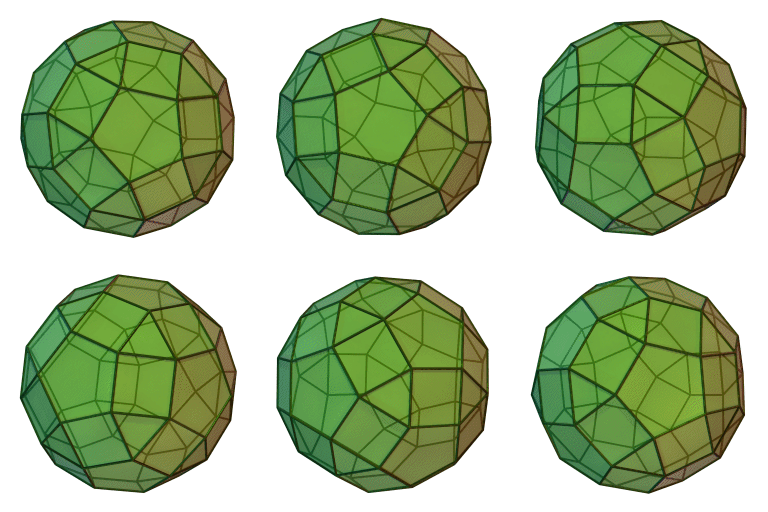
For example, Steininger and Yurkevich have conjectured that the rhombicosidodecahedron fails to have the Prince Rupert property. As of today, that is still an open problem.
***
[0] The rational numbers are sprinkled everywhere like a fine dust: given any real number, you can find a rational number (aka a fraction) as close as you like to that number. Nevertheless, almost none of the real numbers are rational numbers.
[1] The same Prince Rupert of Prince Rupert’s Drop fame.
[3] More precisely, Scriba did the tetrahedron and octahedron in the 1960s, and Jerrard-Wetzel-Yuan did the other two a decade ago.
[4] A polyhedron is a 3D solid made up of flat faces. Think Platonic solids, not spheres.
[5] The adjective “convex” means the surface of the shape is always flat or bulging outwards, never bulging inwards. See Wikipedia.
***
Enjoying the content on 3QD? Help keep us going by donating now.