
by Chris Horner

Why be happy when you could be interesting? —Zizek
What follows is what I know about the Good Life. Some of it, anyway. It’s what I have gleaned and which may be useful to you. There are obvious limitations: it is one person’s perspective, a white heterosexual male of a certain age in the UK. You need to bear that in mind. Less important, I think, are my tastes: I don’t care much about, say, sport or gardening. No matter, just swap my preferences for yours and then the general framework, what kinds of things to go for, what to avoid, can stay in place. Or you can just ignore me. Be warned: I’m going to be didactic and dogmatic. It’s what I think.
Aiming at Happiness and pleasure: don’t fall for it.
Don’t aim at being happy and certainly don’t try to just maximise pleasure. Obviously, we all like pleasure rather than pain. But long term, the pursuit of happiness leads to the ‘hedonic treadmill’. This applies particularly to commodities. Capitalism is very effective at offering us shiny new things, but the problem with the chase after them is that like any addiction, you find you want more. Click on this, get that etc. What happens is that your unconscious desire is diverted into to the conscious conviction that that thing overthere: car, shoes, job, romance, whatever, will make you happy. It won’t. Quite soon after getting it, the allure will fade and you will want the next thing. And the next. It’s a recipe for emptiness. I like shiny new things as much as anyone, but I have learned, slowly, to see what kind of deception they involve. We have a sense that somehow our lack will be filled by that X over there. It won’t be. Avoid the happiness trap.

What you should do instead.
Aim at what you must do. Don’t give ground on your desire, once you find what it is. A clue to help you find it: it’s a thing, or things, that you feel you must do. Something that may make you seem eccentric, even unpopular, that takes time and effort, that you return to repeatedly. That struggle will cause frustration, boredom sometimes, maybe pain, but costs effort. It needs to be something you can consciously aim to succeed at, but which, in the end, you will always return to, because it can never be done with once and for all. This might be writing, or studying, gardening, volunteering, music, a cause, a project – something that matters to you more than comfort. This is the discovery of purpose, and the chance of a worthwhile life, in which happiness, if it comes, will be a by-product. Repeated struggles, failures, at something you deem worthwhile is the road to a life beyond doomscrolling.

Nature and Art
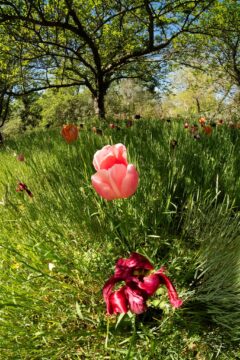
Discover and develop a sensitivity to art and natural world. You need to expand your spirit into something larger than the quotidian self. What art and nature have in common is the capacity to enhance your powers of attention. Walk in the woods, climb the hill – and put some effort into it. But also stop, breathe and be aware of the living world around you. See its colour, hear its song. And as for art: whatever the medium is, spend slow time with it, looking, hearing, touching, reading. Slow art is best – the kind that requires you to suspend your daily business and attend. Even better if you can make art: the total absorption in the difficult business of making is a part of the kind of life I described above. It may not make you a morally better person, but it just might make you a different one.
Be public
A paradox of the good life is that only through a cause or project more important than you, is a life worth living attainable. We are political animals. By this I mean that we are what we are in and through others. One of the problems we have isn’t so much loneliness, is the prevalence of alone-ness. There are different ways of being alone: a walk in the woods is one, sitting with a screen is another. Both have their place and time. But capitalism encourages the existence of the atomised shopper, the Robinson Crusoe of consumption. The life of going-to-work-plus-private-consumption is another way the lure of happiness through pleasure traps us. Private means privation here: we are creatures who need to the public realm, not just our little nests. You are the political animal with the goal of finding ‘oneself in another’. Only by pursuing goals with others can you be something more than the self-pleasuring monad of consumer capitalism. There is evil abroad in the world: genocide, climate catastrophe, inequality. Don’t be indifferent: act. Finally, it is by working with others who need not be your friends, but could be your comrades, that you can live a life that is fully human. A kind of happiness, perhaps.