
by Herbert Lui
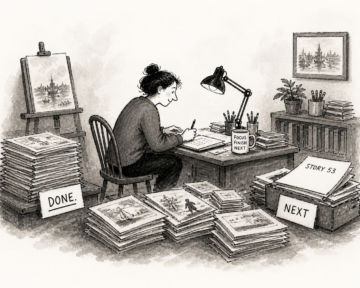 By definition, in order to be prolific, you only need to produce and publish a lot of work.
When you set out to produce and publish a lot of creative work, you focus on what’s in your control. Your time will be limited, as will the size of each project, as well as your expectation for each one. There’s no time to get in your own head—for example, thinking about the prizes the work may earn—which means there’s no time for you to get blocked. Instead of getting too precious about a single piece of work, and falling into the trance of hesitation, you focus your energy on making a contribution to your body of work by finishing this one and starting on the next.
When you aim to produce a vast quantity of acceptable work, you also naturally find opportunities to improve along the way. Being prolific turns out to be a structure to improve your skills. Joseph Mallord William Turner’s practice of travel and painting led him to create and complete a vast quantity of work, including more than 550 oil paintings, 2,000 watercolors, and 30,000 works on paper. Ray Bradbury advice comes to mind, “If you can write one short story a week — it doesn’t matter what the quality is to start, but at least you’re practicing, and at the end of the year you have 52 short stories, and I defy you to write 52 bad ones.”
Being prolific encourages—perhaps forces—you to experiment. You don’t need to worry too much about failure, because your next project will be coming up soon. This means you can try a lot of new approaches with your work, and take it in new directions. The more you create, the more ideas you generate. You may be familiar with Yayoi Kusama, who has created thousands of works—and has 12,000+ auction results—for art involving polka dots, infinity nets, and mirrored infinity rooms. The spotlight shines a little less on her series of chairs with phallic protrusions, and dims much more so on her novels and her fashion company.
This process of publishing your work allows other people to find you. As people watch you improve, some of them start to see opportunities for how you can collaborate. They become more bought into your career and willing to support. They also can give you feedback on how your work is coming along, which—if you’re open-minded—contributes to your improvement. When you’re prolific, you can also intentionally publish drafts of early versions of your work, and use it to gain feedback; if you’re not prolific, each of your releases will be taken too seriously for you to try this.
When you focus on making a large body of work, you also give it the highest probability of success. In his book The Genius Checklist, professor Dean Keith Simonton, who has studied the statistics of creative success for decades, notes how the more attempts an artist or craftsperson makes, the more major works they create. As a general rule, Simonton suggests that making a lot of acceptable pieces of work will, on average, produce better results than focusing on a single idea and trying to make it perfect. Simonton writes, “Giving up on perfectionism doesn’t mean that you will not produce anything perfect, but rather that perfection will happen from time to time because of the sheer mass of output.” In a paper exploring a model of creative productivity, Simonton writes: “Ludwig van Beethoven produced many compositions that only embarrass his admirers, just as William Shakespeare could write ‘problem plays’ that are rarely performed today.” Perhaps another way of saying this is being prolific helps you get lucky, or creates circumstances for unluckiness to run out.
This is an important shift: being prolific means treating your body of work the way you would treat a well-balanced stock portfolio. It will have a long tail of work that doesn’t garner much external success or feel particularly inspired. However, there will also be a small number of hits, and those will deliver most of the returns both in terms of success and inspiration. It will accumulate slowly and steadily each year, compounding on the year before. As Derek Sivers says, “All professional songwriters write many, many songs and most of them don’t become big hits. But are all of those songs failures? Of course not.”
While being prolific offers neither a shield against the trials that come with creative work or a guarantee of success, it can be incredibly useful as a liberating rule to keep you showing up and staying in motion. In an era when there are all sorts of reasons to stop—discouragement, flashier opportunities, and other distractions—and disappear, and everyone “has an idea,” being prolific helps you work and improve at a consistent pace, deliver good work, and build a competitive advantage.
***
Herbert Lui is an author and marketing strategist whose work encourages people to embrace the messy, joyful process of creating with purpose and impact. His writing has appeared in Fast Company, The Globe and Mail, and The Fader. As the author of Creative Doing, Herbert draws from his years of practice to help creatives move through blocks, build momentum, and reconnect with the joy of showing up consistently and honestly. He writes every day at his blog and twice a month at his newsletter.
Enjoying the content on 3QD? Help keep us going by donating now.