
by Steve Szilagyi
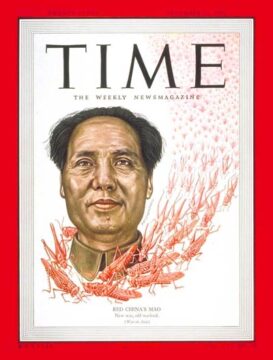
A few weeks ago, I came into possession of a bound volume of Time magazines from late 1950. As I leafed through it, admiring the cover art, I came to the issue of December 11—which showed a portrait of the young Mao Tse-tung surrounded by a swarm of locusts. Reading inside, I was gripped—not by nostalgia, but by something closer to vertigo. The prose was so dire, the political situation so apocalyptic, the leaders involved so reckless and unpredictable, that I had to keep reminding myself: this is 1950. This is not now.
Which got me thinking. We hear a lot today about the fertility crisis, and one explanation that circulates is fear—fear of climate change, fear of war, fear of the future. “What sane person would bring a child into a world like this?” But the world of 1950 seemed no less on the verge of self-immolation than ours. Yet that period produced the largest sustained surge in births in American history.
Tyrants and thrill killers. Those of us born in the early 1950s were conceived during what appeared to be one of the bleakest, most frightening periods in American history: a three-year stretch when tyrants ruled half the earth, nuclear war seemed imminent, and the entire effective ground force of the U.S. and United Nations was on the verge of annihilation in Korea.
Domestically, it was a time of deadly weather disasters, gruesome thrill killings, government persecution of dissent, and widespread racial segregation. Oh yes—and a housing shortage that put home ownership out of reach for thousands of young families.
Our parents knew what was going on in the world. Mass media made sure of that. And how did the young people of the time respond to this avalanche of horrors? According to the mass of aging, but still living, evidence, they gave each other sad looks, threw off their clothes, and hopped into bed.
Massacres and atrocities. In world affairs, one of the scariest months of the 20th century had to be December 1950. Communist North Korea had attacked South Korea five months earlier, and the United States armed forces, under the auspices of the United Nations, went to Korea to show them who was boss. It wasn’t easy, but they managed to beat the northerners back after a bloody, seesaw campaign characterized by massacres and atrocities by both sides. By November, it looked like the U.S./U.N. had won a solid victory; the northerners were pushed all the way to the Yalu River, and all that remained was to mop them up. On November 24, Commander Douglas MacArthur spoke the fatal words: “Home by Christmas.”
The very next night—in minus-20-degree temperatures—the Chinese People’s Army entered the war on the side of North Korea. Thousands of well-equipped Chinese soldiers poured over the border and began mowing down U.S. soldiers and Marines at the Chosen Reservoir and Chongchon River, killing thousands and sending MacArthur’s entire command running back down the peninsula. Some 2,000–3,000 U.S. and allied troops were killed in the first days; thousands more were wounded, missing, or taken prisoner.
Desperate retreat. The scope of the disaster was reported on the front page of every newspaper in the country. Time magazine of December 11, 1950, put it this way: “Caught in the desperate retreat were 140,000 American troops, the flower of the U.S. Army—almost the entire effective Army the U.S. had … It was defeat—the worst defeat the U.S. had ever suffered.”
Time held nothing back in warning readers what was likely to come next. With nearly every battle-ready U.S. soldier committed to desperate fighting in Korea, there was nothing to stop the Soviet Union from walking in and taking over Western Europe, or to stop China from invading Taiwan, as it appeared ready to do.
The U.S. and its allies were in full strategic panic. The only way to prevent this communist takeover would be for the U.S. to unholster its big weapon—the atomic bomb—and threaten to use it.
“On Capitol Hill …” the Associated Press reported, “voices were calling for the atom bomb to be used.” At a press conference on December 1, President Truman called the situation a fight for the nation’s “survival” and said the use of atomic weapons was “under consideration.”
Come to blows? Only a year or so earlier, the U.S. had ceased to be the sole possessor of this weapon—the Soviet Union had atomic bombs too, aided by spies embedded in the Western establishment. But the U.S. still had the advantage in the number and deliverability of bombs on hand. That is to say, if it came to blows, the U.S. could bomb the Soviets back into the Stone Age, while the Soviets could only bomb the U.S. back to—say—the Corded Ware Culture.
And who were the decision-makers in this crisis? Who were the leaders whose humane judgment would determine the fate of the human race at this critical juncture, when the very existence of civilization was at stake?
Ladies and gentlemen, I give you Josef Stalin and Mao Tse-tung. You may consider our current 2026 batch of presidents and premiers particularly reckless and unhinged. But they don’t come any madder or badder than Stalin or Mao. The merest nod from either dictator to his minions could have accelerated the Korean conflict into a world conflagration—and the opacity of both leaders meant that no one knew what they were going to do from one day to the next.
Harry Truman was no Stalin or Mao. But the sign on his desk said, “The buck stops here,” and he had already shown—at Hiroshima, Nagasaki, and in the firebombing of Japan—that he was willing to accept mass civilian deaths in pursuit of victory.
Numb reception. “The nation received the fearful news from Korea with a strange-seeming calmness,” wrote Time. “The kind of confused, half-disbelieving matter-of-factness with which many a man has reacted on learning that he has cancer or tuberculosis.”
There are other ways to interpret that “strange-seeming calmness,” though. I think something else was afoot. Some force of nature had begun to stir in the loins of young Americans in the 1940s. By the 1950s it was gathering unstoppable momentum—an unbridled wave of generative energy, a brute and unstoppable urge that was pumping the nation’s streets, parks, and playgrounds full of children, and doing so with a merry indifference to war, politics, and the threat of nuclear annihilation.
Young men and women were recklessly reproducing, despite living in a world that was—compared to 2026—objectively horrible: maternal death rates were high, and childbirth offered little or no pain relief. Parents struggled with cloth diapers. Detroit cars were death traps. Alcoholism was widespread, damaging to families and productivity, and widely unacknowledged. Baby equipment—carriages, strollers, playpens—had barely changed since Victorian times. There were no credit cards, no health insurance, no substantial government assistance.
A whole world of safety nets we take for granted in 2026 simply didn’t exist. Having kids was a tremendous risk in terms of health, finances, and convenience.
Nonetheless, about 3.8 million babies were born in the U.S. in that scary year of 1950, another 3.9 million the next year of the Korean War, and 4 million the year after that.
Dimensions of dread. Some might argue that today’s tense atmosphere is qualitatively different from the 1950s: more chronic, more diffuse, more civilizational. While the people of 2026 also live with hot wars, the threat of nuclear annihilation, and unaffordable housing, fear of climate change has added a whole new dimension of dread. And our current leaders—okay, they’re not Stalin and Mao—but they can still seem irrational and unpredictable.
Even so, if the early 1950s teach us anything, it is this: living in a frightening, morally confusing time—amid wars, massacres, unstable strongmen, and the daily possibility of catastrophe—is not necessarily enough to suppress the ever-loving urge to have children, and plenty of them.
Young people weren’t worried that having children would ruin their lives. Having children was their lives.
Fertility may respond less to abstract fear than to the degree to which a culture believes that childbearing is normal, manageable, and expected. Weaken that expectation, and every inconvenience begins to loom large: housing costs, delayed marriage, dual careers, scattered families—and even something as simple as getting in the car and going somewhere.
Some of these inconveniences are cultural, some economic, and some absurdly mechanical—like the modern mandate for child car safety seats. How different it was for those conceived in the dismal December of 1950, and thereabouts. When it was time to go somewhere, my mother would throw us in the backseat of our rusty station wagon, step on the gas, and go … and if someone flew out the back gate, well—there were plenty more kids where that one came from.
Enjoying the content on 3QD? Help keep us going by donating now.