
by Ananya Vajpeyi
 In the early 1990s, I began listening to qawwali in a serious way. In 1994 I happened upon a recording of one of the great performances of the Pakistani maestro, Nusrat Fateh Ali Khan. He must have been addressing an audience outside South Asia because he began the concert with a sentence in English (of sorts). “Now we are singing,” he announced in his gravelly voice and thick Punjabi accent, “a poetry in the Persian.” Without further preamble he and his troupe began to sing. For many years now I’ve tried to correct the sentence in my mind. Poetry in the Persian. Poetry in Persian. A poem in the Persian. A poem in Persian. But it never sounds quite right, except in Nusrat’s idiosyncratic grammar: Now we are singing a poetry in the Persian.
Premodern Persian poetry was largely produced in an urban environment and poets, whether associated with a royal court or of a mystical bent, had a special relationship with the city in which they practiced their craft. In prosperous times the city was the location of patronage networks and a cosmopolitan centre of cultural life, as well as being a macrocosm of the narrower spaces that provided the context for the performance of Persianate poetry, i.e., the private mahfil (assembly) or the majlis (session) of courtiers or Sufis.
Sunil Sharma, an Indian scholar of Persian literature, begins an article titled, “The City of Beauties in Indo-Persian Poetic Landscape” with these lines. When I first met Sunil in 1995, we were both graduate students; he was studying Farsi and I was just beginning to study Sanskrit. We knew there was a close relationship between Persian and Sanskrit and that the history of philology, as a discipline, had much to do with this relationship between the two classical tongues. What I didn’t understand, then, was that the connection was not merely philological; rather, Indic and Persianate cultures had been intertwined for centuries. Indo-Persian culture was the child of this marriage and, like many progeny of miscegenation, it was a beautiful being.
In Delhi, the city of the Sufi saint Nizamuddin Auliya, the summer heat is excruciating. When the monsoon arrives one can glimpse Paradise. Paradise is really a garden in the rain. Paradise is the crowding of the summer sky with clouds so dark they are almost black. It is trees restless in the wind laden with water, the deep sound of thunder, intimations that relief will pour out of the sky onto the taut, waiting earth. Amir Khusro, the greatest poet of Indo-Persian culture in medieval times, wrote his verses and composed his tunes in Delhi. It was the heat that gave him words, the rain that gave him music.
Delhi was the crucible of Khusro’s poetry. In his city, peacocks danced in bejewelled choreography, parrots rose into the air in vortices of green, the Yamuna was swollen in the monsoon. The sky sputtered with unshed rain, like laughter held back. Into this rapture came Khusro’s poems, spirals of song, heaving, lurching, reckless melodies, lightning-flashed like the inundated city and its gardens, poet and river in flood, a love-making of language the like of which has not been heard on the subcontinent in the seven centuries since.
Khusro’s oeuvre is among humanity’s most exquisite artefacts. Qawwali—the style of Sufi music and singing he is said to have invented—takes the tears out of one’s heart, fills up one’s eyes to the brim. Qawwali is the great coming, of rain, of love, of deliverance. It touches one in places only a lover may reach. It opens doors known only to teachers. It rises from the city of Delhi into the heavens; it is a storm and the city its eye. Khusro’s verses hover, flash, growl and pour. He sings for the ages:
My heart is so enamoured of you, love,
I cannot bear to look at your face.
I am smitten, stricken.
You glance at me and armies advance.
Your armies advance.
I shall be routed.*
Sunil Sharma refers to Amir Khusro in the Persian spelling, as Amir Khusraw Dihlavi, and to his teacher as Nizam al-Din Awliya, with both names followed by the same detail, the year of the demise of their bearers: d. 1325. But in truth both the master and his disciple are alive even today. In the mahfil and the majlis, the gatherings of Sufis and the assemblies of the patrons of qawwali, the presence of Nizamuddin and of Khusro cannot be denied. Now we are singing a poetry in the Persian—the present of this musical form is continuous; its continuity from Khusro’s time is present to us. Khusro’s epithet, in his life and for posterity, is Dihlavi, ‘of Delhi’. Amir Khusro of Delhi, he is tied to his city, and the city to its foremost citizen. Come to the city of Delhi. Come to Paradise. Poetry is perfection.
The painter peregrine
Down Under Manhattan Bridge Overpass. DUMBO, Brooklyn. Old warehouse buildings full of workspaces for architects, painters, sculptors, new media practitioners. Massive steel bridges stretched out over the water. Incessant stream of vehicles, flowing on the highways like corpuscles. Dull roar of heavy machinery on gigantic construction sites. Overwhelming Manhattan skyline. On the sidewalk, a film crew at work. Fluorescent orange roadworks to divert cars away from the delicate mesh of camera equipment, the street awash with building workers, actors, artists, traffic policemen. June noon time, humid and heady; the beating heart of New York City.
It is 2004, about 15 years after I first began listening to qawwali. Here in this gritty part of Brooklyn is Shahzia Sikander’s studio. It has a high ceiling; it is lit by a very large window whose glass is grimy with age. The room is crowded with canvases, wooden frames, art books, paint, CDs, brushes, boards and the uncontainable creativity of its occupant. She is a slight figure, dwarfed in her own loft space, but her mastery of the miniature form is quite unprecedented. Far from Delhi, in a city without gardens, once again, the Indo-Persian sublime takes shape. Painting is perfection.
My arms are fair
My bangles, green.
You took me by the hand
You pulled me close.
My bangles broke
Green
Glass.
What Khusro did for poetry in the Indo-Persian world, no one else had done until his time. He made it, fashioned it in the languages of the Gangetic plains that until then did not have a poetic register. This was a feat akin to divine intelligence creating the world. We cannot even begin to comprehend the novelty, the effulgence, of making poetry for the first time in a tongue of everyday commerce and conversation. For us language is a worn coin, cheapened by use, saturated with significance and depleted in value. Code floods our world, drowns all meaning. We can scarcely even imagine, let alone remember, such an inaugural minting of poems as Khusro achieved in the 13th century.
Who says poetry
Cannot be written in Hindavi?
That Persian alone
Is worthy?
Persian is fine wine
Hindavi crude liquor
But we know which
Is more intoxicating!
Something reminiscent of the mystery of making brand new poetry goes on in Shahzia Sikander’s studio. Visions opening in her mind’s eye unfurl on gossamer sheets of paper. Most noticeable, amidst the magical realms and unexpected forms that fill the loft in Brooklyn, are Sikander’s women. Women behind diaphanous veils. Women in flowering gardens. Women crowding around a blue-skinned god. Women breaking out of the framed portraits of princes in profile. Armed women, bearing weapons. Many-armed women, goddesses on earth. I am reminded of Gayatri Spivak in her celebrated essay, “Moving Devi”: “Such powerful females, improbably limbed.”
The charm of Sikander’s world, with its welter of women, is ineffable; its rigour, breathtaking. As at the singing of a qaul—the ‘word’ of qawwali, its opening call—tears rise out of their home in one’s heart, into one’s eyes, where they must remain.
You looked in my eyes
The unspeakable was uttered.
I drank deep
From your brew of love.
I was intoxicated.
Stranded in the present
I can be in Delhi, but not in the city that was when Khusro lived and wrote and sang and composed and invented and imagined and made from his mind, meaning and music. Fragments of Khusro’s Delhi surround me and yet its totality is irretrievable. One senses monsoon winds bearing their burden, but they are remembered more clearly than they are seen. One glimpses parrots among the rain-harassed trees in the Lodi Gardens, but they are gliding to their extinction. One smells the Yamuna, two notional banks for a vanished city, filthy trace of a river that was murdered. One hears old qawwals at Nizamuddin’s shrine, their voices broken with thirst, pollution, poverty. I can, however, go into the crucible that is New York City and visit Sikander’s space where she brings alive, on a far continent, in another age, the Indo-Persian sublime.
She gives me directions over our cell phones. I take the subway across the water from Manhattan. She meets me at the first station on the other side. We walk in the sunlight across a park, under a bridge, down streets shaded by tall buildings. She shows me a new animation CD she is making on her iBook, recently dropped and partially broken, its hold on data somewhat precarious. She tells me that it takes her two years, sometimes more, to make work for a show. Making work. Every era has its flavour, its own sweetness on one’s tongue. Roar of storm clouds in Sultanate Delhi; roar of traffic in new millennium New York. Qawwali pounding in my ears; miniature painting piercing my eyes.
The novelist Orhan Pamuk has written of sharp needles, of dark workshops, of the blindness and the betrayal, the heresy and the epiphany that constituted the lives of miniaturists in Safavid Iran, in Ottoman Turkey, in Mughal India. In My Name is Red Pamuk writes of Istanbul long ago. Sikander exhibited in the Istanbul Biennale in 2003. Her paintings were displayed in a bank, as befits works that are precious. On the walls of a vault, a charming tale she had painstakingly animated folded and unfolded, her monsters and men came together and fell apart in exquisite detail, with her trademark intricacy, her signature humour; a two-dimensional puppet show on Istiklal Avenue. I have been there too, to Istanbul of the Blue Mosque, I have seen its minarets and bridges, its cobbled streets and covered markets. Two years later Pamuk would come out with another book about his beloved city, Istanbul. Khusro lived in Delhi long ago. Sikander lives in New York now. Beauty is precisely that which comes across oceans, ages and media, with grace, perfectly.
In qawwali a major theme is the Battle of Karbala, site of the martyrdom of Imam Hussein, grandson of the Prophet Mohammed. The heart-rending scenes surrounding Hussein’s death and the slaughter of his family are sung ever and anon in distant India, my country in which the pain and ecstasy of every religion on earth fills the air with cries. As I meet Sikander in New York, America is at war with Iraq. Karbala is once again drenched in blood. History leaves us ever uncivilised.
In my Delhi, where Khusro and his beloved Sufi master, Nizamuddin, lie buried close together, married beyond their mortal coils, beggars mill at the traffic signal. Their bodies are so mutilated by poverty they do not even have arms to stretch out in beggary, hands with which to tap the closed windows of air-conditioned cars, or legs to carry them from one waiting vehicle to the next. Lights turn red-orange-green-red-orange-green. I look for the Yamuna but do not see it. I look for peacocks, I look for rain; the sky is empty, the air burns. I see the poor with their missing limbs. In New York, I see the skyline with its absent towers.
For our meeting, love,
I made up my face, so carefully.
One look at your face
And I forgot my own.
You looked in my eyes
My composure was lost.
You looked in my eyes
And took from me my modesty.
One look
And you made a bride of me.
Sikander explains how she is fusing two important but entirely disparate elements of the miniature painting—one, an indoor setting, depicting a royal court, a sort of pavilion in which a royal personage might sit, surrounded by his courtiers; and two, the dance of the blue god Krishna with his playmates, the cow-herding gopis in a forest or garden by the banks of the Yamuna. Both are standard tropes in the Indian miniature—only, for obvious reasons, you would never see them together in the same painting. The computer works fitfully; the work itself is incomplete; and animation is something Sikander is still learning. But even the fragments I see are complex, beautiful, surprising—the royal palace becomes the site for a dance that ought to be taking place in a pristine forest; the formality of the interior space is disrupted by the movements of innumerable dancers who resemble a flock of black birds more than a circle of pastoral women. Later I would learn that this work is titled “SpiNN”, and that its various versions have been extensively shown and reviewed.
On Sikander’s pin-board, two columns of colour photocopies of her recent works, all in pink, peach, mud, terracotta, flesh-tones. I paint from memory, she says. Has she been there, I ask her, to Central Asia, to the Middle East, to North India, to Mongolia, to the vast Asiatic home of Persianate miniature painting? No, she smiles. I meant, my memory of works by medieval painters that I’ve seen in art books. That’s all one remembers, those images in books, they are all one can remember. She pulls out a book from her laden shelves, randomly flips through the pages and points to paintings. One knows of the Indo-Persian tradition, not from having been there, in Khusro’s universe, but from having been here, in front of the artefacts that have survived.
But there’s no time to be lost. In the garden of Venus, enchantment. In the arms of Kali, terror. In the paintings of Shahzia Sikander, rapture. Khusro in a thousand-year concert. The qawwals sing. Delhi is its eighth self. Where there are so many residues there must also be unendurable loss. New York was stabbed in the heart, but it watered its ground with blood and sprouted new life, continuing to throb like an indestructible Leviathan. Making work. Make the poem, the painting, the song, the city. The Indo-Persian sublime, it is one of the things of beauty to be salvaged from the great destruction that surrounds us, every street, Baghdad. Make work. Through the tumult of time, by some miracle, qawwali lives, miniature painting lives. Make work, not war.
Mahfil: the gathering of connoisseurs
In early 2005 I am to return to Delhi. I am afraid that the city will vanish, like a mirage upon approach. I grew up in it and yet I’ve travelled very long, very far, to be coming to Delhi again. Could it be that Khusro awaits me in Delhi, hanging about in his city and mine, as he has done for the last 700 or 800 years? Will I meet him, at last, on some street corner, gossiping, chewing paan, reciting verses to an appreciative audience of stragglers and passers-by, making up the words as he goes along?
The path to the river
Twists and turns
The path to the river
Is strewn with stones
How shall I walk this treacherous path
Bearing a pot heavy with water?
***
*All translations of verses and songs attributed to Amir Khusro, as well as those of unattributed but popular qawwali lyrics, are my own. I have translated most of them from hearing them being performed. Almost all of them are popularly and conventionally attributed to Khusro, but in scholarly literature there is no hard evidence that he did in fact write them.
***
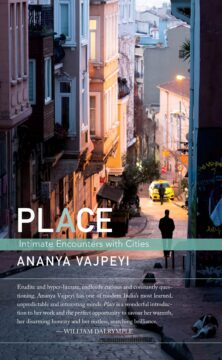
(Excerpted from Place: intimate encounters with cities by Ananya Vajpeyi, published by Women Unlimited Ink, pp: 239, Rs 625.)
***
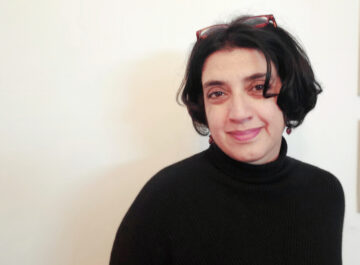
Ananya Vajpeyi is a Professor at the Centre for the Study of Developing Societies, New Delhi. An intellectual historian, political theorist and writer, she was educated in Delhi, Oxford, and Chicago. Her book, Righteous Republic: The Political Foundations of Modern India (2012), won the Thomas J. Wilson Memorial Prize from Harvard University Press, the Crossword Award for Non-Fiction, the Tata First Book Prize for Non-Fiction, and was listed among the Books of the Year by The Guardian and The New Republic.
Apart from her scholarly work, she writes widely for newspapers and journals in India and abroad. She edited AROOP: Journal of Art, Ideas and Poetry of the Raza Foundation from 2019 to 2024. Her translation of her late father Kailash Vajpeyi’s Hindi poems Signature on the Wind has been published by the Sahitya Akademi in 2026. She is currently completing a book about the modern life of Sanskrit.
***
Enjoying the content on 3QD? Help keep us going by donating now.