
by Scott Samuelson
I’ve noticed something peculiar when I’m at an academic talk. While the paper is being read, I tend to become increasingly skeptical of it. Sometimes I dismiss it because I can’t track its jargon or follow its argument. But even when I do follow its every twist and turn, I often experience a strange resistance to it.
In the Q and A after the talk, the audience seems in a similar boat. They raise objections of their own and are rarely enthusiastic about the consequent rebuttals. When they’re not making objections, they end up asking one of two questions. How does this relate to my work? Or: why doesn’t this relate to my work?
In short, a paper that’s meant to win over its audience tends to have the exact opposite effect. This is especially true at philosophy talks.
Here’s the really curious thing. When I happen to have drinks or dinner afterwards with the speakers, they become way more fascinating, way more winning. They tell the story of how they got into their subject. They joke around. They confess their nagging doubts. They relate their ideas to their personal lives and to contemporary events. I see the value in the very points that had me dreaming up objections a short while ago. Now I’m enjoying myself and having new ideas of my own. When they stop trying to convince me they’re right, I start to come around to their ideas.
I’ve experienced a related phenomenon at poetry readings. A poet will recite a poem full of references to, say, up-to-date hospital equipment and mid-century European train commerce. After intoning the last bewildering line, the poet will start talking like a normal person and tell the backstory of writing the poem by a dying grandpa’s bedside, listening to the bleeping EKG and thinking about tales of his escape from Nazi Germany hidden among boxcar freight. I’ll go from being completely baffled to being immensely moved.
What I’ve long wondered is why thinkers and writers don’t think and write the interesting stuff, the stuff that actually convinces us and moves us.
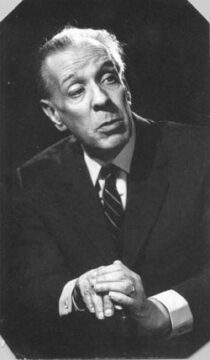
In This Craft of Verse, Jorge Luis Borges makes a helpful observation. Discussing the famous last lines of Robert Frost’s “Stopping by the Woods on a Snowy Evening,” Borges observes that by repeating “And miles to go before I sleep” the poet suggests a metaphysical meaning without actually saying, “And years to go before I die,” which wouldn’t be near as powerful. Then Borges digresses,
As I understand it, anything suggested is far more effective than anything laid down. Perhaps the human mind has a tendency to deny a statement. Remember what Emerson said: arguments convince nobody. They convince nobody because they are presented as arguments. But when something is merely said or—better still—hinted at, there is a kind of hospitality in our imagination. We are ready to accept it.
I love that idea of the hospitality of the imagination. Maybe academics and poets need to be more gracious to their audience! Not that you can tell academics or poets anything, in my experience.
The flipside of hospitality is hostility. Hospitality welcomes, hostility attacks. The dream of an academic paper, especially one in philosophy, is to advance a claim with airtight reasoning and to fend off every possible objection. As with aggressive warfare, even when the attacker is successful, the conquered still resent the takeover. No wonder I’m so resistant to academic papers.
I’m not saying that hostility is always bad. You can’t have hospitality without hostility—at least not this side of heaven. For me to be able to welcome guests into my house, I need the safety that’s afforded by walls, locks, and the police. And if my guests become unruly, I need to be able to kick them out.
Similarly, a mind needs the ability to protect itself against bad ideas. A good education should involve some of the roughhousing on display in academic debates to build up the mental muscles and argumentative skills necessary for self-defense.
But shouldn’t the martial arts of the intellect be in service to the hospitality of the imagination?
Let’s say that I want to understand something about grandmas. Well, I could conduct interviews, gather anthropological evidence, look at the relevant sociological literature, perform a Husserlian epoché, and then formulate and defend my universal theory of grandmotherhood, rebutting any objections that I encounter. Or I could write an elliptical poem about impressions from Grandma’s house, strategically never mentioning Grandma. Or I could just tell you a story of visiting my grandma’s farmhouse as a kid and getting served Squirt in a wineglass with a maraschino cherry.
Though all these activities could prove interesting and illuminating, my hunch is you’d think that there was something fishy about my theory of grandmotherhood, that it was subjectivity wrapped up as objectivity. Unless I was a master of suggestion, my guess is that you’d find my impressionistic poem confusing and narcissistic. But if I did an even halfway decent job of telling you a story about the kiddie cocktail, I bet you’d find something to connect to in its quirkiness—a universality in the maraschino cherry.
Maybe the ideal would be a combo: a well-told story about Grandma that’s informed by wide learning and enhanced with poetic detail.
In one of his essays, David Hume makes a distinction between the “conversible” and the “learned,” which maps roughly onto my distinction between stories about Grandma (on the one hand) and poems and theories about grandmotherhood (on the other). Hume argues for a union between the two worlds. When social discourse is disconnected from learning and eloquence, it tends to become “a continued Series of gossiping Stories and idle Remarks.” But the really big problem is the reverse disconnection, when the life of the mind is “shut up in Colleges and Cells, and secluded from the World and good Company.”
Am I overstating things if I say that a lot of what’s wrong with our world—political polarization, social dysfunction, a culture of spectacle, academic collapse, loneliness—is traceable back to the breakdown of hospitality? Even if that point is overblown, I suspect that Hume is right. The worlds of the conversible and the learned would be better off with some imaginative hospitality between them.
To go back to my original story, it’s worth mentioning that the basic hospitality of food and drink after those academic talks is what has stimulated the stories, jokes, asides, and vulnerabilities that have won me over. For that matter, I felt like a prince whenever I sipped Squirt out of a wineglass at Grandma’s. I’m inclined to think that the world would be a better place with more of that kind of hospitality too.
***
Scott Samuelson is the author of several books. His most recent, To Taste: On Cooking and the Good Life, comes out this fall.
Enjoying the content on 3QD? Help keep us going by donating now.