
by Barbara Fischkin
I am writing this in honor of my late mother Ida Fischkin who, as a child, saved her own life in the midst an anti-Semitic pogrom in Eastern Europe. She taught me to fight for the seemingly powerless—to consider they might not be weak or stupid. Her lessons came in handy as I raised our elder son, who has nonspeaking autism. For 33 of his 38 years, he has typed to communicate his own thoughts with sensory support from me and from some of his more enlightened and well-trained therapists and teachers. These days, at the keyboard, he approaches independence and often demonstrates it.
There are hundreds, perhaps thousands, of non-speakers who use this same technique.
Some need the same sensory support as my son—a touch on the hand can fade to the arm or shoulder. Then they move on to independence. Others need support for longer. The training is intense and complicated. One must learn to merely touch non-speakers, not move them to the keys. This communication has been validated as real and original by doctoral level professors, expert educators and scholars and by the typers themselves who communicate information their sensory supporters do not know.
I have a long list of “validations,” which were typed by my son Daniel Mulvaney and span the years. I write about him and offer two examples of these validations, with his permission. As a child he told his teachers that he had seen a dead bird while on a walk with me. Indeed, he had. More recently he bemoaned the loss of a romantic opportunity with a nonspeaking woman because “she found a boyfriend who drives.” She did.
But now the chair of a committee in the New York State Senate, the legislature’s upper house—wants to officially denigrate this method. She wants to demolish its use. She wants to terrify schools, teachers and programs for children and adults so that this method—called facilitated communication or supported typing—will die a brutal death like that bird my son Dan and I saw smashed on the sidewalk so many years ago. She wants to put Dan and his “compatriots” back into an autism cohort that may not exist, that of the cognitively “retarded.” She wants to regress to the Willowbrook years, when so many with autism were cruelly institutionalized because they could not show what they knew.
If the Senate goes along with her, it will disenfranchise hundreds, perhaps thousands more, of non-speakers who communicate with related techniques in which, instead of typing they use a pointer to spell on cardboard or plastic letterboards. I have seen some do this with lightning speed and independence. Some of these spellers need support, as they learn independence. Some do not.
The details: The Senate Disabilities Committee chair wants to amend a bill passed last year by a similar committee in the lower state Assembly house and then, unanimously, by the entire house. That original bill, “The Communication Bill of Rights,” guaranteed that any individual with a disability could use any technique to communicate—any technique that worked for that individual. This victory was celebrated by many in the autism community. Passage by the Senate was also expected, as was the expectation that the governor would sign the “Communication Bill of Rights” into law. (A law that actually was not needed, since this right is already guaranteed by the longstanding Americans With Disabilities Act.)
All was going well until the head of the Senate Disability Committee decided to add those amendments.
These current amendments now insist that nonspeaking individuals who use typing and spelling techniques be independent from the get-go. If the entire Senate committee agrees to keep these restrictive amendments, it could have implications for others with disabilities. Consider a child with ambulatory disabilities who needs to wear braces which will hopefully lead to independent walking. Following the Senate amendments’ logic on autism communication techniques, the braces would be outlawed, and the child would have to walk without them right away. Or not walk. Ever.
———–
To keep order in these draft memoir chapters on this 3quarksdaily page I had planned to write about my mother as a much older woman, visiting my husband and myself when we were reporting on the longstanding war in Northern Ireland. My mother was nearly arrested after telling British police officers that they should stop discriminating against Catholics. That she, herself, had been victimized by religious discrimination.
I am putting that chapter aside for now because this attempt at discrimination—against the disabled—is hitting my son in the face. I know that his grandmother is looking down on this from the heavens and she is not happy. As an oppressed child, my mother immigrated to New York, a state she never left, a state with the motto “Excelsior.” Latin for excellence. What is happening in regard to the faltering Communication Bill of Rights is not excellence. It’s a shamble. As I write, scores of individuals with autism, their parents, family members and supporters are planning to descend on Albany this Wednesday, April 29, 2026. A “Go Fund Me” Campaign is underway for a billboard in Albany, shaming the leader of this fiasco, the chair of the Senate Disabilities Committee.
I am hoping this mess can be rectified before Wednesday—and human rights restored—so that the march and the billboard can be cancelled. But even if that does happen, there is a major lesson here on how our elected officials waste time as part of their efforts to make life unfair. And how they can be unduly influenced.
It is no secret among autism communicators—and their families, teachers and supporters—that these amendments are part of a nationwide lobbying effort by ASHA, more formally known as the American Speech-Language-Hearing Association. ASHA is determined to stop the teaching and use of facilitated communication and the letterboard techniques. Why? ASHA seems stuck in the last century—and also unwilling to require backward thinking therapists to learn these new techniques. Do its members have money invested in the simplistic computer programs approved by the association? I keep thinking back to my junior high school history teacher, the first teacher to tell me to “follow the money.” ASHA also seems to have this undue influence over not only the Senate Disabilities Committee but also the New York State Office For People With Developmental Disabilities, known as OPWDD. The big question: Why should a professional organization have such power over government?
Why do I believe this? A few years ago at the suggestion of the agency that runs my elder son Dan’s terrific group home, I asked OPWDD for a small addition of funding to train more of Dan’s helpers. I had already paid $300 of our own money for training for two. In response OPWDD took away Dan’s entire “self-direction” budget of $30,000, monies he had had for several years. OPWDD said it made a mistake. He never should have had the money anyway. Huh? Go figure.
Meanwhile, back to the Senate. It’s not as if these Senators have nothing else to do.
The New York State budget is weeks late with its sixth extension passed on April 22. You’d think legislators up there in Albany would have more important things to do than mess around with the disabled.
Some more money facts: In the early 1990s I worked with my son Dan on a plastic toy typewriter, which I bought myself. Cost: under $5. These days he has two iPads used by his group home and his day program, each costing under a thousand dollars and paid for with public money. Why two had to be bought is beyond me.
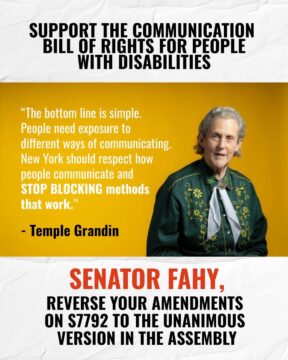
In closing, the Assembly’s original Communication Bill of Rights has the support of Temple Grandin, perhaps the most well-known individual with autism in the United States. It also has the support of Helen Keller’s descendants.
I guess the New York State Senate would rather listen to ASHA.
As an endnote to this post see this letter, written by my husband James Mulvaney, Dan’s father and a former New York State Deputy Commissioner of Human Rights. It will answer any questions I have not addressed here.
ENDNOTE: Re: S7792 – Communication Bill of Rights for Individuals with Disabilities
Dear Senate Leadership Team:
I write to vigorously oppose Senator Fahy’s attempt to prevent my son from using assisted communication, so vital to his dignity, well-being, and survival, and to urge you to support S7792, the Communication Bill of Rights for Individuals with Disabilities, by restoring the unanimously passed Assembly version of the bill.
I served under Governor Paterson as Deputy Commissioner of the New York State Division of Human Rights, the oldest state civil rights law enforcement agency in the nation. During our term, we were able to facilitate a U.S. Department of Justice settlement with the state’s third largest police department to end discriminatory practices, specifically targeting Latinos. We were also able to win a $19 million settlement from an international construction company that included admissions of civil rights violations related to MWBE regulations on public works projects. I mention those achievements to demonstrate my commitment to human rights and to suggest that this bill likely has Thomas Dewey spinning in his grave. As a long-time adjunct in the Law and Police Science Department at John Jay College, I cherish our state’s moral leadership related to human dignity and the tenets of compassionate laws.
The opposition to any type of assistance to non-verbal individuals runs contrary to the spirit—and likely the letter—of Dewey’s law. Opponents with vested financial interests, like ASHA, oppose the use of assisted communication because of their knee-jerk refusal to add a tool that doesn’t profit them. We need programs that can assist the non-verbal population in expressing their desires and opinions, as protected under the First Amendment.
The opponents drag up old canards about false allegations of sexual abuse and shamelessly blame assisted communication for the manslaughter of a non-verbal child by his mentally unstable mother. Courts have handled cases with false claims for decades. Do we abolish police SVUs because of cases like Tawana Brawley?
The “studies” dismiss the practical applications that keep my 39-year-old son relatively stable. When we visit restaurants, I turn first to the appetizers page; he quickly points out his order. That is followed by entrees, etc. Without that methodology, I would “guess,” often incorrectly, his preference, leading to repeated meltdowns in places of public accommodation that might appear as criminal. We have had law enforcement interactions that thankfully ended without consequence. (At DHR, I led a team that created autism response guides for the Nassau County Police Department.) How dare Senator Fahy or the speech-for-profit industry say my son should not be allowed to choose onion rings over fries?
Fahy’s follies have been decried by the family of Helen Keller, as well as by Dr. Temple Grandin, perhaps the most famous person on the autism spectrum. If Fahy were dining with my son, he would likely steal her onion rings—not because he is larcenous, but because he has lived much of his life suffering a lack of choice and dignity.
Concerns about authorship and false reporting are not unique to individuals who use assisted communication. Every system that relies on human communication—courts, law enforcement, healthcare—already has layers of corroboration in place. We look for consistency. We look for repeated communication across different partners and settings. We investigate and apply due process. Speaking people lie. We do not cut out their tongues. We assess credibility.
Preventing access to communication in the name of “protection” is not protection—it is exposure. It increases vulnerability by silencing the very people who most need to be heard.
I am writing as a constituent of Senator Canzoneri, and to Senator Bynoe on behalf of my son Dan, who lives in a group home in Baldwin. Senator Stewart-Cousins is included because of her strong leadership on behalf of all New Yorkers.
New York has long stood for civil rights and human dignity. I urge you to do so again here.
Restore the original Assembly version of S7792.
Respectfully,
Jim Mulvaney