
by David Hoyt
For most of history, humans have experienced the world as a collective of various agents, many of which were, and are not, human. These agents, typically conceived of as persons, inhabited the things of the world – trees, and rivers, animals, mountains and weather. Together they animated the universe. Their collaboration has been necessary for all of the great undertakings and everyday routines of life on Earth. The involvement of the human with the non-human has ensured the continuing, balanced order of the world for all participants – the recurrence of animal migrations, the flourishing of game, and the success of the harvest.
The recently deceased, American anthropologist Marshall Sahlins (1930-2021) proposed the term metaperson to describe these agents which an older anthropology was inclined to label using dismissive terminology particular to Western religious history, such as spirits, gods, and ghosts, all subjects of myth and superstition, and all denizens of the realm of the supernatural. It is tempting to look at such collectives of persons and metapersons as so many forms of contract between the human and the non-human far exceeding our own in their composition. One need not push the analogy too far to note the contrast between the collectives described by Sahlins, and the strictly human state of nature presumed to lie at the root of modern theories of a social contract grounded on natural law. To paraphrase Nietzsche, our own communities have only ever been human, all too human.
Anthropology long ago resolved to retain the idea of a state of nature and its corollary of natural law as helpful legal fictions. Not so with the category of personhood, which has been jealously preserved as a fundamental attribute of humans, around which a cluster attributes – such as reason, intentionality, consciousness – work to authorize relations among humans and non-humans. By demonstrating just how unusual this restricted conception of personhood is in the broad sweep of human experience, Sahlins developed a way of describing the majority of societies in terms more appropriate to their own experience. At the same time, by criticizing the restricted notion of personhood, he questioned a categorical distinction at the basis of anthropology, of the human sciences, and the scientific enterprise itself: that between Nature and Culture.
Whatever we mean when we use the term Nature, it did not exist before the early 17th century, and has had no equivalent in cosmologies elsewhere. What distinguished the concept was the withdrawal of personhood from all that had once intermingled with humans in the world, and the unification of this domain as inertial matter in space. In the histories of this development, the watershed is typically presented in the materialist philosophy of René Descartes who, while positing the world as made up of matter in extension, paired this with the cogito, or the divinely granted and non-material human faculty by which the mechanisms of Nature could be comprehended. Nature and Mind were thus bundled at the outset. For Descartes, as for much subsequent European thought, Mind and personhood went together. Where there was no Mind, or cogito, there was no personhood, and the sovereignty of Nature began. Where the realm of Nature commenced, the possibilities for community of human and non-human persons, or metapersons, ceased, and was replaced by a mandate for domination of the latter.
Beginning with the work of Steven Shapin and Simon Shaffer in the early 1980s, and continuing in the works of Margaret Jacob, Ian Hacking, and Stephen Toulmin, the concept of Nature was shown to have been elaborated by a range of people who had experience of the prolonged and devastating conflicts of the European Wars of Religion, which began in the mid-16th century and lasted well into the 17th century. In the context of this continental and even global instability, Nature was proposed by a number of thinkers of the time as a sort of neutral ground upon which Men (yes, only Men) could find ways to agree on things in ways that were demonstrable and not rhetorical, thus allowing them to bypass sectarian controversy and begin to rebuild social order.
In the realm of natural philosophy, Nature thus provided a service similar to that offered by the state system enacted in the Treaty of Westphalia, which finally ended the period of religious warfare in 1648. The instrumental life exemplified by Sir Robert Boyle and the members of the early Royal Society of the 1660’s made the collective witnessing of natural phenomena, such as a mechanically-induced vacuum, a way of publically certifying the facts of Nature, while at the same time bringing a community of Men into agreement. That this model of sociability and experimental tinkering could be built upon to authorize one or another form of political authority should not be surprising. As Shapin and Shaffer put it in the conclusion to their 1985 work, Leviathan and the Air-Pump, “solutions to the problem of knowledge are solutions to the problem of social order.”
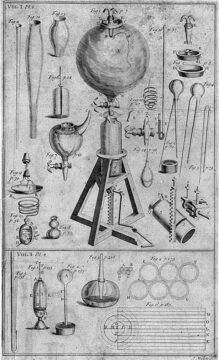
Apparatus for Boyle’s “New Experiments Physico-Mechanical touching the Spring of the Air” (1660); his first air pump. Image courtesy of the Wellcome Collection.
What Sahlins calls a recent surge of interest in animist cosmologies suggests an ambient dissatisfaction with the centuries-old dispensation of naturalism inherited from the 17th century and its scientific revolution. Not necessarily dissatisfaction with the tinkering by which certainty was attained within the Royal Society, and by which knowledge continues to be obtained – the experimental life – but with the metaphysics that grew up around it, and which exiled many of the things once considered persons into the infinite, silent and mindless reaches of matter (animals, objects, technology, rivers, plants, women, indigenes, slaves).
It is from the Amazonian basin that the most sustained assault on the 17th century legacy of the autonomy of Nature has recently been directed, foremost by the French anthropologist and student of Claude Lévi-Strauss, Philippe Descola. In a venerable tradition linking French thinking on Brazilian indigenous peoples, running from Michel de Montaigne’s late 16th century commentary on Tupinambá through Lévi-Strauss’ fieldwork in Mato Grosso, Descola’s work is concerned above all to contest the presumed universality of what he calls the naturalist ontology. He does so through close ethnographic exploration of the animist cosmology of Achuar, a tribe of the far western Amazon basin.
As he puts it in his magnum opus, Beyond Nature and Culture, and writing more generally of Amerindian animism:
…plants and animals possess … physicalities different from those of humans [but] most of them have so far preserved the faculties that they enjoyed before the split into different species. These faculties were subjectivity, reflective consciousness, intentionality, and ability to communicate in a universal language… They are thus persons, clothed in the body of an animal or plant, which they occasionally set aside in order to live a collective life analogous to that of humans. (Descola, Beyond Nature and Culture, 132)
The examples of various persons as they are conceived in Amerindian thought are enthralling in their own right, lending weight to Descola’s ultimate project of disproving any claim that Nature as separate from Culture is a universally held dichotomy. If anything, and here he is in harmony with Sahlins, the universe has been, for most people, for most of history, an assembly of humans and non-humans organized in a variety of ways other than according to a naturalist ontology. “For those weary of an overuniform world,” he concludes, this “realization is surely cause for a measure of rejoicing.” (Descola 143)
For those of us living on the far side of what Descola calls “the great divide” between Modern and non-Modern worlds, however, are these non-naturalist schemas of ontological distribution meaningful or of use? Like Sahlins, Descola notes a broad shift in the willingness to entertain such a possibility among Moderns and sees this as a crack in the foundation of naturalism, but he is quick to point out that the animism of Achuar and other comparable peoples is not transferable to contemporary, capitalist societies. Of the schemas he distills from the global ethnographic corpus and presents as the four possibilities available to us (animism, totemism, analogism, and naturalism), none offers an completely satisfying solution to the distribution of agents in the world within any given society; all come with unresolvable, residual contradictions; some have existed in combination with another.
Sahlins reminds us of the thickets of rules that surround all animist activity, of the constant negotiations and pourparlers with metapersons, not all of them benevolent, on whom most human undertakings are dependent (with the guardians of fish, of game, of garden plants, of canoes and houses and weapons). Sharing a society with metapersons is work, and we Moderns are lazy. As much as any Modern might yearn for the call of wild things and thrill to the encounter with animate projects and intentions other than their own, as much as we might acknowledge and foster principles of indigenous ecological knowledge in our treatment of wild lands, we are still constrained in very large part by the world that has been fashioned according to the ontology of naturalism, and which has, for better or worse, made of Nature a thing separate from us.
What, then, is to be done?
Descola is convinced that the idea of Nature must be dismantled, for the benefit of persons and metapersons and for the survival of life itself. Yet he does not offer any concrete proposals for doing so. Fortunately, a colleague of his, Bruno Latour, took up the baton in the decade before his passing in 2022, turning tools honed in nearly half a century of research toward the consideration of the ecological crisis, and global warming in particular.
Latour is well-known for his work in the sociology and philosophy of science, where his actor-network theory emerged in the 80’s and 90’s as a way around the competing determinisms in science studies. Rather than reducing the sources of scientific knowledge to the self-presentation of Nature, or surrendering them to the representations of Culture, Latour offered a sort of behaviorist approach to the study of scientific knowledge.
A key element of this method was to assume an agnostic posture with regard to the agents involved, and to observe without prejudice what was done in the messy, experimental side of knowledge production, not just by scientist-Persons. One outcome of this approach was that Latour found science to have a surprising degree of fecundity. Science in practice (rather than science as it formalized itself retrospectively) introduced agents into the world in the process of establishing facts. A classic example of this, which was the subject of one of Latour’s early monographs, was the case of Louis Pasteur, whose achievement lay in the construction of experimental methods capable of disclosing the action of a new, previously unrecognized class of agents in the world – microorganisms.
This is the signature method of actor-network theory. In its trail, like plants sprouting from seeds carried by the fur of migrating animals, new agents proliferate, living objects such as microorganisms and non-living objects such as the devices used to capture and record information, whether they be large hadron colliders or cavity ring-down spectroscopy analyzers. This is very clear in the case of climate and geosystems research, where new objects emerge from enormous amounts of data gathered by extensive systems of instruments (themselves actors in the story) and processed using ever-more sophisticated computational models (still more actors in the story). The output is a menagerie of new entities: the North Atlantic Thermocline; the Atlantic Meridional Overturning Circulation; Arctic Sea Ice Minima and Maxima, to name a few.
Most interesting with regards to Latour’s ecological turn are his Gifford Lectures of 2013 on the subject of Gaia and the New Climate Regime, in which he makes the case for yet another new object, Gaia. Not to be confused with the Earth itself, or with a consolidated, intentional agent managing a flurry of complicated systems and feedback loops, nor a giant macrocosmic organism, Latour weaves mythology, science, and philosophy to suggest that the form of emergent order that Gaia embodies serve as the replacement for the classical notion of Nature.
Latour’s arguments in this series of lectures are subtle and wide-ranging. For our purposes, it is enough to retain his plea for Gaia as a substitute for the 17th century mechanical model of Nature. Like its mythical namesake, Gaia is unpredictable, surprising, vengeful and bountiful, and cruel, the mother of the Greek Gods who is capable of betraying them all. It is this instability, this potential for metamorphosis, pregnant with agents of all kinds, which distinguishes it from what he calls, with reference to the period before the French Revolution, the Ancien régime.
It is Nature that is now capable of transformation and of acting historically, while humans and humanity appear frozen in place like the inertial matter of the mechanical philosophers, incapable of responding to any alarms. In this philosophy, laden with examples and arguments drawn from the history of science and technology, constantly referring to the texts of the Western philosophical tradition and to the events of the scientific revolution and its aftermath, Latour comes close to sounding like an animist.
The official philosophy of science considers the … dis-animation of the world as the essential and rational process, whereas the reverse is true. Animation is the essential phenomenon. The dis-animation of the world is superficial, auxiliary, polemical, and often apologetical. One of the great enigmas of Western history is not that there are still so many people naïve enough to believe in animism, but that so many people still naively believe in a “material world” that has supposedly been deanimated. And this, at the moment when the sciences are multiplying agents with which they are every day more and more deeply implicated – and us together with them. (Latour, Face a Gaia, 2e conference. Comment ne pas (des)animer la nature. My translation, p. 93)
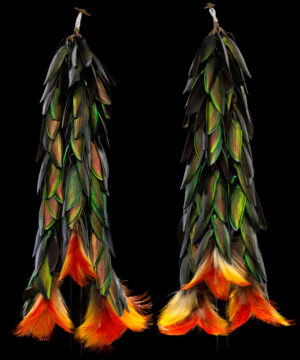
Shuar Ear Ornaments made from toucan feathers in Upper Amazonian Ecuador, ca. 1930.
Image courtesy The National Museum of the American Indian
Quite apart from global warming and climate science, examples of this “multiplication of agents” are to be found in the sciences that have begun to move beyond the framework of the Earth as an inert backdrop to the emergence of life, and to investigate the ways in which life has affected transformations of the Earth, up to and including the atmospheric and oceanic equilibrium states so crucial to life’s preservation. Where once the Earth’s crust was considered lifeless, microbes have been found miles below the surface, where they actively shape its composition. Where continental drift and plate subduction was thought to be a blind process driven exclusively by volcanic activity and circulation of magma within the Earth’s mantle, some now theorize that the granite of which continents are mostly composed may have followed from the introduction of water by microbes deep into the planet’s crust.
Where once soil was also thought to be inert, and the growth of plants a strictly chemical process, it is now understood that soil is a complex ecosystem of organic derivation and possibly the most diverse ecosystem we know of, and that plant growth depends on a range of microbial and fungal mediations. Those microbes play a key role in the cycling of atmospheric gases upon which life depends, behaving in such a way to keep stocks of atmospheric nitrogen, oxygen, and carbon dioxide in rough balance over time. Plankton in the ocean play a similar role, absorbing CO2 in a way that is thought to help regulate global climate.
It is unfortunate for us that Latour did not live long enough to address the fact that Gaia is but one of two consequential agents in the process of constituting themselves, both vying for the status of personhood. The other is artificial intelligence. The difference in their public reception well illustrates how deeply the ontological divide between Nature and Culture is entrenched among Moderns. Whereas many of the most powerful are racing to fashion something that can be thought of as a ‘person’ in the form of AI, an agent having the ability to reason and at least give the appearance of acting intentionally, and which they wish to insinuate as rapidly as possible into all aspects of life, an equivalent understanding of Gaia has drawn vociferous criticism from the scientific community since its introduction by James Lovelock in the 1970s.
The capacity to maintain certain equilibria through feedback loops, which gives the appearance of higher coordination and purpose, is felt to violate the cardinal principle of naturalist ontology, by which volition cannot be attributed to matter. While we seem to be making accommodations for the compulsory intrusion of AI agents into the community of persons, with healthy doses of skepticism regarding their self-representations, models of Gaia and climate science that suggest systemic forces capable of both equilibrium and metamorphosis directly affecting human life face strong resistance not only among vested interests but also among scientists themselves.
An animism that satisfied the yearnings many of us have for connection with the creatures of the natural world would need to be open to the abstract but powerful agents of Gaia, as well as those of the agents we ourselves create. An Achuar or an Inuit understands that, if they take more than is necessary in the hunt, if they disrespect the personhood of those on whom they depend with mockery or cruelty, then the guardian spirits will punish them by refusing to send them game in future. Thus works the society of metapersons to maintain the equilibrium upon which their collective existence depends. Is there an analogy with the systems of the Earth, on larger scales and longer chronologies? If a particular equilibrium is perturbed, if too much is taken or wasted or dishonored from a forest or river or species, will Gaia disrupt the balance of seasons, the rain for future crops, the snow for future irrigation, or the triggers that cause the flower to bloom just as the hummingbird arrives?
If, as Sahlins argues, the metapersons who occupy the undifferentiated space of the animist world are born of human finitude, hypostatizations of forces beyond human control, then the respect that animist tradition pays to them can be logically extrapolated to the systems and balances and cycles and circulations, all scientifically described, that give the impression of personhood to the Earth itself, upon which we likewise all inescapably depend.
Sahlins writes:
From the most intimate aspects of life – people’s own bodies, their implements, plants and animals on which they subsist – to the state of the world affecting everyone, raining on the just and unjust alike, they live and die by forces of which they are well aware, but which are not their own. Beside the intimate powers of daily life, potencies of universal, encompassing dimensions make the weal and woe of all people collectively – rain and shine, seasons, epidemic disease, the running of the salmon, migration of the caribous, the growth of sweet potatoes. (Sahlins, The New Science of the Enchanted Universe, p. 174)