
by Angela Starita
Years ago while teaching a college composition class in Jersey City, NJ, I met a student named Denise James. She was lanky and sullen and looked upon her fellow classmates with a combination of suspicion and boredom. Yet somehow, she had an affection for me. She’d stay after class to ask a question or, more usually, to give me advice. I had the impression she felt I needed some guidance about Jersey City which, though I’d lived there until I was 11, knew only superficially as an adult.
One time, for instance, I revealed that I’d never been to the Newport Mall, part of a 1980’s hi-rise and shopping complex. It had the usual mall offerings of the era, but in Jersey City stores like Benetton and Eddie Bauer were strictly aspirational for most residents and were meant to attract white, middle-class suburbanites to the stores and, hopefully, to move into its buildings. To hedge their bets, the mall’s owners included a Sears for everybody else. When Denise learned I’d not been there, she lowered her voice and counseled me to never tell anyone else. I found it funny–her attempt to save me from social ostracism–but in thinking it over, realized that for her, Newport was the one place of value in this whole city, the only place that could deliver a bit of newness and shine, a moment of possibility in a place where expectations were low.
This was in keeping with Denise’s most memorable pronouncement, her one-word assessment of her hometown: raggedy. It really is the ideal descriptor, more apt than any other adjective I can think of. It’s not a dangerous place, it’s not brutal. Even to call it ugly is an exaggeration: there are many places in Jersey City where the landscape can make you feel energized or cozy or even exhilarated. But in an honest appraisal, one that took in the whole of the place, you’d couldn’t help but see how right Denise was. Is? It’s hard to say what tense I should use. The place has changed enormously since I first worked there in the 90’s and from my memories of it from the first half of my childhood in the mid-1970’s. The city hospital, a collection of Art Deco behemoths, were abandoned then coverted to condos, dingy pocket parks and their surrounding brownstones have been restored; a light rail connects the city to other parts of Hudson County, and most notably, I mean, in-your-face notably, are acres of new construction in the form of giant towers.
But when I was a kid, the Newport Mall and its hi-rises were just a vast train yard with miles of tracks and overhead wires left by the Erie Railroad that would dump out its cross-country passengers at the Hudson waterfront where they’d be herded onto ferries to bring them to their presumed final destination, Manhattan. That last part of the journey was a sticking point for the Vanderbilts and Goulds of the world: why couldn’t their passengers travel from start to finish via rail? The obstacle, of course, was the Hudson River, not to mention palisades bedrock.
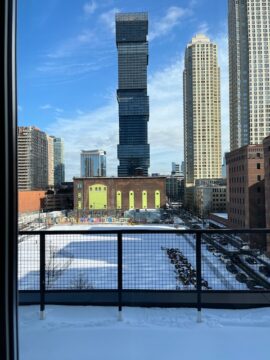
The problem was solved by engineers of the Hudson and Manhattan Railroad, and the first trains to run under the river were electrified by a powerhouse still standing on the Jersey City waterfront. It’s a stately if intimidating brick building with tall arched windows and careful brickwork, a utilitarian building and civic monument both. Today, the building is the biggest reminder of Jersey City’s role as railway handmaiden to NYC arrivals, and she’s not looking so good. Long, arched windows have been boarded up with wood or sheetrock painted yellow and electric blue. It’s surrounded by new glass apartment towers and looks every bit the sad sack kid getting the lunch-money shakedown. Even its long-time steward and co-owner, the Port Authority, doesn’t care and has made no secret of wanting to demolish the thing starting back in the late 1990s.
But a man named John Gomez has been fighting to keep the powerhouse standing and through extraordinary efforts, has done just that. Gomez, an English teacher at a local junior high school, founded a group called the Jersey City Landmarks Conservancy precisely to save the powerhouse in 1999. The group was essentially Gomez and a photographer, Leon Yost, who’d moved to Jersey City from Pennsylvania in the 1970’s. Now the JCLC has an official structure with a board, a president, a social media coordinator, and regular monthly meetings. It’s a mix of locals and transplants who’ve fought for 26 years to save churches, a rope factory, an early skyscraper, a movie palace, a tobacco factory, and early 19th century warehouses.
Though no longer the group’s president, Gomez has recently jumped back into the powerhouse fray for a lot of reasons. One is that the Port Authority is leaving, and he thinks it’s the last chance to get this building out of a wrecking ball’s way once and for all. And second, he’s gone through a full-throated depression that he seems to keep at bay only through his preservation work. His therapist had advised him to do something that gave him pleasure, and preservation was all he could think of. That makes sense because saving buildings—or at least bringing them to everyone’s attention— has provided him with a stage for his outsized passions. It gives him a real platform and measurable outcomes.
Until recently, Gomez had put most of his preservation energies into “Legends & Landmarks,” his column for the Jersey Journal, the city’s newspaper. He’s used the column to cover the destruction of a community garden, 1950s car dealerships, and many, many churches. (Gomez, who has an M.A. from Columbia’s historic preservation program, loves 19th century, neo-Gothic churches, and he finds their demolition particularly galling.) Before the Jersey Journal closed in February, 2025, he’d written about local politicians, architects, and civil rights leaders like Dr. George Cannon, one of the founders of Frederick Douglass Films, which according to Gomez, was the first Black-owned film production company. He covered the lace industry of West New York, a Hudson County town north of Jersey City; the history of an infamous prison; a crumbling 1920s office building where Frank Sinatra did some of his early radio broadcasts; and the planning of the city’s commercial hub, Journal Square.
Every subject gets the Gomez treatment, which is to say they are lavished with an equal and intense ardor conveyed through superlatives and short paragraphs, theatrical caesura to let you know this is all very serious and the stakes are high. And when you meet Gomez, you immediately realize that the overheated prose isn’t a put on at all. There’s nothing cool about him. He has no interest–maybe not even the ability–to downplay his passion about the beat he’s carved out for himself as Jersey City’s preservationist watchdog.
All the fervor, though, can make it hard to detect another essential aspect of Gomez as preservation advocate: he’s a terrific strategist, realistic about the odds he’s facing and canny in assessing his team as well as his adversaries. He keeps close eye on the region’s political scene not to mention local development deals. When he heard that the Port Authority would be leaving the Powerhouse site by 2027, he decided to jumpstart his original JCLC campaign and renew the fight to keep the powerhouse standing and rehabilitate the property for community use. The sole owner of the site will be the city itself, which, with a new mayor at the helm, could be the powerhouse’s best and last shot at restoration.
He began this latest powerhouse campaign in November by giving twice monthly tours of the neighborhood around the powerhouse, one every other Saturday between November and April. He wants to get new residents, the people living in the towers dwarfing the powerhouse, to imagine what the site could be. Chris Perez, the JCLC’s president, agrees with the strategy. “So many people have moved in who haven’t a clue what they’re looking at. To them it’s just an eyesore.”
A lot of the area’s neighbors feel the same way. They’ve paid more than a million dollars for condos on the Jersey waterfront. Galleries have moved in to the local warehouses, there’s a light rail stop, and a few blocks away is the PATH train to Newark and Manhattan. Most of these residents are new to Jersey City and moved there for the proximity to New York and what a realtor I know calls “new dev,” high-rise, amenity-filled towers, many of them erected in a matter of months with little to recommend them in the ways of beauty, character, or quality. But they do have gyms (a few treadmills), blank-walled community rooms, and gaudy lobbies. And just as Native American names flourished once the tribes themselves were decimated, some developers in Jersey City have thrown a few toponymic bones to the city’s history. There’s the Oakman, a better cut of new dev on First Street, named for the architect of the Powerhouse, John Oakman, who thanks to a family connection, landed the commission in the first years of the 20th century. It turned out to be the greatest accomplishment of a career otherwise dedicated to a few houses and a lot of alcohol. In the lobby of another new building, Haus 25, an artist named John Grande has painted a 12-foot tall canvas showing sunbathers lounging along a greenway in front of a fountain while children and dogs cross a wooden boardwalk towards a fountain and lake. Presiding over the whole scene is the Powerhouse looking like a distant Emerald City.
The Oakman and Haus 25 are on Gomez’s tour, as are the physical testaments to the area’s industrial past including a 1905 furniture warehouse converted to condos by Chicago architect Jarvis Hunt, a dazzling testament to the toughness and beauty coming out of Chicago in those years, The developer, Mill Creek Residential, which began converting the Hunt building into deluxe condos in 2016, earned the JCLC’s good will when it committed to expanding the size of all 1,200 of the Butler windows by hiring specialty masons to cut the 2-foot deep brick walls without destroying the rhythm of the building’s facade.
Gomez gives his views on corroding factories and abandoned churches with a confidence bordering on arrogance and no small amount of anger. These aren’t spur-of-the-moment opinions: he’s spent many hours researching the buildings he cares about, staring at them, photographing them, working out just why they need to be saved. When you get to know him, though, you realize that the talk, though genuine, is a kind of talisman against failure. He reminds me of a story I heard somewhere about Judy Garland, a tiny woman who before her concerts would repeat, “Fuck ‘em! Fuck ‘em! Fuck ‘em!” just before going on stage. One witness claimed that this ritual had the effect of making her exponentially bigger, appropriately expanded to be noticed on the Palladium stage.
It’s like that with Gomez: he puffs himself up for the fight conceding no doubts or even shades of gray. He’s been trying to save the powerhouse from demolition or neglect for 26 years, and has reason to think his strategies work. When he started the JCLC in 1999, the group was essentially Gomez and a photographer, Leon Yost, who’d moved to Jersey City from Pennsylvania in the 1970’s. Now the group has an official structure with a board, a president, a social media coordinator, and regular monthly meetings.
But when he’d started out, the city was the kind of place where you learned to expect little and got even less. To call residents there cynical wouldn’t be accurate; cynicism assumes more civic engagement and energy than locals were likely to muster. There’s no doubt that they came by their passivity honestly. In fact, passivity may have been the only honest reaction to a place steeped in a long history of corruption. To begin with it had been ruled for 30 years by Mayor Frank Hague who’d run the place on patronage, labor busting, and ethnic resentments. His was the template for the region for the next 50 years, not just in Jersey City, but in all the smaller nearby towns: West New York, Union City, and North Bergen. By the ‘80s, jail time for mayors and other officials became commonplace. My husband, who still teaches at the same college where I’d met Denise, used to say, “If we invite someone to be commencement speaker, you can bet they’ll be in jail within a couple of years.”
But even in those early years, Gomez was offering something different and rarely seen, a conviction that in fact Jersey City had an important history that needed to be documented. He was a kind of Hudson County evangelist and a powerful one. I saw it most dramatically when he gave a tour to a group of my students. He explained how the Loew’s theater in Journal Square was one of five Wonder Theaters in the New York area, so grand it had its own orchestra and dance troupe. He described the Belgian brick streets of the waterfront and the way the powerhouse had changed NY rail travel. My students were genuinely amazed: something valuable happened in their also-ran hometown? Denise wasn’t in that class, but if she had been, I doubt she would’ve cared for the powerhouse’s dilapidated brick and smokestacks. Still, with her eye for the novel, she’d have noted something appealing and out of the ordinary in Gomez’s conviction. She might’ve even been impressed.