
by Carol A Westbrook
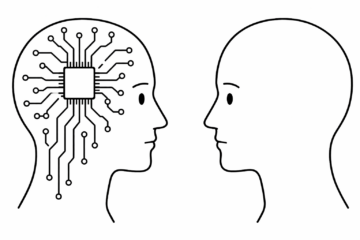 When did you first notice that you cell phone was finishing your sentences? Sure, spellcheck had been around for a while, however annoying it might be, but coming up with whole sentences that seemed to read your mind—“can I call you later?” “Can we meet tomorrow?” “Do you need groceries? These suggestions seem to come out of nowhere but can surprisingly express exactly what you want to say.
But so-called artificial intelligence struck like lightening in November 2022 when a start-up company called Open AI was founded with a billion dollars from an assortment of Silicon Valley techies who released a chatbot called Chat GPT. Within 5 days a million people had chatted with the bot, generating essays, poems, and answers to questions, if not always perfectly accurate. Two months later, Chat GPT had 100 million users.
Chat GPT is available to everyone online for free, like Wikipedia. However, for an extra monthly cost of about $20, you can obtain the Premium version, which gives you faster results, more access, and rapid application of new updates. AI is expensive to run, however. It requires large data centers, occupying acres of land, to process the data and analyze the problems it is given; large amounts of water are needed to cool these massive computers; and finally, large amounts of data, printed matter, poetry, computer programs, and so on must be constantly fed into the data banks in order to keep up with current events and new discoveries. Microsoft has been a major supporter of Open AI, providing critical cloud computing infrastructure via Microsoft Azure, enabling the training of large models, and investing millions in the company.
Since its inception in 2022, Artificial intelligence (AI) has rapidly increased in power, and many people think it is approaching human intelligence—at least in solving individual problems; for example analyzing Covid sequence and using this to develop a vaccine for Moderna. It’s generally accepted that if this trend continues, at some point AI will reach and then surpass human intelligence. This is easy to imagine. But what is harder to picture is what the world will be like when this point is reached–When artificial intelligence surpasses human intelligence. This point has been called the Singularity.
I have asked a number of my technically-minded friends what they predict will occur when the singularity is reached. Most of them do not have any opinion and usually say they don’t know what the singularity actually is. One friend said that he “knows a lot about artificial intelligence, he uses it at work all the time, using programs such as Chat GPT” but he can’t really imagine a time when AI is smarter than humans.
In a recent Substack blog, cognitive scientist and futurist Gary Marcus skeptically said that the singularity is “sufficiently imprecise, filled with emotional and historic baggage, and touches some of humanity’s deepest hopes and fears, that it is hard to have a rational discussion therein.
In fact, this has been my experience; most people cannot fathom this idea, and the conversation quickly turns to joking. People seem very uncomfortable trying to comprehend a world in which computers are smarter than they are.
But joking aside, this is something we –or our grandchildren–may have to face. So what can we expect when our human intellect is surpassed by artificial intelligence?
The term “Singularity” to describe this situation was first proposed by John von Neumann in 1958, who discussed “an essential singularity in the history of the race beyond which human affairs, as we know them, could not continue”.
Futurist Ray Kurzweil in his 2005 book The Singlarity is Near said the singularity will occur in 2045. (He predicted that AI will pass the Turing test by 2029.) [The Turing Test, proposed by Alan Turing in 1950, is a measure of a machine’s ability to exhibit intelligent behavior equivalent to, or indistinguishable from, that of a human. During the test, a human interrogator engages in a text-only conversation with both a human and a machine; if the interrogator cannot reliably distinguish between them, the machine passes. The Turing test does not require the machine to be correct or logical, but rather to be convincing, to fool the judge into believing that it is human. Recently, GPT version 4.5 passed the Turing test as human 73% of the time.]
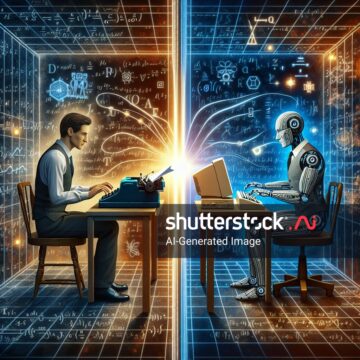
The next step in the development of thinking machines will be the achievement of artificial general intelligence (AGI). AGI is more than just the ability to solve a problem put to it; it is generalized, human-level intelligence that can handle, or exceed, any cognitive task a human can. It can analyze situations, adapt to novel situations, and apply ethical and moral judgement. In 1999, Kurzweil theorized that AGI would be achieved once humanity could achieve a technology capable of a trillion calculations per second, which he pegged to occur in 2029.
In Kurzweil’s point of view, the human brain will begin to rely on AI so much that it cannot function without a direct connection to the AI, that it will actually fuse with the robotic brain. Exactly how this might happen biologically is not explained, but consider how much you rely on Siri or Alexa, on using your smart phone to get info and guidance. Soon you won’t have to think at all!
Another common perception of how the Singularity might look, is that the machines that possess AI become so powerful that they take over the running of the earth, and humans become obsolete, and perhaps even extinct. I can see how this might happen as we slowly transfer chores to AI—it will run the water system, triage medical patients (and perhaps treat some of them), manage the power grid, collect trash every week, teach high school, plant and harvest crops, write our term papers, and so on. Soon, there will be nothing left for humans to do! Many folks think this is going to happen within the next few decades! Realistically, this would require that the AI computer had already achieved AGI, which is still a long way into the future.
There is one final scenario that has not yet been considered: when the Singularity is reached, when machine intelligence surpasses human intelligence. In this scenario, we will continue to rely on the AI as before, to answer questions, solve problems, and do the tedious, repetitive tasks that we humans dislike, and complete these tasks with lightning speed. Nothing will have changed, except that we humans will have the benefit of a very intelligent partner. We will be entering an age of enlightenment, the likes of which we have never seen. Or will we?
The important question here is whether it is possible that machine intelligence can surpass human intelligence. Consider that all of the knowledge that an AI computer contains has been fed into it from human sources—so will we be able to surpass human intelligence, as predicted by the futurists, or will we just be able to access it more rapidly? Many prominent technologists and academics dispute the plausibility that a machine can be more intelligent than a human brain. Whether or not the singularity will actually occur is heavily debated. And, like many future predictions, we will have to wait to 2029 to find out.
***
Enjoying the content on 3QD? Help keep us going by donating now.