
by Bill Murray
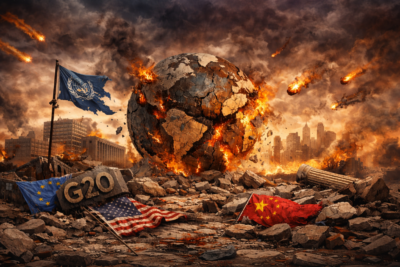 International order in the twentieth century was set by empires, then blocs engaged in ideological struggle, and finally by alliances based on common ideological and financial interests. Now even those alliances are dissolving. The Iran episode is the unmistakable break, and the United States is the agent of that break.
For most of the twentieth century, the world was organized not just among sovereign states, but also by hierarchy. First, powerful empires governed weaker colonies. Then two powerful Cold War superpowers rode herd over their less powerful allies.
Post-Cold War alliances also required a dominant member, and in the West it was the United States. Now, even the post-Cold War system is breaking down before our eyes. The eighty-year post-World War II order looks unlikely to survive abandonment by its architect.
The last day of February, 2026 could be remembered by history as the day the incredible shrinking of respect, regard, and trust for the United States crossed a terrible threshold, under the leadership of a president clearly in over his head.
Until that day, when ill winds had whistled through the rules-based international order, the timbers may have creaked, but the structure stood strong. On February 28th the Western alliance, on life-support since 2016 through well-meant efforts of various world figures, just may have died along with the ayatollah.
Let’s look at how Washington’s attack on Tehran hastens a much larger unraveling of the Western system that World War II built, and sends us all into uncharted territory.
After the seventeenth-century Peace of Westphalia loosened the grip of religious authorities in Rome, the idea of sovereign states took root across Europe. Where there were fewer than a dozen major European nations back then, today there are around fifty.
And yet for most of the twentieth century the world had been organized not just by sovereignty, but by hierarchy as well. Empires governed colonies. Then superpowers disciplined satellites, and subsequent alliances still required a dominant patron.
European colonial alliances broke down over the second half of the twentieth century. Belgium abruptly granted independence to the Congo in 1960. France exited Algeria in 1962, plunging that country into factional competition. British withdrawal from east of Suez in 1968 forced the Gulf monarchies, so in the news today, to scramble to improvise new security arrangements. Each of these occurrences and many more caused frantic searches new alignments at the end of the colonial era.
Like the end of the colonial era, the Cold War’s close sent weaker states on new searches for security. The final collapse of the Soviet Union on Christmas night 1991, freed fourteen new countries from their dominant Russian overlord, and half a dozen more countries in Eastern Europe from their Warsaw Pact ‘satellite’ status. More broadly, the Cold War’s end freed Russian and American proxies from Afghanistan to Angola, whose actions had been, up to then, constrained by their patrons’ desires.
All of these events removed existing frameworks – both security and economic – and each left former client states to their own devices.
In the first quarter of the twenty-first century, that process of fragmentation has accelerated. By 2025, the first year of Trump II, American relations with the world had begun to break down in real time. This time, the abdication of the leader of a willing hierarchical order—not one imposed on hapless countries with no choice—leaves not just individual countries, but entire alliances to fend for themselves.
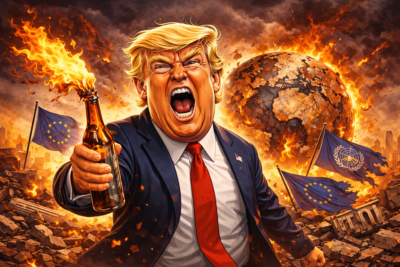 DONALD TRUMP AS ACCELERANT: There is a difference between hierarchical systems held together by the threat of force, as in the colonial and Cold War periods, and alliance systems held together by common values, like the now-collapsing Western system.
America’s alliances have taken various forms. Some, like NATO, have formal members, while others are tacit, based on common interests, values or goals. The US-Saudi relationship trades energy stability for security, for example, while the US’s sort-of alliance with Taiwan is based more on values and political goals.
However formal or informal the alliance, each has been backed by the power of the United States. What they all hold in common is that the dominant partner is now instigating the break.
In abandoning America’s alliance system, Donald Trump has done incalculable, incomprehensible harm. This American war on Iran fires the starting gun on the rest of the world’s wholesale abandonment of the United States as a trusted ally.
Analysts now openly discuss former allies’ distrust. Ukraine offers an example. One journalist observes that “the Trump administration is only willing to utilize Kyiv’s help when it suits (its) own interests — and states the world over have learned, loyalty is not a word that appears in Trump’s vocabulary.”
With three years left in the Trump administration, its governance by permanent crisis and jaw-jutting defiance has time to collapse American governance completely.
•••••
Academics, historians and statesmen search for order, and there is no shortage of leading figures just now trying to arrest the damage. A flurry of new books and papers analyzes the problem from a North Atlantic perspective, amid all-hands-on-deck disarray.
Economist Adam Tooze looks the most sanguine. He thinks global systems remain far more centralized than many appreciate. He argues that the modern world economy is organized around a few powerful hubs: the dollar, the Federal Reserve’s crisis-management capacity, global capital markets, and others.
He has written that in crises—the 2008 financial crash, the Covid pandemic, even the early sanctions wave after the invasion of Ukraine—those hubs reassert their dominance.
In Tooze’s view, interdependence in global financial markets stabilizes the system. He credits the global architecture for working, so far.
Edward Fishman, in his new and illuminating Chokepoints, describes the stress fractures now apparent within that architecture from a government insider’s perspective. Fishman argues that since the Cold War globalization has run through American-designed ‘chokepoints’ and that once Washington began weaponizing them, others have begun to build ways around them.
Finland’s President Alexander Stubb and Mark Leonard, president of the European Council on Foreign Relations, separately seek to impose theoretical structure on the fracturing system to better understand it. But such is the pace of change that both Stubb’s new book, The Triangle of Power, just published in the US, and Leonard’s Surviving Chaos (not published in the US until June) already look dated.
Stubb’s book, conceived between 2000 and 2003, when he was out of government, imagines the United States with the rest of the West as one angle of the triangle. Stubb has said that in retrospect, he might better have made his triangle a rectangle, in which the United States stakes out its own corner.
Even so, in an interview last month with the Telegraph, the Finnish president acknowledged that “There is a split in the Global West now,” and that Europe must “save what is salvageable.”
Leonard’s book describes “architects” and “artisans,” who operate tactically within interdependent systems. This may well be true, but it assumes a functioning interdependent system, which no doubt he perceived when he began writing the book.
Norwegian historian Odd Arne Westad’s worthy The Coming Storm argues that what lies ahead “will not be a repetition of the Cold War,” and finds uncomfortable parallels with the run-up to the Great War.
Elsewhere, Canadian Prime Minister Mark Carney’s well-received “rupture” speech at Davos, and his fast, determined reordering of Canadian trade, have little to do with academic analysis. His speech offered no playbook for his appeal to “middle powers” to band together.
Rather, beneath his oratory, his words and travel schedule (India, Australia, Japan, Norway, and the United Kingdom since Davos), reveal that his immediate objective is not to contemplate geostrategy, but to urgently mitigate Canada’s potentially desperate exposure to the United States.
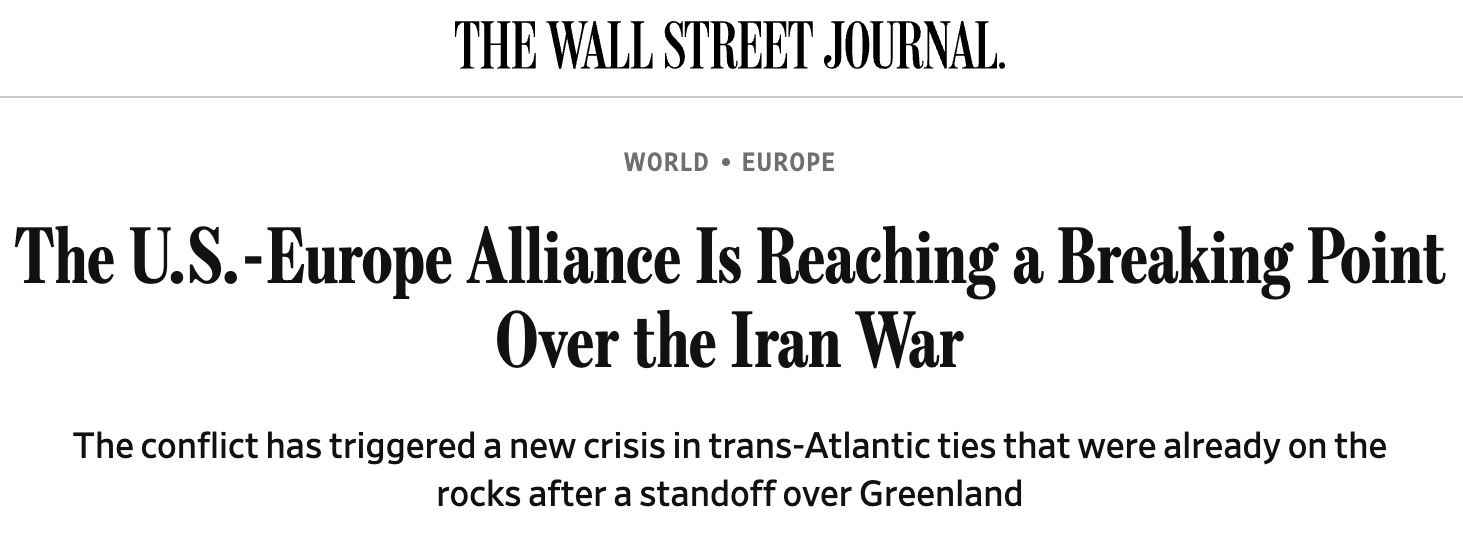
A quarter of the way through the twenty-first century, we are live witnesses to the collapse of the North Atlantic alliance. The reordering to come may dramatically reshape the lives of most of the world’s people.
Russia has been on its mission of imperial restoration for just about all of Vladimir Putin’s rule. On its longer civilizational time frame, China prepares to replace the United States as the world’s dominant force. Neither promises freedom, democracy or liberty. In the West, meanwhile, evidence of the destruction of the alliance is clear. Trust is gone and that is irreversible.
In both Trump terms, European leaders have gritted their teeth, lined up for Oval Office humiliation and gone along with arbitrary tariffs, inequitable trade deals, threats to their sovereignty and personal insults, in hopes of keeping the Western alliance together.
But over the weekend of March 14 and 15, the American president asked his erstwhile allies for help to open the Strait of Hormuz and all of them turned him down.
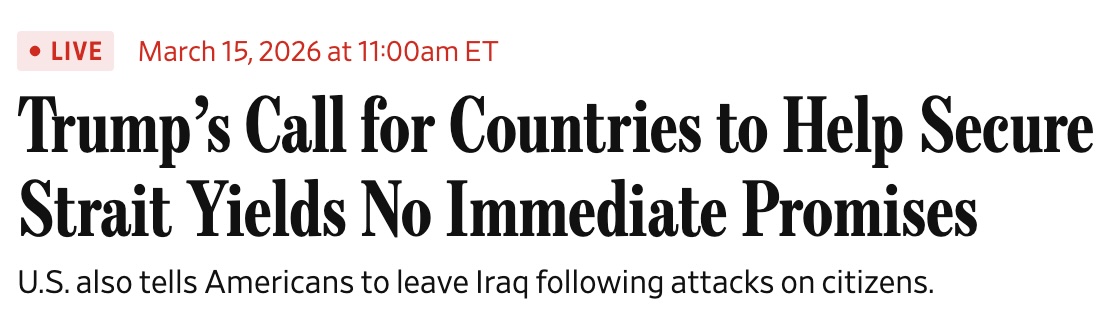
Stop and consider. After the 9/11 attacks in 2001 the cry rang out across the alliance that “we’re all Americans now.” A quarter century later, Australia, Germany, Japan and the United Kingdom all told Washington some variation of “it’s not our war.”
There is no escaping our moment.
The Financial Times editorialized that “However it ends, Operation Epic Fury will leave an indelible mark on the world’s economy.” And on America’s reputation. But it will do much more than that.
‘Systemic collapse’ used to be a term for catastrophists. That’s not true anymore. The Iran war has opened the floodgates. Momentum has grown for the non-American part of the former Western alliance to stop trying to maintain its relationship with the US and get on with abandoning it.
“Europe can no longer be a custodian for the old world order, for a world that has gone and will not return,” Ursula von der Leyen said last month.
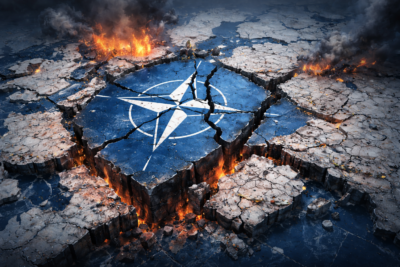 In this environment NATO chief Mark Rutte visits Washington this week to salvage what he can of the NATO alliance.
It is an epochal moment. “Of course, we want to be a good, loyal ally of the United States, but we cannot pretend that the U.S. President isn’t saying what he (Trump) is saying,” Polish Foreign Minister Radosław Sikorski wrote on X last Thursday.
In its November 2025 national security strategy, the Trump administration called on Europeans to repair their culture, to focus on home. Four months later it called for them to patrol the Persian Gulf. For a non-serious American leadership, contradictions like this are no longer even a surprise.
At Munich February a year ago, JD Vance worried about Europe’s “crisis not from outside but from within … the retreat from fundamental values, the silencing of dissent, and the loss of confidence in its own civilization.”
This February Marco Rubio put it this way: “We will take on the task of renewal and restoration … not to break with Europe, but to revitalize an old friendship and renew the greatest civilization in human history.”
Pessimists speak of decline, while patriots call for renewal. It’s an idea from Paul Kennedy’s The Rise and Fall of the Great Powers. But alliances don’t need renewal and restoration if they are thriving.
In the future, the death of a cleric in Iran in 2026 may rank historically with the death of an archduke in Serbia.
A European continent made up of fifty states and historically fractured politics is the largest part of what remains of the Western alliance. It is left to grapple with our historical moment whether it wants to or not. Because it has to.
•••••
I write more like this on Substack at Common Sense and Whiskey.
•••••
Enjoying the content on 3QD? Help keep us going by donating now.