
by Paul Braterman
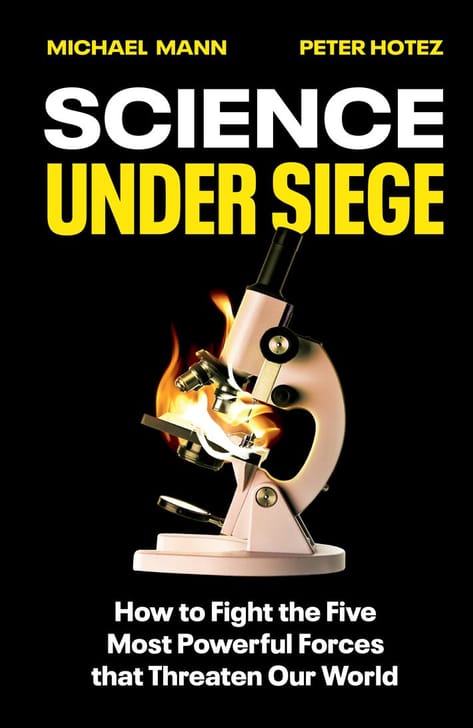
Study this book if you are at all interested in the threats to the scientific and rational underpinnings of our culture, in the US and to some extent elsewhere. It is not an easy read, because of the density of material that the authors assembled to make their case, and the wide-ranging phenomena that they survey, but this is unavoidable given the depth of our predicament. Science, and indeed any sense of reality, is increasingly under threat from governments and the oligarchs who control them. Such a level of disdain for truth, and irresponsible indifference to the consequences of this disdain, once seemed an absurd nightmare, but is now our everyday reality. Since the book was written, growing US government interference with science, and the collusion of a press increasingly controlled by a handful of oligarchs, must add to the force of the authors’ warnings. The book itself, incidentally, it is excellent value at $35/£20 for a 350-page hardback.
Some examples of what would have seen impossible a mere decade ago. Vaccine refusal based on ignorance and ideology is estimated to have caused at least 230,000 unnecessary Covid-related deaths in the US. (For comparison, the total US military death toll in all foreign wars since World War II, including Korea, Vietnam, Afghanistan, and both Gulf Wars, was slightly less than 90,000). The US Department of Energy secretly commissioned a report from the denialist fringe of climate science (two of whose members I have written about earlier), and then attempted to conceal their working documents. As I write, the future shape and funding of agencies such as NOAA, NSF, and NASA is in doubt. And two days after the blocking of the Straits of Hormuz, the US Interior Department announced that it was paying almost $1 billion to the French company, TotalEnergies, to not proceed with planned wind and solar generation. All this in the nation that has been (had been?) the world’s leader in science for more than 80 years.
As this book explains in great detail, such things do not happen by themselves. In 270 pages of main text, and 60 pages of notes, including 800 references, the authors give us their perspective on these phenomena. And a very well-informed perspective it is. Michael Mann and Peter Hotez are world leaders in their respective fields of climate science and virology. In addition, they have both published extensively1Michael E. Mann: Dire predictions: understanding global warming (2008, 2nd ed. , with Lee R. Kump, 2015); The Hockey Stick and the Climate Wars: Dispatches from the Front Lines (2012); The Madhouse Effect : How Climate Change Denial Is Threatening Our Planet, Destroying Our Politics, and Driving Us Crazy (2016, with Tom Toles); The New Climate War: The Fight to Take Back Our Planet. PublicAffairs (2021); . Our Fragile Moment: How Lessons from Earth’s Past Can Help Us Survive the Climate Crisis (2023). Peter Hotez: Forgotten People, Forgotten Diseases: The Neglected Tropical Diseases and Their Impact on Global Health and Development (2008); Blue Marble Health: an Innovative Plan to Fight Diseases of the Poor Amid Wealth (2016); Vaccines Did Not Cause Rachel’s Autism: My Journey As a Vaccine Scientist, Pediatrician, and Autism Dad (2018); Preventing the Next Pandemic: Vaccine Diplomacy In a Time of Anti-Science (2021); The Deadly Rise of Anti-science: A Scientist’s Warning (2023). about their findings for the general reader, and as detailed in this volume both have been viciously attacked by enemies of their science, to the point that at one stage Peter2I follow the authors in using first names here required police protection from physical threats after refusing to dignify Robert F Kennedy Jr’s fantasies by debating, while Michael had to face repeated investigations based on the bogus Climategate scandal.3This was based on an extensive hacking in 2009 of emails from the University of East Anglia’s Climate Research Unit, and the use of phrases taken out context to make unfounded claims of data manipulation, which have been refuted by seven separate major investigations involving between them the US Congress, the UK Parliament, and three separate US government agencies. Peter is also denounced as a shill for Big Pharma, although he is if anything in competition with the major players, since his work is devoted to finding small-scale cheap routes to mRNA vaccines.
To summarize the main findings; the driver for climate change denial is the fossil fuel industry, backed up by the power of petrostates and billionaires. The forces behind vaccine denial are less obvious, but spring from opposition to the pandemic lockdowns, which were bad for business. This then generalized to a broader attack, firstly on government regulation, such as vaccine requirements, and hence on the scientific underpinning of these policies. All of this fits in well with the American ideology of Individual Enterprise, mistrust of government, resentment of experts, and the search for scapegoats.
The attack on science is made possible by a number of factors. First among these is the accumulation of vast amounts of wealth, both corporate (as with the fossil fuel industries) and individual. This accumulation has been made possible by taxation and subsidy policies. The use of money to influence politics gives an extremely high return on investment, and the US Supreme Court has greatly facilitated such expenditure, by its 2010 ruling in Citizens United that corporations had the same First Amendment free speech rights as individuals. The authors also mention Reagan’s 1987 abolition of the Fairness Doctrine, which required broadcast media to give evenhanded treatment of controversial topics, and the fact that in any case this doctrine would not have applied to social media, which have overtaken the legacy media in the last two decades. To this I would add the adoption of primary elections. This was intended to further democracy by weakening the power of the political party establishments. However, the presumably unintended consequence was to make all elected officials dependent on their own funding sources, and vulnerable to the threat of being “primaried” by billionaires threatened by their policies.
In recent years, there has been a further development, namely the takeover by extremely wealthy individuals of the means of communication. The Murdochs’ News Corporation and its successors, which include Fox News, have long had enormous influence in the UK press and in US television. Jeff Bezos, one of the world’s richest individuals, bought the Washington Post in 2013 for $350 million, and in 2024 effectively destroyed the paper in order to further the candidacy and interests of Donald Trump, while Elon Musk, the world’s richest individual, bought Twitter (which he renamed X) in 2022, for a price of $44 billion, and allowed thoroughly discredited accounts to resume. We now know that the purchase was financed by a range of associates, including a Saudi Arabian Crown Prince, and Larry Ellison, whose other media interests are mentioned below, as well as Fidelity Investments, which has lost a lot of money as a result, and really should have known better. Another recent development is the use of bots to generate multiple messages that appear to come from different individuals. By 2020, an estimated 15% of accounts on Twitter were actually run by bots, and we can assume that this proportion will have greatly increased since then. Cryptocurrency obscures such funding, as does the use of “dark money.” This is money whose ultimate source is effectively concealed through networks, often involving partisan so-called educational charities whose donors can claim tax relief. Also, since at least 2016, Russia has been running troll farms to influence social media.
The book classifies those at work undermining science into five categories; plutocrats, petrostates, propagandists, professionals, and the press. Wealth is more unevenly distributed in the US than for many decades, with 728 billionaires holding between them as much wealth as the entire bottom half of the population. I would add that people who become billionaires are generally extremely successful at controlling events, and furthering their own interests. As the authors point out, plutocrats are sometimes major benefactors, with Pete’s own work vaccines having benefited from the legacy of John D Rockefeller. More to the point here is what happened during the Covid pandemic. During lockdowns, demand for gasoline falls, reducing the income of fuel companies such as Koch Industries, which therefore campaigned against lockdown and in favor of the foredoomed search for herd immunity (more on herd immunity below). A handful of Texas oil billionaires is behind the organization Texans for Vaccine Choice, which does not just defend conscientious objection to vaccine requirements, but promotes the conspiracy theorist myth that vaccines cause autism. Vaccine refusal was to lead to at least 40,000 unnecessary deaths in Texas.
The petrostates are, as the name implies, those whose economy is dependent on fossil fuels, and extractive industries in general, at the expense of other economic activity. (For the damage that fossil fuels can do in the absence of appropriate management, I would point to the importance of North Sea gas in speeding up the UK’s deindustrialization under Thatcher, in contrast to Norway where revenues were reinvested externally.) Such dependency favors economic inequality, because of the importance of ownership, while political control of a narrow resource base invites autocracy and corruption. Thus the governments of petrostates tend to develop authoritarian attitudes, hostile to scientific enquiry, while their interest in suppressing climate change science is obvious.
The outstanding example is Russia, whose interference in the 2016 US election may have been decisive. Russia used trolls and bots to spread disinformation on social media, and tactics included attacks on Hillary Clinton from ostensibly left-wing sources, in order to demotivate her potential supporters. Trump’s 2016 campaign manager had served earlier as a lobbyist for the pro-Russian former Ukrainian president Viktor Yanukovych, and when elected to his first term of office Trump chose Tillerson, CEO of ExxonMobil, as Secretary of State. He also dismantled sanctions imposed on Russian oil by Obama in the wake of the Russian 2014 seizure of Crimea and other Ukrainian territories. Russia had also probably been involved in the 2009 Climategate affair, mentioned earlier, with the obvious motive of casting doubt on the scientific case for limiting fossil fuel consumption. I have myself written here about Russian influence in the in the 2018 Italian general election, where promotion of antivaxx was one of the themes, and before that, as mentioned in the book, in the 2015 UK Brexit campaign. In addition to the obvious Russian interest in weakening Europe, the pro-Brexit UK Independence Party, now relabeled as Reform, opposes restraint of the use of fossil fuels.
Saudi Arabia, another major petrostate, was also involved in publicizing Climategate, through its then partial ownership of Fox News and the Wall Street Journal, while the leading Saudi negotiator at the 2009 COP28 climate conference claimed that there was no relationship between human activities and climate. Bizarrely, both COP28 and COP29 were hosted by petrostates, United Arab Emirates and Azerbaijan respectively.
The US itself now functions almost like a petrostate, with rollback of policies aiming to reduce CO2 emissions, removal of information about climate change from government websites, and legislators denying the significance of climate change, sometimes even citing the biblical flood as counterargument. Showing another characteristic feature of petrostates, the Republican Party is a center of opposition to Covid vaccines, with the 2021 Conservative Political Action Conference in Dallas actually applauding the news that President Trump’s vaccination goals had not been met. Applause, for the news that people were unnecessarily placing themselves at risk of dying, as many of them did. And by 2023, the Republican-dominated House subcommittee on Covid had sought to discredit Covid scientists, promoting the lab leak theory and even suggested that US scientists had been involved in producing the virus. Unsurprisingly, under the current Trump regime, funding for vaccine-related research, and much other health research, has been severely cut.
Terrifyingly, but too late for inclusion in this book, in June 2025 Kennedy dismissed all 17 members of the Center for Disease Control Advisory Committee on Immunization Practices (ACIP), replacing them with eight new advisers more to his liking, including vaccine opponents and conspiracy theorists {the functioning of this committee is now in litigation, because of judicial concern about its fitness for purpose).
It gets worse. In August 2025 the White House issued an executive order, subordinating all federal grants to political control, offering an absurd array of reasons including the long refuted allegation that the Wuhan research laboratory was the source of Covid, as well as the factually incorrect assertion that this laboratory had received US federal funding. And as I was writing this paragraph I learnt that the US Center for Disease Control has paused testing for rabies and monkeypox, because of staff reductions.
I should state here why, as the book shows, the lab leak theory is completely implausible. As with the closely related SARS-1 virus, responsible for severe acute respiratory syndrome, it is a zoonotic disease, a rapidly mutated virus that has self-assembled from components found in bats, and evolved further in animals, before being transmitted to humans. The original center of infection was Wuhan wet market, where a wide range of live animals are sold for food, and where the virus itself had already evolved into two separate strains before its effects were first detected. All of this is well documented in the scientific literature. I would add that Google Maps shows that the Wuhan wet market and the Wuhan Institute of Virology are ten miles apart and on opposite sides of the Yangtse.
Other cited examples of antiscience, which achieved a great prominence despite their utter implausibility, include the advocacy by both Trump and Musk of ivermectin and hydroxychloroquine as purported treatments for Covid, and herd immunity as a strategy for coping with the pandemic. Ivermectin is an effective treatment for parasitic diseases, while hydroxychloroquine is an antimalarial that can cause heart problems. As for herd immunity, without a vaccine this can only be achieved for any disease after widespread infection. Even at that, it cannot be attained against a fast mutating virus, which is why we have not developed herd immunity to influenza. And Covid mutates so fast that it’s possible to catch it more than once.
The professionals have been with us a long time. One long-standing example is Fred Singer (1924-2020), who left academia in 1990 to found his own “Science and Environmental Policy Project.” Singer has argued in turn against the scientific consensus that tobacco is bad for health, that chlorofluorocarbons were damaging the ozone hole, and most recently that carbon dioxide emissions present a problem. He was responsible for the self-styled Non-governmental International Panel on Climate Change, which is supported by the denialist Heartland Institute, and his technique was to argue in every case that the science is inconclusive.4From the BBC satire Yes Minister, “Say scientists disagree. They always disagree about something. Say more work is required. More work is always required.” Another familiar name is that of Bjorn Lomborg, a political scientist, who does not deny but minimizes the effect of CO2 on climate, and urges adaptation, rather than reduction in fossil fuel use, as strategy. (I have written about Lomborg’s work here before, as the inspiration for the theologian Wayne Grudem’s rejection of climate policy.) Then there are broad-spectrum denialist newsmen posing as experts. One example is Steve Milloy who denies that CO2 is having a detectable effect on climate, and who at the bidding of his client Syngenta smeared Tyrone Hayes for showing that the weedkiller atrazine induces abnormalities in frogs. Another is Marc Morano, who says that climate scientists “deserve to be publicly flogged,” and who had earlier helped launch the Swift Boat campaign against John Kerry’s 2004 Presidential candidacy.
There is also a long-standing group of professionals advocating alternatives to conventional medicine, of whom Robert F Kennedy Jr, now head of the US Department of Health and Human Services, is the most prominent. Kennedy had made a career out of litigation against childhood vaccines, and thus bears personal responsibility for the re-emergence of measles in the United States and elsewhere, and his agency is in charge of the National Institutes of Health and the Center for Disease Control. Vaccine denial is big business. 65% of online vaccine denial comes from 12 primary sources who have accumulated tens of millions of followers, and the resulting business is worth over $1 billion a year to the Tech companies. The vaccine denial industry relies on three themes; attacks on vaccine mandates; appeals to individual’s right to choose their own treatment regime, including reliance on herd immunity, “natural” medicine, and other unproven therapies; and demonizing Big Pharma. Kennedy has said that he can read the scientific literature for himself, and that the very fact that he is not a scientist enables him to judge it more impartially.
There are next generation professional denialists, such as America’s Frontline Doctors, AFLD, “Protecting Your Medical Freedom,” which has claimed that the US government was suppressing effective treatments for Covid, that hospitals were killing patients, and that the virus vaccine was causing cancer. This organization offers hydroxychloroquine and ivermectin prescriptions, on the basis of a $90 teleconsultation. The current Surgeon General of Florida, Joseph Ladapo, is affiliated with AFLD. He has described mRNA vaccines as “the anti-Christ of all products,” and claimed that they can alter an individual’s DNA and cause cancer. Other organizations are even more lucrative, with online appointments costing over $1000, although the American Board of Internal Medicine has revoked board certification of some of the doctors involved.
Next, Michael and Peter consider the publicists, who attract notoriety by the extravagance and emotional impact of their claims. Among these, Alex Jones, whose following does not seem to have been diminished by his claim that the Sandy Hook shootings were staged, frequently denies climate science and medical science, and has attacked both Michael and Peter by name. Jordan Peterson, who rose to prominence by misrepresenting Canadian law regarding trans persons, has since set himself up as a public intellectual, and has ties so the Heritage Foundation. His lack of relevant expertise does not stop him from dismissing climate science as a “pseudo-religion.” Joe Rogan, since around 2022, has been promoting both climate and Covid antiscience, and has disingenuously invited both Michael and Peter to debate science denialists on his show; they refused, since that merely gives the denialists unwarranted status. Then we have an entire layer of publicists even more unhinged from reality, who maintain that climate science is a fraud connected with the “deep state,” the World Economic Forum, the United Nations, and people they describe as “globalists.” (“Globalist” is one of the anti-Semitic wolf whistles mentioned in the book, though the anti-Semitism is sometimes explicit.)
The conspiracy theory thinking spills over to attacks on Covid-prevention measures. For example, Tucker Carlson in November 2020 claimed on Fox News that elitists were using Covid lockdowns to usher in the Great Reset.5A term expressing the short-lived hope that the interruption of business as usual by the pandemic could be used to good effect in economic planning.I see here a connection to Christian conservatism and end times theology, though the book does not consider that angle. Claims regarding radiofrequency transmissions, space lasers, and chemtrail, also often connected with Sandy Hook conspiracy theories, belong in the same category. So do even more bizarre allegations, such as the suggestion that hurricanes have been manipulated for political reasons to target Republican-leaning states. The Republican-leaning state most vulnerable to the effects of climate change is Florida, whose governor, Ron Desantis, wants references to climate change removed from Florida textbooks. Twitter had banned many science-denying contributors, but rebranded as “X” under Elon Musk it has reinstated them. Here Musk is functioning both as a plutocrat (remember that Twitter cost $44 billion), and as a publicist. He attempted to fund protests against vaccine mandates using cryptocurrency, and posted that “My pronouns are Prosecute/Fauci.”
Next, the contribution of the press, where the partisan attack on science is all too obvious. I have already mentioned the sacrifice of the Washington Post on the altar of Trump, and the Murdoch empire on both sides of the Atlantic. This empire includes the Wall Street Journal, which devoted several opinion pieces to the myth of Climategate. Here again the situation has got even worse since the book went to press, with the expansion of the Ellison Empire, and the October 2025 appointment of Bari Weiss as editor-in-chief of CBS News. There is also an underlying problem with the legacy media, going back decades. These media, and newspapers in particular, have experienced falling revenues, forcing them to cut back on specialized journalism, including science reporting. We can see the results in the way in which papers like the New York Times, and even the Guardian (which otherwise the book singles out for praise), promoted the lab leak theory.
In the final chapter of the book, and also in some earlier segments, the authors discuss what can be done about the situation. It would be good to deplatform propagandists spreading lies, but one of the largest platforms, X, is owned by one of the most malignant influencers. There are also real problems regarding free speech, so we should be very careful what we wish for. Imagine what would happen, if Trump had further powers to shut down what he chose to regard as disinformation. However, some degree of regulation is possible, as European experience shows.
The defense of science falls mainly to the scientists. This requires care, especially in forums controlled by their opponents. Attacking nonsense always has the unfortunate side effect of publicizing it, formal debate invites further obfuscation, and direct responding on social media can be counter-effective, by boosting an opponent’s ratings. Antiscience memes have gone through a process of Darwinian selection, and are sometimes very sticky. For example, “lab leak” is a very sticky meme and I would not have used those words if they were not already overfamiliar. Effective communication must address what the authors call “the ‘triple threat’ of invisible scientists, missing service journalism, and performative journalistic neutrality.” Scientists are particularly vulnerable to bad faith attacks, since research funding can be misdescribed as the search for personal gain. Public trust in science, while still fairly strong, has fallen recently and could be improved by contact with actual scientists and scientist-teachers. There are organizations, such as the US National Center for Science Education (on whose board Michael sits), concerned to improve science teaching. Here useful measures include the adoption of proper science standards and improving the teaching of high school science teachers themselves, with particular attention to climate science. (I would add that in the US, university-level science teaching for nonscientists can be nothing more than a watered-down version of specialist training, with no mention of implications or cultural context. I was halfway through my own teaching career before I realized that the most important part of my job was showing my students, both specialists and others there to fulfil requirements, why any of it mattered.) Scientists should engage with reporters, and here Mike mentions his center having hosted the Society of Environmental Journalists. This may help counteract the performative neutrality that led the New York Times to accept Covid antiscience on its opinion pages.
Messages may come best from those who share general positions with those who need to be persuaded, such as climate-conscious Republicans. As the book reminds us, the Republican Party has not always been the enemy of environmentalism. Nixon founded the Environmental Protection Agency, and Eisenhower supported the Montréal Protocol phasing out chlorofluorocarbons. I also think here of John McCain’s expressions of concern about climate. The Republican Party has not always been the party of Trump, and one of the few hopeful changes I have seen since this book was written are the signs that his hold on the party (to say nothing of the party’s future hold on Congress) may be weakening.
Bodies representing science have an obvious role to play. At its 2004 meeting, the National Academy of Science devoted a plenary session to the topic, with Peter, Mike, and Anthony Fauci among the speakers. (I would remind readers that Fauci, who received the Presidential Medal of Freedom from President George W Bush for his work on containing Ebola, and who played a major role in vaccine development and uptake throughout the first Trump presidency and the first half of the Biden presidency, was later so thoroughly smeared in connection with the lab leak theory that his name became a byword among Republican campaigners, to the point that Biden thought it prudent in the last hours of his presidency to grant him a protective pardon.)
I see an important role for informal action in the new public spaces. The book mentions a group called “#ClimateNinjas” on X that refutes climate antiscience, and there is also a growing army of good influencers on YouTube and social media, often people at the beginning of their own formal careers, producing educational material and exposing political disinformation.
In the US part of the problem is of course a highly partisan Supreme Court, responsible as already mentioned for Citizens United, and also, in 2004, for restricting government agencies’ ability to regulate polluters. This last decision is particularly disturbing, since it was based on the extremely broad argument that the agencies do not have special competence in dealing with legislative ambiguities although the issues that they were actually dealing with were factual. The only answer here is political. However, the Court did allow the Biden administration to regulate posts that posed a danger to the public, for example by promoting anti-Semitism or hostility to Muslims. There are signs of growing bipartisan pressure to regulate social media, and growing pushback on the media themselves, and the same applies with even more force to AI.
University academics are well placed to expose disinformation, but their administrations cannot be relied on to support them. A shameful case detailed in the book is Stanford’s decision to defund the Stanford Internet Observatory, which had been prominent in exposing Russian support of Trump’s 2016 election campaign. This decision was taken in June 2024, before Trump was even re-elected; obeying in advance, in advance.
The book concludes with a four-part battle plan. First comes penalizing the professionals, the propagandists, and the petrostates. The book convincingly warns us of the power of professional disinformation, funded as it has been in the past by the petrostates, and enhanced as it surely will be by AI, as well as by the sophisticated feedback and marketing algorithms already in use. Such cyberwarfare (the term is not too strong) requires international deterrence and control, though it is not clear what this could consist of. Then pressuring the plutocrats, by limiting the amounts and increasing the transparency of political donations, and restoring the fairness doctrine and applying it to the new media. (This should be part of the agenda of whatever replaces the current US regime.) Meantime of course, speaking up, and supporting others who do so, at times running serious personal risks; here the authors lead by example. To which I would add seeking allies, sometimes in unlikely places. It was a surprise to me, and I suspect it would be to many Baptists, to learn that one of the Trump regime’s severest critics is a regular contributor to Baptist News. Mending the media, by calling out their failings, and using the courts to punish libelous disinformation. And finally, being part of the change, by political engagement, and support for pro-science initiatives.
The one point where I part company from the authors is in their dismissive hostility towards what they called “doomers,” who expect decarbonation to be insufficient to protect us from severe future warming, and say that we should seriously be considering lifestyle alterations and even geo-engineering. Advocates for this approach do indeed include apologists for the fuel industry, who see it as a way of minimizing concerns about warming, but they also include people like James Hansen and, I would add, the late Paul Crutzen. Hansen is, as the book states, one of our most distinguished climatologists, while Crutzen’s Nobel Prize winning work on atmospheric chemistry established the need to phase out chlorofluorocarbons. My own view, for what it’s worth, is that we need unflinching discussion of the full consequences of breaching each temperature limit, and also of the practicality of radical solutions. Crutzen’s 2006 suggestion6Made before wind and solar achieved their present impact to dim the atmosphere using sulfuric acid haze seems to me potentially disastrous, since eventual rain-out of the haze will exacerbate ocean acidification, which to my mind is potentially just as harmful as increased temperature and ice cap melting. On the other hand, fertilizing the oceans with soluble salts of iron and manganese to encourage plankton growth seems to me worthy of the most serious consideration.
There is also one major omission from the book’s account, namely the role of the evangelical churches now so closely linked to US right-wing politics. This may be a strategic decision by the authors, and there is mention in the book of clearly religion-inspired language, such as references to Lucifer and the lake of fire and brimstone. US Conservative Christian churches generally deny the climate crisis, because of what God said to Noah, because we can trust God to look after the planet, and even because environmental action is irrelevant since God is going to destroy the planet and replace it in His own good time. These churches have also encouraged the new phenomenon of conscientious objection to vaccination, on the grounds that they may use cell tissue ultimately derived from abortions decades ago. From this, they argue that requiring health workers to be vaccinated is religious persecution. They also have defied orders to suspend church services, or to wear masks when attending them, while denying the serious risks that such behavior poses to their congregations. All this is of a piece with the libertarian ideology, suspicion of government, and conspiracy thinking, among these groups. Why this should be the case leads us back to our starting point.
Footnotes
- 1Michael E. Mann: Dire predictions: understanding global warming (2008, 2nd ed. , with Lee R. Kump, 2015); The Hockey Stick and the Climate Wars: Dispatches from the Front Lines (2012); The Madhouse Effect : How Climate Change Denial Is Threatening Our Planet, Destroying Our Politics, and Driving Us Crazy (2016, with Tom Toles); The New Climate War: The Fight to Take Back Our Planet. PublicAffairs (2021); . Our Fragile Moment: How Lessons from Earth’s Past Can Help Us Survive the Climate Crisis (2023). Peter Hotez: Forgotten People, Forgotten Diseases: The Neglected Tropical Diseases and Their Impact on Global Health and Development (2008); Blue Marble Health: an Innovative Plan to Fight Diseases of the Poor Amid Wealth (2016); Vaccines Did Not Cause Rachel’s Autism: My Journey As a Vaccine Scientist, Pediatrician, and Autism Dad (2018); Preventing the Next Pandemic: Vaccine Diplomacy In a Time of Anti-Science (2021); The Deadly Rise of Anti-science: A Scientist’s Warning (2023). ↩︎
- 2I follow the authors in using first names here ↩︎
- 3This was based on an extensive hacking in 2009 of emails from the University of East Anglia’s Climate Research Unit, and the use of phrases taken out context to make unfounded claims of data manipulation, which have been refuted by seven separate major investigations involving between them the US Congress, the UK Parliament, and three separate US government agencies. ↩︎
- 4From the BBC satire Yes Minister, “Say scientists disagree. They always disagree about something. Say more work is required. More work is always required.” ↩︎
- 5A term expressing the short-lived hope that the interruption of business as usual by the pandemic could be used to good effect in economic planning. ↩︎
- 6Made before wind and solar achieved their present impact ↩︎