
by Tammy Lai-Ming Ho

Maybe in the many nearby ghost towns,
ghosts do roam
and send old-fashioned good wishes
to abstract relatives in distant homes.
—from the poem “Maybe”, If I Do Not Reply (2024)
*
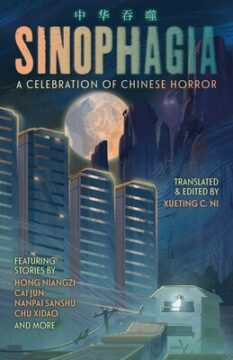 In Zhou Dedong’s short story “Have You Heard of ‘Ancient Glory’?” (Hereafter “Ancient Glory”),[1] a young couple scrapes together a down payment on a new apartment in the western outskirts of a Chinese city, the only place they can afford. The complex, Ancient Glory, looks impeccable: freshly rendered concrete, manicured paths, functioning lifts. It is also dead quiet. No lights in the windows. No footsteps echo in the corridors. The couple sense something strange hanging over the place. Then Qingming Festival arrives, and people start showing up. Qingming, falling in spring, is a day when families visit graves or memorial sites to clean them, burn paper offerings, and honour the dead—an act of filial piety, the deep reverence for one’s elders and forebears that sits at the heart of Chinese moral life. The apartments in Ancient Glory hold funeral urns. The buildings are occupied. Just not by the living.
Zhou Dedong, often called the godfather of suspense fiction in China, published this story in Sinophagia: A Celebration of Chinese Horror (2024), the first English-language anthology of contemporary Chinese horror fiction. He meant “Ancient Glory” as a ghost story. But in a strange way, it is also a documentary.
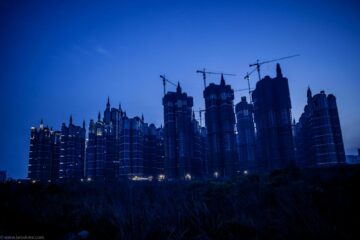
A cemetery plot in Beijing’s unhinged property market can now cost 60,000 RMB per square metre (about US$8,000), sometimes more, which is several times what one would pay for a home in nearby Hebei Province. A burial plot comes up for renewal every twenty years, while an apartment deed runs for seventy. The calculation is clear and brutal: a flat is simply better value for the dead. Families have begun purchasing apartments in struggling developments to house cremated remains, giving rise to what scholars have termed guhui fang, bone ash apartments.[2] The ghost city and the columbarium have become, in contemporary China, the same building.
The concept of the ghost city has over the past two decades accumulated a substantial literature of its own. In journalism and urban scholarship alike, the term tends to frame emptiness as failure: overbuilding, miscalculated demand, withdrawn capital, the violent contraction of industry. Wade Shepard’s Ghost Cities of China (2015)[3] meticulously catalogues the phenomenon; Tom Miller’s China’s Urban Billion (2012)[4] situates ghost urbanism within the largest migration in human history, a restructuring of space so vast that its failures produce, as a kind of inevitable by-product, entire empty districts. Estimates of unoccupied urban dwellings in China run from fifty to sixty-five million units. The numbers are so big they no longer have meaning. He Keng, a former deputy director of China’s National Bureau of Statistics, suggested in 2023 that current vacant housing stock could accommodate three billion people. The quantity defeats the imagination. Fiction, characteristically, does not deal in quantities. It deals in rooms.
What distinguishes the fiction from journalism is the former’s insistence on the specific. Ordos Kangbashi,[5] perhaps the most photographed ghost city on earth, a district in Inner Mongolia planned for hundreds of thousands of residents, which remained almost entirely empty for a decade before slowly gaining some population, presents itself to the camera as pure abstraction: symmetrical boulevards, identical towers, the surreal geometry of a city awaiting its own content. Journalism and photography have been drawn to this abstraction, to the strange formal beauty of streets without pedestrians and shops without customers. But fiction presses into the rooms. Zhou Dedong’s genius in “Ancient Glory” is to inhabit the space from the inside, to install the reader within those silent corridors as night falls, to make the emptiness sensory rather than statistical. The horror of the story is not that of scale but that of a neighbour you cannot see, of coins appearing in your mouth that you cannot account for: a detail Zhou draws from the ancient funerary practice of placing coins with the dead to ease their passage into the afterlife.
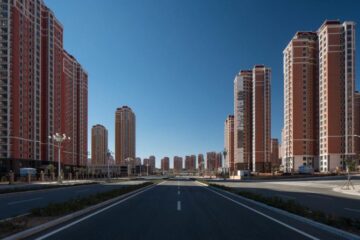
The discourse of ghost urbanism has been slow to theorise this uncanniness, and literature has been correspondingly quicker. Scholarly analysis must account for populations, percentages, policy decisions; fiction does not. Anthony Vidler, in The Architectural Uncanny (1992),[6] argued that the uncanny manifests in modern architecture through “the strange, the neglected, the disguised,” and that its power derives from resemblance to the familiar.
A ghost city looks like a city in every respect except the one that matters: it is not lived in. The buildings are architecturally complete, the parks have ornamental gates, the fountains are installed and ready. They await habitation, just as a stage set awaits its actors, and this incompleteness-that-looks-like-completeness recalls Freud’s concept of the uncanny: the familiar made strange, the homely turned unhomely, or unheimliche.
Chinese horror fiction finds its natural material in the ghost city. The genre’s classical precursor, the zhiguai (志怪) tradition of strange tales running from Pu Songling’s eighteenth-century Strange Tales from a Chinese Studio through to contemporary writers, has always located horror in the proximity of the dead to the living, in how easily the boundary between the yin (the world of the dead, spirits, and darkness) and yang (the world of the living) can blur. What Zhou Dedong recognises is that contemporary capitalism has reproduced this ancient permeability in market logic.
*
Alongside the ghost city stands a second spatial category: the building arrested mid-construction, funding withdrawn, its future frozen. The lanwei lou, the “rotten-tail building”, a tower stalled, its concrete skeleton holding its geometry against the skyline while legal disputes run for years or decades. In 2022, when homebuyers of stalled projects undertaken by the floundering developer Evergrande launched a wave of mortgage boycotts that spread within weeks to hundreds of cities across China, the lanwei lou was pushed onto the national stage. [7] The unfinished building embodies a peculiar form of betrayal. A stopped clock shows the time it broke. An unfinished building shows the moment it was abandoned.
*
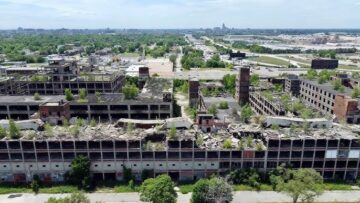
A third category of spectral urbanism is distinct from the two preceding ones. While the ghost city was never filled and the lanwei lou was never completed, this third space was once inhabited; its haunting comes from what was there and is now no longer. In the Anglophone imagination, Detroit, once the industrial heartland of American automobile manufacturing and, at its mid-twentieth-century peak, among the most populous and prosperous cities in the United States, has long supplied the paradigmatic image. It represents the slow withdrawal of capital and population from a once-productive urban centre, where factories shuttered, the tax base steadily diminished, and neighbourhoods hollowed out, block by block, over the course of several decades.[8]
Zach Cregger’s horror film Barbarian (2022) is set in Brightmoor, a Detroit neighbourhood whose trajectory the film features: a working-class district in the 1920s, populated by immigrants and southerners drawn to the auto industry’s boom, now an urban prairie of vacant lots and demolition slips. The film’s present-day storyline takes place amid houses with thick brush, tarps for roofs, boarded windows, and collapsing foundations, while a flashback sequence returns to the 1980s, the decade in which, as the film signals through a Reagan-era radio announcement and a neighbour’s pointed farewell, the neighbourhood began its long unravelling.
In China and Hong Kong, the same condition can be seen, though the mechanism tends to be different: instead of slow withdrawal, it is deliberate clearance, and the ghost is sometimes not a ruin but a replacement, a new development built over the place where the old life was.
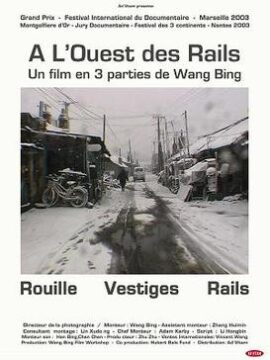
Wang Bing’s nine-hour documentary Tie Xi Qu: West of the Tracks (2002) follows the managed collapse of Shenyang’s Tiexi district, once China’s largest industrial zone, as its state-run factories closed and their worker communities were pushed out of housing blocks whose electricity and water had been deliberately cut off to force residents to leave. The film shows life seeping out of spaces that remain physically intact. Its final image, a teenage boy keeping vigil in an empty room lit by a single candle, prompted Adam Nayman to write that he seemed to be standing in for an entire generation fretting about the fate of its elders.
Jia Zhangke’s Still Life (2006), shows this same condition of deliberate erasure, shot on location in Fengjie county as the imminent rising waters of the Three Gorges Dam condemned the town to systematic demolition. Jia arrived in September 2005 to find a landscape he described as looking “more like after a nuclear war or alien attack”: buildings spraypainted with the single character 拆 (“demolish”), entire districts reduced to rubble in preparation for the next scheduled rise in the waterline. Labourers earn sixty to seventy yuan a day to dismantle a city that has two thousand years of history. The film follows two figures navigating this landscape of systematic erasure in parallel: a coal miner searching for the wife he has not seen in sixteen years, whose last known address is already underwater; and a nurse searching for her husband who has reinvented himself as a demolition contractor.
Still Life is different from social documentary in its insistence on the uncanny dimension of this cleared space. The film ends with the image of a tightrope walker crossing between two condemned buildings, suspended precariously between the no-longer and the not-yet. Three famous surreal interruptions occur: a UFO crossing the night sky; an unfinished “Migrants’ Commemorative Tower” that launches unexpectedly into the air like a rocket—a lanwei lou become monument, projectile; and a Sichuan opera song accompanying the final image. Mark Fisher, following Derrida, described hauntology as the condition of a present moment that has lost its own futurity: a culture haunted not by what existed, but by what was promised and never delivered. The Three Gorges displacement is that condition.
The displacement involved over 1.3 million people and the submerging of nearly a thousand towns and villages, and generated an entire cultural archive around this logic of arrested promise: from Yung Chang’s documentary Up the Yangtze (2007), which follows a peasant family as the rising waters engulf their home, to the painter Liu Xiaodong, who made one of his Three Gorges compositions on top of a half-demolished building, employing the demolition workers themselves as subjects.
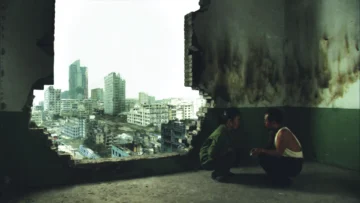
In Hong Kong, this condition takes on a particular intensity. The city’s successive waves of redevelopment have cleared walled villages, demolished tenements, and relocated communities that had cohered over generations; the built fabric has been so thoroughly remade across the past half-century that the cultural theorist Ackbar Abbas could argue, in Hong Kong: Culture and the Politics of Disappearance (1997), that the city’s defining condition is the déjà disparu, the already-disappeared, a sensation in which one inhabits a place that has already been lost before it is gone. In the poetry of Leung Ping-kwan, who published City at the End of Time (2012) as the handover approached, the city’s material surfaces, its market stalls, its neon signage, its cramped residential blocks, become the record of a culture being systematically erased by forces too large and too remote for any individual to resist.
Fruit Chan’s Hollywood Hong Kong (2001) catches a community already marked for disappearance, filmed in and around the Tai Hom squatter village in Kowloon as redevelopment pressures closed in on it. The film captures its narrow lanes, pig butchers, and dense, improvised social life. In one sequence, the village at night is bathed in an unnatural blue light, the towers of the new development rising behind it like something pasted into the wrong frame. The village already looks like a ghost, lit not from within but by the city about to take its place. Tai Hom no longer appears on any map. It lives now only on film.
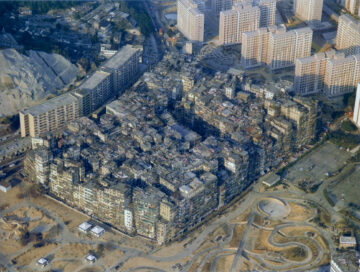
The most extreme instance of this deliberate clearance is not a ruin but a park. Where Kowloon Walled City once stood, its 2.6 hectares containing an estimated 33,000 to 50,000 residents in a warren of interconnected illegally-built high-rises that had grown without plan or oversight across four decades due to its de facto anomalous legal status as a Chinese exclave in British Hong Kong, there is now a manicured public garden with koi ponds and pavilions, with the yamen of the old Chinese imperial fort at its centre. The city was demolished between 1993 and 1994; the park opened the following year.
The Walled City does not simply disappear into its replacement, however. Greg Girard and Ian Lambot’s four years of interior photography produced City of Darkness (1993), a record of the Walled City’s multiple bakeries, dentists, noodle factories, and rooftop play areas; Ryūji Miyamoto’s earlier photographs of the interior, part of his Architectural Apocalypse body of work, which earned him the Kimura Ihei Memorial Photography Award in 1989; and the 2024 film Twilight of the Warriors: Walled In recreated the settlement on two full-scale sets and became the second-highest-grossing domestic Hong Kong film in history.[9]
The Walled City was photographed in detail before its demolition and rebuilt as a film set three decades later; it persists as an afterimage in the park that now occupies its site. The haunting is the discrepancy between what was here and what is here now.
*
This essay has traced three forms of spectral urbanism, each with its own loneliness. The first was built but never inhabited: the loneliness of a city waiting to be filled. The second was begun but never completed, its skeleton holding the shape of a retracted promise: the loneliness of a city whose promise was withdrawn before it could be kept. The third was full, and then deliberately emptied, a place lived in and loved in, cleared and left to haunt what would replace it: the loneliness of a city stripped of its life by deliberate force.
Zhou Dedong’s “Have You Heard of ‘Ancient Glory’?”, discussed at the start of this essay, presents a fourth condition, one without precedent outside mainland China and without a name in urban theory. It is occupied; the buildings are full.
The horror in Zhou’s story lies in the ordinary logic of the market pursued to its terminal conclusion. It requires no supernatural element because capitalism, pushed far enough, produces its own uncanny. The couple who move into Ancient Glory are not victims of haunting in any traditional sense; they are victims of a market that has made the occupation of the dead more economically rational than the occupation of the living. What returns to haunt them, the coins appearing in their mouths, the silent neighbours, the Qingming procession at dawn, is not the revenge of the supernatural but the return of a repressed social logic that insists a home is an asset before it is a dwelling, a commodity before it is a shelter. The horror is not that the dead are there but the calculation that put them there.
Zhou Dedong’s fourth condition traverses all three forms of spectral urbanism without belonging to any of them. It is the loneliness of a city that haunts from within: sealed windows, drawn curtains, the occasional smell of incense where there should be the aroma of a modest home-cooked meal: three dishes and one soup, the everyday Chinese dinner drifting from next door. In “Ancient Glory”, the woman refuses to switch on the light. “We’re the only window in the whole xiaoqu with the light on,” she says, “it’s too conspicuous.” The living have become the anomaly: in a compound of darkness, their single lit window would be the thing that haunts.
***
The idea for this piece originated during the author’s research stay at the Department of Asian and North African Studies, Ca’ Foscari University of Venice.
***
[1] Zhou Dedong, “Have You Heard of ‘Ancient Glory’?”, trans. Xueting Christine Ni, in Sinophagia: A Celebration of Chinese Horror, ed. and trans. Xueting Christine Ni (Oxford: Solaris/Rebellion Publishing, 2024).
[2] The phenomenon of guhui fang (骨灰房, “bone ash apartments”) has been documented in Nantong, Qingdao, Tianjin, and elsewhere. In early 2025, the Chinese government moved to enact legislation specifically prohibiting the use of residential properties for housing cremated remains.
[3] Wade Shepard, Ghost Cities of China: The Story of Cities without People in the World’s Most Populated Country (London: Zed Books, 2015).
[4] Tom Miller, China’s Urban Billion: The Story Behind the Biggest Migration in Human History (London: Zed Books, 2012).
[5] Ordos Kangbashi was inaugurated in 2004 as a planned district of Ordos City, Inner Mongolia, funded substantially by revenues from the surrounding coalfields. Designed for several hundred thousand residents and built across approximately 355 square kilometres, it attracted international attention beginning with Al Jazeera’s Melissa Chan in 2009 and intensifying when Time applied the “ghost city” label in 2010, calling it “eerie evidence of property oversupply”.
[6] Anthony Vidler, The Architectural Uncanny: Essays in the Modern Unhomely (Cambridge, MA: MIT Press, 1992).
[7] The lanwei lou (爛尾樓, “rotten-tail building”) crisis of 2022 began when buyers of a stalled Evergrande project in Jingdezhen, Jiangxi Province, threatened to withhold mortgage payments unless construction resumed. By late summer 2022, the boycott had spread to more than 300 stalled developments across over 100 cities. China Evergrande Group’s total debt reached $300 billion USD. The pre-sale model originated in 1950s Hong Kong. An estimated 20 million homes nationally remained unfinished.
[8] Thomas J. Sugrue, The Origins of the Urban Crisis: Race and Inequality in Postwar Detroit (Princeton University Press, 1996); Yves Marchand and Romain Meffre, The Ruins of Detroit (Göttingen: Steidl, 2010).
[9] Greg Girard and Ian Lambot, City of Darkness: Life in Kowloon Walled City (Watermark, 1993; rev. ed. 2014). For the cultural afterlife of Kowloon Walled City see Alistair Fraser and Eva Cheuk-Yin Li, “The Second Life of Kowloon Walled City,” International Journal of Urban and Regional Research 41, no. 3 (2017).