
by Eric Feigenbaum
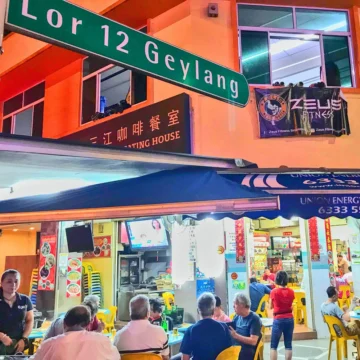
In a city-state that fines spitting in public, requires stores to check identification and log purchasers of chewing gum, heavily taxes alcohol and tobacco and bans durian from public transportation, one could easily think there’s little tolerance for vice.
In many ways, there’s not. Illegal gambling rings have been busted and faces severe punishments. Many a drug runner has been put to death.
But on the quiet, residential streets of the Geylang neighborhood, there’s a lot more going on than meets the eye. It would be easy to think that the relatively central neighborhood has lower property values because of its aging housing or that it wasn’t as well planned as subsequently developed parts of Singapore. In reality, prostitution explains it better.
Singapore’s moral overtones are undergirded by a certain pragmatism. Singapore’s founders decided that being a major international seaport meant prostitution could never be eradicated. And like so many vices, if they are allowed to exist in a black market, then crime and an underworld follow.
There are essentially two ways to prevent a black market: strict and intense deterrents or legalize the vice. America’s experiment with Prohibition led it to abhor the effects of a black market more than the harm mitigation strategy of keeping alcohol legal and holding people responsible for their behaviors under the influence.
Singapore decided from the get-go to go the harm mitigation route as founding Prime Minister Lee Kuan Yew explained in his memoir, From Third World to First:
We were candid about the problems we could not solve. Vices like prostitution, gambling, drug addiction and alcoholism could only be controlled, not eradicated. Singapore’s history as a seaport meant prostitution had to be managed and confined to certain areas of the city where the women were given regular health checks. Gambling was impossible to suppress. It was an addiction Chinese migrants had carried with them wherever they settled. But we had eliminated the triads or secret societies and broken up organized crime.
So quiet Geylang became the almost invisible epicenter of prostitution. There are no ladies of the night on the street, no neon signs, certainly no pimps. Just unmarked doorways with blackout film – similar to an Asian massage parlor. Not only is it not seedy, if you didn’t know, you probably would never notice.
Singaporeans know, of course. It’s not unusual to hear a Geylang joke. But really, they live in a city where there is no visible prostitution. This is in part because beyond licensing brothels, law and law enforcement focus on the activities that often accompany prostitution – solicitation and public nuisance. Moreover, as Lee mentions, regulating the sex industry means Singapore can ensure sex workers receive health screenings and care as needed – addressing both personal and public health.
Much as with prostitution, Singapore understands that if you want to keep your residential neighborhoods quiet, safe and clean, then sailors and other visitors need a place to play. Singapore’s leaders smartly figured out that civic planning and vice prevention can go hand-in-hand. Building a thriving, even glamorous nightlife scene in and around the City Center – up and down the Singapore River in areas like Clarke Quay and Boat Quay; in Marina Bay and extending East to Chinatown both adds to Singapore’s appeal as a business and travel destination, gives young Singaporeans a place to enjoy themselves and keeps residential neighborhoods quiet and safe.
In fact, it’s uncommon to have a local bar or pub in a typical Singaporean neighborhood. More often, you can find a group of neighbors casually enjoying drinks together sitting in common spaces in their HDB and condo buildings. But actual nightlife establishments, are mostly downtown.
Certainly, all of this breaks from other cities that permit prostitution. Bangkok, for example, has neighborhoods where corporate offices, residential apartments, redlight districts, high-end restaurants, local markets and bars all exist intermingled. Singaporeans seek more order and less seediness – and while they have other tools, their first line of defense is civic design.
As for that cultural proclivity for gambling, Singapore spent decades dedicated police resources to foil underground casinos and secret card games. Eventually, it took the left turn Lee Kuan Yew’s words suggested it might. In 2005, the Singaporean Parliament approved plans for two full-scale casinos, both as integrated resorts.
The debate leading up to it was significant. Many Singaporeans were reluctant to legalize gambling, for fear of normalizing it. They had no desire for Singapore to become like Las Vegas or even Macau. Those in favor argued that Singapore does things the Singaporean way and that gambling could be as controlled and manicured as everything else in the tiny nation.
Indeed it is.
The Marina Bay Sands – the three pillared resort hotel with a giant boat across the top – is now an icon of Singapore. Sitting along Marina Bay just at the edge of Singapore’s Central District, the casino resort came closer to Monaco’s model – adding a trendy, upscale element to Singapore. As hoped for, the Marina Bay Sands provides an effective mechanism for convincing international visitors to go home without their money.
Similarly, Resorts World Sentosa on Singapore’s man-made beachscape performs a similar function with a little more of a family beach vacation vibe. It also helps towards a goal Singapore has long struggled with – becoming a tourist destination. Being small, flat, relatively densely populated and having only been seriously settled since the mid-nineteenth century, Singapore doesn’t have the kind of natural or cultural wonders as neighboring Thailand, Malaysia, Indonesia or Vietnam. A luxury resort with gambling on a beautiful – if very designed and curated beach – is a significant anchor for visitors.
The first time I went to Singapore in 2004, my friend said to me on the taxi ride from the airport into town, “This place is Disneyland….” Meaning it was exceedingly clean and orderly to an almost artificial extent. Amazingly, Singapore proves you can have Disney vibes while quietly maintaining prostitution, drinking and gambling. It seems if engineered and placed smartly, Pirates of the Carribean can help the rest of the city resemble Main Street.
***
Enjoying the content on 3QD? Help keep us going by donating now.