
Annie Roth in Harvard Magazine:
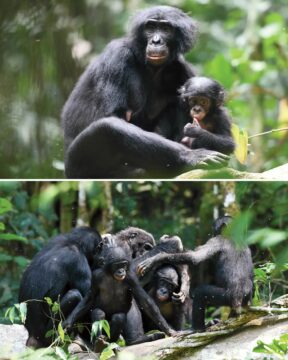 Scientists have long been interested in bonobos, a highly intelligent, socially sophisticated species that, along with chimpanzees, are our closest living relatives. Found only in the jungles of the DRC, they are the smallest living great apes, standing between three and four feet tall when upright and weighing upwards of 86 pounds. They form social groups ranging from eight to 25 adults and engage in complex forms of communication, including the use of symbols, gestures, and vocalizations.
Due to habitat loss and poaching, as well as their smaller population size, bonobos are an endangered species: only between 10,000 and 50,000 of them remain in the wild. Because most studies have focused on groups in captivity, Surbeck’s long-term fieldwork in the DRC stands out for its ability to follow their communities over time. “Bonobos, like us, are a long-lived species, and until recently we had access only to short snippets of individuals’ lives,” he says. “The emergence of long-term data is very exciting, as it allows us to see how individuals change over time…and to modify the picture we have.”
More here.
Enjoying the content on 3QD? Help keep us going by donating now.