
by Thomas R. Wells
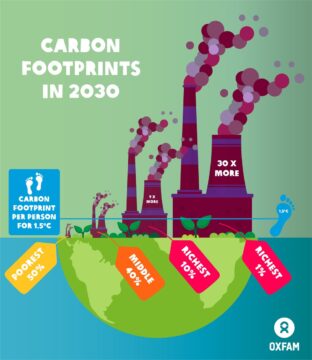 The world’s richest 1% have more purchasing power, and hence more command over what the economy produces than ordinary people. They can afford a more extravagant lifestyle – at the extreme including multiple yachts, mansions, and private jets. One may reasonably quibble with the way activists like Oxfam produce their numbers, but it is obviously true that the average 1 percenter has a far greater climate impact than the median person in a rich country, let alone the world. What a waste! What a crime against the planet! How can it be allowed to continue?
Oxfam, Guardian readers, an unfortunate number of my academic colleagues, and many others are confusing questions of fairness (whether huge economic inequality can be justified) with questions of harm (whether inequality speeds up climate change). Specifically, it can be true that
Per person, rich people do enormously more harm to the climate than ordinary people, and
Redistributing wealth from the rich to the poor would make the world fairer
Without it being true that
Redistributing rich people’s wealth would result in less harm to the climate
I. A Robin Hood tax on the rich would increase climate change
The reason is quite straightforward. Per dollar, rich people’s spending is far less carbon-intensive than that of ‘ordinary’ (middle-class) people, let alone the world’s poor. If the purchasing power of the rich were transferred to ordinary people, it would be spent on the things we want, which tend to be more carbon-intensive. The result would be an increase in total GHG emissions and an acceleration of global climate change.
Perhaps this needs more explanation.
Rich people — pretty much by definition — already have most of the material things they want. So most of their money is spent on more immaterial things, requiring far less energy and matter in their production and consumption, and far more labour. Because they are so much richer than ordinary people they can afford to directly employ people to serve their needs – cooks, nannies, gardeners and so on. Many of the material objects they do buy are produced in unnecessarily labour intensive — basically artisanal — ways, such as million dollar cars and Louis Vuitton handbags.
Some of this consumption may be because the rich like nice things, just like anyone else, and they can afford to have them. Some of it may be due to a spiritually empty desire to show off their status via conspicuous consumption. The important thing is that although the rich spend a lot of money the way they spend it is not particularly carbon intensive. At least, it is less carbon intensive than the way we middle class people spend our money, and much less than how the world’s poor do.
Ordinary people cannot afford luxuries, but we do buy cars (or would like to). A billionaire may spend a million dollars and end up with one fancy car. A million dollars of spending on cars by ordinary people will yield a lot more cars, and moreover, they are likely to be driven a lot more (environmental impact comes from how a product is consumed as well as how it is produced). One can extend this across the different domains of consumption. From fast fashion to meat to domestic pets to trans-Atlantic flights, the things ordinary people spend our money on are on average more material and energy intensive than the rich. If we had a bit more money to spend (thanks to the redistribution of the wealth of the 1%), the way we would spend it would continue that pattern. The result would be higher total GHG emissions and environmental impacts more generally. The living world would suffer more harm.
As you can imagine, this effect would be even more significant if the redistribution was from the richest 1% to the very poorest people in the world, who somehow survive on less that what 3$ per day could buy in America. (Although, note, ending extreme poverty is not particularly difficult or expensive: it does not require taxing away the rich.) These people are so far down Maslow’s hierarchy of needs that almost all of every additional dollar would be spent on energy and material intensive things like nicer food, a concrete floor, heating, proper clothing, smart phone, moped, and so on. Such a cash infusion would no doubt be great for their lives, but it would not be better for the planet. Not all nice things go together.
II. Ban the yachts
An alternative may occur to some readers, as it did to the authors of Oxfam’s report. Perhaps instead of redistributing the purchasing power of the rich, they should simply be discouraged from spending on climate-harming things, such as by banning or punitively taxing carbon-intensive luxury items like super-yachts and private jets. Would this help the planet?
Not really.
One has to remember that a market economy can produce all kinds of things from the various resources available, including directing resources to developing technological innovations that change what those resources are capable of. What an economy actually produces is determined by what people want to consume, but people want many different things and would generally like to have more of them if they can. Of course, not everyone can have everything they want: the world isn’t rich enough for that and never will be (even the ultra-rich can’t afford to satisfy all their desires – colonising Mars, for example).
In a market economy the conundrum of who gets what of the limited resources available is resolved through the price mechanism. Everyone who wants to buy something must compensate for the social cost that implies: they must provide those whose resources their desires require with more than their next best option would yield for the use of those resources. This naturally means that those with a great deal of purchasing power (the rich) will be able to outbid those with less in many cases, and this is how the rich end up directing an ‘unfair’ share of the world’s economic production possibilities to supporting the luxurious lifestyles that Oxfam complains are destroying the world.
In this context, suppose that the rich were banned or otherwise dissuaded from carbon-intensive luxury consumption (which, remember, is not representative of their overall consumption and seems only really relevant for the super-rich, not the global 1% as a whole). Suppose, even more generously, that ending such consumption is not merely of symbolic significance (satisfying an itch to punish the rich) but actually results in discernible structural changes to the world economy and thus to the quantity and distribution of GHG emissions.
If the rich are no longer using the carbon-intensive materials (steel, petrol, etc) associated with yachts and jets, what happens to them?
They do not disappear: the economy does not shrink. Instead those resources become available for other uses by those who would previously have been outbid for them. For example, commercial airlines will find that things like airplane grade aluminum and jet fuel are now slightly cheaper, so they can offer more of their carbon-intensive service at a lower price. As a result middle-class people will find flying slightly more affordable and so we will either fly more often than than before, or else spend the money we save on something else – likely also quite carbon-intensive. Thus, the main effect of forcing the rich to relinquish their yachts and jets would be a small subsidy, and hence encouragement, for middle-class people to expand their carbon-intensive activities.
It is true that there would presumably be a small reduction in the production of the specific carbon-intensive materials associated with yachts and jets over the longer term. Because the market price of those resources will fall (the middle-class subsidy), some of the highest cost, marginal producers will no longer be able cover their costs and will find something else more profitable to do. But this is a minor achievement, lined with caveats.
A ban on yachts and jets should be contrasted with what would be achieved by a real, universal carbon tax that raised the market price of all GHG-emitting activities above the social cost they inflict on the (future) world. In that case there would be no mixed signals – no subsidy encouraging increased emissions by the middle-classes. Instead there would be a clear and consistent price signal that would force an enormous reduction in the carbon-intensity of the whole economy and thereby the total GHG emissions that people who care about the living world are supposed to be concerned about. The political activism around the awfulness of the existence of the rich seems at best a distraction from achieving such actually important policies.
III. Nothing else works either
The basic mechanisms I have discussed yield similar conclusions for other policies targeting the rich in order to benefit the environment.
1. Suppose governments tax away the wealth of the rich and then use it to provide public services like education and public libraries. Such labour-intensive services emit relatively little carbon per $ of spending. Perhaps such government spending would indeed be of comparable or even lower carbon-intensity to what the rich would have done with the money. Throw in subsidies for public transport and green energy and one might even expect reductions in projected GHG emissions.
The problem, however, is that if this spending reduces the costs to ordinary people of obtaining things they actually want, then it frees them to buy more of the other things they want, which, as discussed, are likely to be of a higher carbon-intensity than if the rich were spending that money. On the other hand, if those services are not seen as providing valuable things to ordinary people then (at least in a democracy) they will demand that the money taken from the rich be spent on the public services they do care about, the ones that were already being funded by the regular tax system. But then the government doesn’t need to raise so much money in taxes on ordinary people, who will demand a rebate and hence a higher discretionary income – which they will of course spend on foreign holidays, second cars, beef products, a higher thermostat setting, and other climate no-nos.
2. Suppose governments take the wealth of the rich and just destroy it instead of redistributing it or using it to fund public services. Would this not solve the problem of removing the ability of the rich to harm the environment without reallocating that ability to where it will do as much or more harm?
This is a scaled up version of money burning. What is destroyed has no value in itself; it is just tokens representing potential claims on the production of the economy. The effect would be to slightly reduce the amount of money in circulation, while leaving the total amount of goods and services produced by the economy unchanged. Prices for everything would be slightly reduced across the economy, as there would be fewer money tokens chasing the same amount of goods. This automatically increases the purchasing power of everyone in the economy in proportion to their holdings of money tokens (so still not especially good for the poorest). With the same nominal income but lower prices, ordinary people will be able afford to buy more and so we would effectively be made richer.
But then of course we have the same problem as ever. Purchasing power has been reallocated from the rich to the less-rich. Producers will redirect their efforts away from producing what the rich wanted to buy and towards the more carbon-intensive things that more ordinary people want. Yes, the rich lose. But so does the planet. And wasn’t saving the planet supposed to be the point?
***
Thomas Wells teaches philosophy in the Netherlands and blogs at The Philosopher’s Beard
Enjoying the content on 3QD? Help keep us going by donating now.