
by Michael Liss
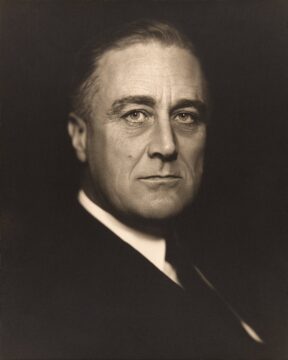
March 3, 1933. Herbert Hoover spent his final hours in the White House in anger and despair. Angry that he’d been decisively rejected by an electorate wrongheaded enough to not realize the wisdom of his policies—even when the evidence of their efficacy had been there for all to see. Despairing that his successor Franklin Delano Roosevelt was such a dilettante, an unworthy lightweight at a time when all serious men understood the necessity for prudence, for careful adherence to sound principles and practices.
He was also profoundly worried. “The Great Engineer” could see that the cracks in the foundation that he had so carefully begun to mend were giving way. Unemployment remained stubbornly high. Europe was deeply unstable and calling home from the U.S. its reserves of gold. Currency was increasingly scarce, and there was an acute loss of confidence in the domestic banking system—many banks could not meet the demand for cash. Without sufficient cash, the economy would completely seize up, and any scrip that might be issued in lieu of it would cause rampant inflation.
Hoover thought he knew the reason: His leadership was coming to an end. The clear policy statements he had made over the course of the previous year—indeed his efforts ever since the Crash itself—had painfully, but certainly, eased the economy back from the brink. Now, he believed all that good was being undone by the public’s anxiety that FDR would abandon his proven approach.
It’s not as if Hoover hadn’t warned the electorate: In his October 31, 1932 campaign speech in Madison Square Garden, he laid out the stakes: elect FDR and “[t]he grass will grow in streets of a hundred cities, a thousand towns; the weeds will overrun the fields of millions of farms if that protection be taken away. Their churches, their hospitals, and their schoolhouses will decay.”
It is also not as if Hoover hadn’t warned FDR—all through late 1932, he had tried to entangle FDR in Hooverian policies, to teach, to guide, to lead. Roosevelt might listen, might smile, but would never commit, and Hoover took to making sure they never met one-on-one without a second Hoover-person in the room. It wasn’t just that Hoover disliked FDR, it’s that his distrust of him applied to everything—and justified even withholding critical information about the troubling political changes occurring in Europe.
What was Hoover to do when it seemed each week brought a fresh crisis and the new pupil refused to learn? Hoover was a patriotic man, but he wouldn’t have been human if hadn’t thought, more than once, of just dumping the steaming mess into FDR’s lap.
He couldn’t do it—partly out of a sense of duty, partly because it galled him to see his work torn down. He had to capture FDR’s attention, make him listen. On February 18, 1933, he used the Secret Service to hand-deliver Roosevelt a letter: “The major difficulty is the state of the public mind, for there is a steadily degenerating confidence in the future which has reached the height of general alarm.” Hoover then went on to recite an extensive list of individual and institutional failures (by others), to laud his own approach as having restored confidence, and to suggest that FDR revive the nation by a promise to reaffirm Hoover’s accomplishments in critical areas.
It’s very hard to understand Hoover’s thinking. For millions of Americans, things were not better, and it had been that way for almost three years. He’d been repudiated at the polls—losing all but six states. Yet there he was, insistent that he was right all along, and that FDR had a duty to follow him and discard the foolishness of the campaign and, above all, the New Deal.
For pure clueless dissonance, the letter was a masterpiece. One wonders what must have gone through FDR’s mind when he read it, but how he treated it says volumes. He put it in a pocket and kept it there without response for 12 days.
He was not going to be persuaded. He had won the election, not Hoover. The public had chosen his approach, not Hoover’s. He was not going to be trapped into blessing an agenda he had rejected while campaigning, no matter how insistent Hoover was. Hoover was President, Hoover could take any course he desired, and when FDR took the Oath of Office, he would do the same. The Constitution had drawn the line in the sand—we get one President at a time.
February turned to March, the crisis intensified, the need to do something was more and more apparent. March 3, the last day of Hoover’s term. It was altogether possible that banks and the banking system were reaching a point of no return. Banks were shuttered and panic was spreading. One solution was to declare a “bank holiday” where they all would shut their doors to stop the runs and confirm their positions in cash and marketable securities.
For that, the banks needed the cover of government action, and in this state of transition from one President to the next, it was not forthcoming. Hoover wouldn’t sign a letter declaring a “holiday” without FDR publicly joining in it. FDR was even more adamant that he would act on his own when he had the power to do so.
Hoover tried again. He scheduled a midday tea and included the Treasury Secretary and Federal Reserve Board Chair for additional leverage. No deal. In the meantime, the Federal Reserve Board grew frustrated with the inaction and Hoover’s insistence that FDR must sign on regardless of the fact that he had no official status yet and thus no actual authority. The Board sent a letter to Hoover with a proposed proclamation. Hoover wouldn’t sign it.
At 11:30 p.m. on March 3rd, Hoover made his last call to Roosevelt, suggesting FDR make a proclamation of emergency powers under an old statute, the Trading with the Enemy Act. The Act, if it could be legally applied, would enable a President to restrict the outflow of currency and gold, and, from that, give him other powers such as to declare a bank holiday. FDR bluntly turned him aside; if the crisis was that great, Hoover, who still had the job, could do it. Otherwise, the final choice on policy would fall to Roosevelt, after he was sworn in.
This seems like a rather petty point given the potential stakes. One could, and maybe one should, be uncharitable about both Hoover and FDR—the public’s needs were trapped in a stare-down and the price was potentially immense. Yet, in a way, inaction was the correct course—for the nation and for both men—even if its correctness was driven by politics. FDR knew where he was going, knew some of it might be controversial, and knew he needed maximum flexibility to accomplish his goals. He could not risk even a part of his program to the appearance of an implied obligation to Hoover. Hoover was looking at posterity—his own political future and the judgment of history—and, in doing so, calibrated that taking unilateral action on an issue as great as shutting the banks might not only be politically fraught, but might also set a troubling precedent. Short of the exigent circumstances of something like mass violence, Presidents should not be in the business of binding (even temporarily) their successors to controversial policies.
March 4, 1933, an ebullient Franklin Delano Roosevelt joins a decidedly dour Herbert Hoover in an open car making its way to the Capitol. Events are moving, regardless of the two men’s differences. There is early-morning news that New York Governor Herbert Lehman has declared a bank holiday, as had newly elected Illinois Governor Henry Horner. The vast majority of banks in the country have now closed, either on their own motion, or by order of a state government. FDR has the tiniest bit of room to work with—as the banks are closed, now he can determine how they will be reopened.
On the arm of his eldest, Jimmie, he makes his way to where Chief Justice Charles Evan Hughes, himself a former Secretary of State and the Republican candidate for the Presidency in 1916, is waiting to swear him in. There is a bit of irony about this—Hughes will later be a conservative vote to strike down some New Deal legislation, but, in this moment, the distinguished Chief joins with the outgoing President to solemnify the glorious ritual of American politics—the peaceful transfer of power.
The nation has chosen. Hoover is now the past. He leaves as quickly as possible for Union Station, his friends, and the train to New York for what must have been among the worst moments of his life: according to a Pennsylvania Railroad employee, he mostly sat by himself, occasionally weeping.
On the podium is the 32nd President of the United States. In a pre-internet time, where the public was not force-fed 24-hour-a-day politics, here is his first opportunity to show himself as a President. 150,000 in the crowd listen at this fraught moment in their country’s life. Millions more at radios hear his voice. They are all ready to take the measure of the man.
Roosevelt is ready for them. There will be two introductions; here, on this day, at this appointed time and place, he will show his “outdoor” voice in his First Inaugural address. Eight days later, on March 12th, he will move it inside, to his first “Fireside Chat” with an estimated 60 million listeners. In these two, he will transform himself into a figure far greater than Hoover’s caricature of him. The amiable young man had grown into someone able to impress even my hard-headed grandmother—an adult, a leader, someone able to speak both authoritatively and intimately.
It’s worth looking at both to get a better idea of what politics looks like when practiced by a master, what communications sound like when the speaker treats his audience with respect.
Let’s touch briefly on the First Inaugural. It opens with some of the most memorable words ever spoken in a political context. With the nation waiting for him, Roosevelt delivers:
This is preeminently the time to speak the truth, the whole truth, frankly and boldly. Nor need we shrink from honestly facing conditions in our country today. This great Nation will endure as it has endured, will revive and will prosper. So, first of all, let me assert my firm belief that the only thing we have to fear is fear itself—nameless, unreasoning, unjustified terror which paralyzes needed efforts to convert retreat into advance.
This, of course, is what people remember. Scholars and partisans look for sharper edges (there are some), but what makes the First Inaugural special is the sense that these few words are the hinge of fate, a turning point after three years of despair. From these words flow an expectation of truth and a promise of victory if we can master our own fears. The listeners do not and cannot know the future, but with FDR’s encouragement, they steel themselves for reality and dare to hope.
The following day, March 5, FDR does something that surely brings anguish to the Hoover psyche: He shuts the banks, all of them. Andrew Ross Sorkin makes the excellent point that if it had been Hoover, the public might have seen it as desperation. Coming from FDR it looks like bold leadership. The public worries, but the public adapts, counting on FDR’s judgment. A week after that, on March 12, FDR holds his first Fireside Chat.
The date was carefully selected—Roosevelt had planned to open the strongest banks the following morning. He and his team wrestled with text, looking for the right balance of sobriety mixed with cautious optimism. This being the first new major policy initiative of the new government, it was not only important to get it right, but to bring the public in as participants and beneficiaries. Back and forth the text bounced between more technical and more accessible language. Finally, the drafts went to Roosevelt himself, who put it in his own idiosyncratic rhythm. At 9:50 p.m., FDR is wheeled into the Oval Room (it was still called that). There, among the equipment set up by the three radio networks and the folding chairs for advisors, friends and family, is Roosevelt, calm, ready. He leans in, puts out his cigarette, and begins to read.
My friends,
he says, as he is often to do in the years to follow.
I want to talk for a few minutes with the people of the United States about banking—with the comparatively few who understand the mechanics of banking but more particularly with the overwhelming majority who use banks for the making of deposits and the drawing of checks. I want to tell you what has been done in the last few days, why it was done, and what the next steps are going to be.
In a quiet, subtle way, this is a pitch-perfect start. He’s not going to dwell on esoterica—he understands it, he will explain it, but his words are directed at an audience of practical people—people like those joining him this evening. What, why, when, and in a language we all speak.
I owe this in particular because of the fortitude and good temper with which everybody has accepted the inconvenience and hardships of the banking holiday. I know that when you understand what we in Washington have been about I shall continue to have your cooperation as fully as I have had your sympathy and help during the past week.
How effortlessly he does this—make them partners, define the universe, exercise command without being coercive or censorious. What a change this is. Hoover wouldn’t have delivered FDR’s Inaugural because he fundamentally disagreed with all of it. But Hoover couldn’t have delivered anything like these few words and those to follow because he lacked the emotional vocabulary.
Roosevelt spends the next two paragraphs explaining a basic of banking that is not necessarily intuitive.
First of all let me state the simple fact that when you deposit money in a bank the bank does not put the money into a safe deposit vault. It invests your money in many different forms of credit—bonds, commercial paper, mortgages and many other kinds of loans. In other words, the bank puts your money to work to keep the wheels of industry and of agriculture turning around. A comparatively small part of the money you put into the bank is kept in currency—an amount which in normal times is wholly sufficient to cover the cash needs of the average citizen. In other words the total amount of all the currency in the country is only a small fraction of the total deposits in all of the banks.
This is beautifully done, clear, even inclusive. Your money is put to work so others can build. The bank retains just a small share of it … more than adequate for normal needs in normal times. The fact that some of it isn’t locked in a vault is not evidence of malfeasance.
What happened? Who took my money?
Because of undermined confidence on the part of the public, there was a general rush by a large portion of our population to turn bank deposits into currency or gold. A rush so great that the soundest banks could not get enough currency to meet the demand…. By the afternoon of March 3 scarcely a bank in the country was open to do business. Proclamations temporarily closing them in whole or in part had been issued by the Governors in almost all the states.
That’s the why and the how of Roosevelt’s proclamation. Not a power grab, a crisis. The public had no inkling of the Hoover/Roosevelt spat. In fact, FDR publicly thanks Congressional Republicans for their help in passing enabling legislation.
To follow, what the public can expect from the programs he’s put in place—the mechanics of how they will work, how they might affect them personally. Roosevelt is a realist, and realistic with his audience.
This bank holiday while resulting in many cases in great inconvenience is affording us the opportunity to supply the currency necessary to meet the situation. No sound bank is a dollar worse off than it was when it closed its doors last Monday. Neither is any bank which may turn out not to be in a position for immediate opening. The new law allows the twelve Federal Reserve banks to issue additional currency on good assets and thus the banks that reopen will be able to meet every legitimate call. The new currency is being sent out by the Bureau of Engraving and Printing in large volume to every part of the country. It is sound currency because it is backed by actual, good assets.
This is a wonderful mental visual—as if food and water were being delivered to a besieged city. Help is on the way in the form of cash-filled canvas bags. But when?
As a result we start tomorrow, Monday, with the opening of banks in the twelve Federal Reserve Bank cities—those banks which on first examination by the Treasury have already been found to be all right. This will be followed on Tuesday by the resumption of all their functions by banks already found to be sound in cities where there are recognized clearinghouses. That means about 250 cities of the United States.
On Wednesday and succeeding days banks in smaller places all through the country will resume business, subject, of course, to the Government’s physical ability to complete its survey. It is necessary that the reopening of banks be extended over a period in order to permit the banks to make applications for necessary loans, to obtain currency needed to meet their requirements and to enable the Government to make common sense checkups.
On he goes, identifying a potential problem, explaining how and when it will be fixed, moving to the next one. But he’s careful not to over-commit.
I do not promise you that every bank will be reopened or that individual losses will not be suffered, but there will be no losses that possibly could be avoided; and there would have been more and greater losses had we continued to drift.
It is a supreme test for FDR. After more than three years of empty and ineffectual reassurances, the challenge has to be met and overcome, not merely for Roosevelt’s political fortunes, but for the country. Just a few weeks of bank runs and bank closings had demonstrated that an industrialized, increasingly urban society cannot function without enough currency and adequate banking services.
It also demonstrated that FDR’s political instincts were right—the banking crises would be his to resolve regardless of what Hoover did or did not do in the last days of his Presidency—so he needed to be in control of it, both its substance and its imagery.
After all there is an element in the readjustment of our financial system more important than currency, more important than gold, and that is the confidence of the people. Confidence and courage are the essentials of success in carrying out our plan. You people must have faith; you must not be stampeded by rumors or guesses. Let us unite in banishing fear. We have provided the machinery to restore our financial system; it is up to you to support and make it work.
It is your problem no less than it is mine. Together we cannot fail.
The effect was remarkable. The following day, Monday, March 13th, hundreds, perhaps thousands of customers returned to their banks—to put their cash and gold in, not take it out. Roosevelt had turned them around, given them confidence. In a short time, $1.2 billion was returned to the system, the need for scrip ended, and the government was once again able to borrow.
In ten days from his final face-off with Hoover, Roosevelt had emerged as the leader the country needed. The first great crisis of Roosevelt’s time had been joined, been met, and been overcome.
Together we did not fail.
There are multiple sources for the text and recording of both the First Inaugural and First Fireside Chat. I’m going to suggest Yale Law School’s The Avalon Project and The University of Virginia’s Miller Center superb collection. The Fireside Chat should be heard to get a sense of how FDR spoke, the inflections he used, and his unmistakable accent.
Enjoying the content on 3QD? Help keep us going by donating now.