
by David Kordahl
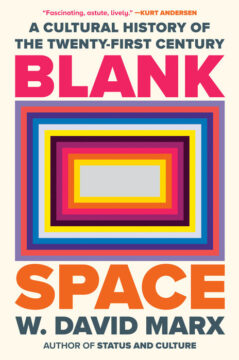 No one sells out anymore. The first pages of Blank Space: A Cultural History of the Twenty-First Century, W. David Marx’s overview of the past quarter-century of popular culture, give a striking example of this cultural shift. In 1992, the Seattle-based grunge band Pearl Jam elected to stop making music videos because they were worried about becoming too commercial. Marx writes, “Pearl Jam’s principled stand resonated with their fans: If rock bands were so desperate for money, they might as well be bankers.” This contrasts with the Lollapalooza festival in 2022, thirty years later, where David Solomon, the CEO of Goldman Sachs, performed as “DJ D-Sol,” playing electronic dance music for party-goers at the Tito’s Handmade Vodka stage after arriving in Chicago on his corporate jet.
How did this shift occur? One thing that makes Marx’s analysis bracing is that the figures he picks as being most significant in our broader cultural history are not the usual musicians or writers. Much more time is spent on Pharrell Williams and Kim Kardashian than, say, Arvo Pärt or Elena Ferrante. This is not a failure of taste, but a decision to focus on figures who managed to understand, before the rest of us, how fundamentally the Internet had altered the logic of cultural change.
Blank Space further develops the model that Marx described in his 2022 book Status and Culture: How Our Desire for Social Rank Creates Taste, Identity, Art, Fashion, and Constant Change. Cultural change in earlier eras, from high culture to low, ran something like this. Small groups of innovators would try new things in relative obscurity. Popularizers would notice them, and would streamline and repackage their ideas to be fed to a mass audience. The public might never experience the original source of such ideas, but the kitsch they consumed might still be directional, moving culture forward, even if at a lag.
Subcultural scarcity was important to such changes. Knowing about trends before others did gave one social capital, and that capital rewarded risk. It made sense for Pearl Jam to stop making music videos, since overexposure was a form of contamination. The gesture worked because the market was suspect, underground knowledge was elevated, and selling out was a real category with real stakes.
Enter the Internet. When information is universally and instantly accessible, it dissolves the status value that subcultural trends once conferred. The early adopter now gains none of the social cachet that would have once been theirs. This results in “poptimism,” the idea that popular ideas are valuable by dint of their popularity, and a stuck culture, rewarding recycled tropes rather than fresh ideas.
Marx argues that services like Spotify now trap young consumers in the vast labyrinths of the past, shielding them from the decisive cultural shifts that were once common. The outcomes have been surprising. The book starts with the “rock revival” of the early 2000s, wends its way through the dissolving influence of critical outlets like Pitchfork, and documents the rise of poptimism, which impugns any aesthetic judgments as implicitly reactionary—thus allowing real reactionaries to rebrand themselves as countercultural revolutionaries. Blank Space ends in May of 2025, after the reelection of Donald J. Trump, with Elon Musk having loosened speech restrictions on X.com, where the rapper Ye (né Kanye West) released “Heil Hitler,” which became momentarily ubiquitous.
The mechanism Marx describes seems plausible enough, but I find it hard to accept his prescriptions. In the final chapter, “Restoring Cultural Invention,” he suggests that we need to “celebrate invention” and “Learn the Canon So Well That It Becomes Boring” (this is a section header). Fine. But who cares?
Consider the worry that our vast digital archives encourage people to look backward rather than innovating into the future. Is this really a problem? The back-glancing enthusiast is not necessarily retreating, but may simply know too much to mistake novelty for originality. This is a different problem from the one that Marx diagnoses. The problem is not that status incentives have collapsed, but that the progressive narrative underlying these incentives—the story insisting that culture advances through successive ruptures—has become hard to take seriously.
We might call this attitude conservative postmodernism, the cultural logic that emerges when postmodern skepticism about progress narratives produces not radical experimentation, but a turn toward the past. The instinct to look backward for wisdom is traditionally conservative, but its current form is stranger than that—not the confident retrieval of an intellectual inheritance, but an archival sampling in the absence of believable futures. The goal is not restoration but recombination. The resulting sensibility is at once traditionalist and ironic. This might be mistaken for empty nihilism (as Blank Space itself suggests), but is better understood as the posture of last men whose myths have run out of steam.
Marx notices the rightward turn in cultural energy—the elevation of the entrepreneur over the artist as the main character of cultural change—without fully probing the internal contradictions that made the last paradigm vulnerable. These contradictions existed well before the Internet arrived.
Blank Space addresses one part of the story: the shift from the ideal artist as Dionysian hedonist to the ideal artist as sensitive activist. These ideals transparently contradict each other. One celebrates freedom and is hostile to bourgeois striving, while the other worries about the long chain of harms that may result from personal selfishness. Attempts have been made to marry them (“What’s more punk than recycling?!”), but young people who have soaked up both are bound to notice that these are conflicting, not complementary, goods.
These are problems that aesthetic innovation alone cannot solve. Entrepreneurial mythology, on the other hand, offers possibilities that neither hedonism nor activism can satisfy—among them the promise of looking out, at the end of life, over a world physically transformed by what you have built. That desire is ancient and civilizational, and it undergirds everything from cathedrals to scientific theories.
W. David Marx wants to reinvigorate the conferral of status for aesthetic innovation, thus restoring the mechanism by which subcultural risk-taking might once again reshape the mainstream. But our “stuck culture” may be less a product of flattened status than of a broader collapse of the story that made aesthetic risk historically meaningful in the first place. The rightward drift in culture is what happens when a civilization loses confidence in its own possibility, leaving people to search for ways forward that seem to put skin back in the game. Marx wants to restore prestige to innovation, but at the moment the figures with the most compelling stories about the future are the ones he least wants to celebrate.
Enjoying the content on 3QD? Help keep us going by donating now.