
by Eric Feigenbaum
On Christmas Eve 1965 – roughly five-and-a-half months after the nascent Singapore’s independence – “The Mexicans” arrived. Their job: to help build and train a Singaporean military. At the time, the British remained nominally committed to protecting Singapore as part of a planned military phase-out, but Singapore needed its own defensive capabilities.
Today it’s easy to look at Singapore and wonder what enemies it could possibly have. But in 1965, Singapore was surrounded by hostile powers – most specifically Indonesia and Malaysia, which for slightly different reasons were resentful, if not opposed to Singapore becoming its own country.
Malaysia was a scorned lover who at the last minute prior to independence from Britain tossed Singapore out of the Malaysian Federation largely for refusing to subscribe to the “Bumiputera First” movement – a set of legal principles that among Malaysia’s multi-ethnic population, gives additional rights and privileges to the indigenous Malays, or “Sons of The Soil”.
Indonesia’s founding leader and dictator, Sukarno – who styled himself with a mononym like Socrates, Charlemagne, Cher and Madonna – believed the Malaysian Federation (later Malaysia and Singapore) was a “neocolonialist” plot by the British to encircle and disempower Indonesia. He particularly resented formerly British Sabah and Sarawak on Borneo going to Malaysia.
As a result, roughly 1.9 million people, 75 percent of whom were Chinese ethnic living on a 500 square kilometer island, relying on water from their hostile northern neighbor, having insufficient agriculture to self-sufficiently feed themselves and being surrounded by enemies found themselves vulnerable.
From far away, Israel looked at Singapore and recognized a country in a very similar situation to itself. Understandably, Israel had spent its earlies years building relationships with the wealthy Western powers. However, as it matured, Israel’s diplomatic strategy began to incorporate seeking recognition and alliances from other parts of the world – and as it happened in 1965, Southeast Asia was an area of focus. As Israel saw it, who in Southeast Asia could be a better fit for a friend than Singapore?
Lee Kuan Yew, founding and longtime Prime Minister of Singapore tells it like this:
A few days after separation on 9 August, [Mordechai] Kidron flew in from Bangkok to offer assistance in military training, and [Goh] Keng Swee brought him to see me. Kidron had approached me several times in 1962–3 to ask for an Israeli consulate in Singapore. He had assured me the Tunku had agreed and that we need not wait until Malaysia was established. I replied that if the Tunku had agreed, there should be no trouble in setting it up after Malaysia was formed, but if I did so before that, I would create an issue that would excite the Malay Muslim grassroots and upset my plans for merger. He was disappointed. As I had expected, when Malaysia came about, the Tunku could not and did not allow an Israeli consulate.
In 1965, without Malaysian leadership thwarting him any further, Lee was free to accept the Israeli offer of help – but he did so only after India and Egypt rejected his entreaties. Once settled on proceeding with Israel, Lee offered a deal not unlike others Israel would face in the coming decades: Singapore could not recognize Israel immediately – it would have to wait until it felt its own Malay Muslim minority would not pushback. That turned out to be four years later in 1969.
Nonetheless, Israel trusted Lee’s intentions and proceeded.
I told Keng Swee to proceed with the Israelis, but to keep it from becoming public knowledge for as long as possible so as not to provoke grassroots antipathy from Malay Muslims in Malaysia and Singapore. A small group of Israelis led by Colonel Jak Ellazari arrived in November 1965, followed by a team of six in December. To disguise their presence, we called them “Mexicans”. They looked swarthy enough.
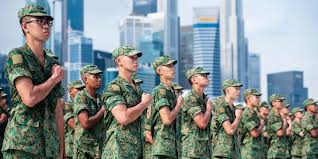
Israel transmitted many of the foundations of its successful military to Singapore including universal compulsory military service, a strong airforce, a system by which to quickly mobilize reserves and nimble fighting capabilities. Like Israel, Singapore needed to create a feast from crumbs.
Only there were a few unique challenges even the Israelis had not previously faced. First, for more than a century, the British had recruited mostly Malays for the police forces and military garrisons of Singapore. The Indian minority and Chinese majority had little interest or proclivity for soldiering. To further complicate matters, despite the separation of Singapore from both Malaysia and Britain, Malaysia remained in control of the two military regiments remaining on Singapore. While they would theoretically would respond to Singaporean instruction, Singapore’s leaders could not trust them. This could not endure.
Ours was no easy task. We had to reorientate people’s minds to accept the need for a people’s army and overcome their traditional dislike for soldiering. Every Chinese parent knew the saying hao han bu dang bing, hao tie bu da ding (a good lad does not become a soldier, good steel does not become nails). We set up national cadet corps and national police cadet corps in all secondary schools so that parents would identify the army and police with their sons and daughters. We wanted the people to regard our soldiers as their protectors – a reversal from the days when army and police uniforms aroused fear and resentment as symbols of colonial coercion.
So, what began with a small battalion of heavily-recruited volunteers and two tanks left behind by the British, within a decade became 12 battalions, advanced equipment and the ability to quickly mobilize roughly 250,000 soldiers.
Israeli commanders helped Singapore identify tactics and defenses that would allow them to defend their small island against a simultaneous attack from two sides (Thailand, Cambodia, Vietnam and Laos were never considered threats). Over time, Singapore developed eight times the firepower and combat strength of its two hostile neighbors.
So enthusiastic did Lee Kuan Yew become with the direction of the Singapore Defence Forces (later Singapore Armed Forces) that he sought to add women to the compulsory service model, just as in Israel – though that never took.
In part, this came from a newfound belief that universal service helped to bind Singaporeans from a collection of multi-ethnic immigrants who arrived to a loosely regulated British open-port, into citizens of a republic who saw themselves as all belonging – which in Singapore’s early years was another major concern.
Lee Hsien Loong – the son of Lee Kuan Yew – served as Prime minister from 2004 to 2024. Having been the first Prime Minister to have been raised under National Service requirements, his assessment was that as expected, military service created the social and identity bonds his father and other early leaders like Defense Minister Goh Keng Swee had hoped:
Over the years, Singaporeans have accepted National Service. It has become a national institution, a rite of passage. Singaporean males, regardless of race, religion or social background, serve two years of National Service and these two years are a defining experience. NS is where boys grow up to become men. Forging bonds that last for life, through blood, sweat and tears. That is why, years after ORD, many of us still make time to meet up with our NS buddies, and feel joyful when we bump into old comrades.
Even now, it happens to me every so often, when I am attending an event, or just taking a walk somewhere. Someone will come up to greet me, and remind me that we did BMT or OCS together, or served in the same unit. He would name the unit, a camp, or an officer we had served with, and the years would melt away, and vivid memories would come flooding back. Tonight, I am happy that we will be meeting some of my old artillery comrades. As we say, “Once a gunner, always a gunner!”
Fortunately for Singapore, creating a strong military early paid off. Indonesia formally recognized Malaysia and Singapore in 1966 and in 1967, Suharto succeeded Sukarno, only he did not share the “neocolonialist” delusion. And while Singapore’s relationship with Malaysia has had many tenuous moments, their trade relations are strong, both are ASEAN members and military conflict is not a part of their discourse.
The strong posture paid off. As Lee Kuan Yew predicted in 1968:
Whether we are shirkers or quitters, or stayers and fighters, will determine whether we live in peace or not. If people believe that we are stayers and fighters, we are more likely to live peacefully. Next year, I hope to see my own son in uniform present on such an occasion. Nobody who is fit and able-bodied can shirk what is a responsibility and an honor, to see that Singapore thrives and prosper, and is left undisturbed and at peace.
Enjoying the content on 3QD? Help keep us going by donating now.