
by Mark R. DeLong
In January five years ago, amidst the turmoil and isolation of a world pandemic, I decided it was time to do a month-long art project. I was newly “retired” (a word that I then disdained and avoided using), and I was intrigued by a project that poet Bernadette Mayer took on when she was in her twenties and living in New York. In July 1971, she took up her 35 mm camera and exposed a 36-shot roll of film every day, processing the film at night, and through it all wrote daily in her free poetic prose. She called her project Memory and it became a gallery exhibition at 98 Greene Street in February 1972—all 1,116 photos with more than six hours of audio narration. In May 2020, nearly fifty years after young Bernadette took her photographs and wrote her words, Memory was issued in book form by Siglio Press.
I wondered whether Memory could serve as a model or at least an inspiration for a project in January 2021. I had my doubts for many reasons, and I knew that having the energy of a twenty-year-old was useful for Mayer back in 1971. My reservations notwithstanding, I decided to apply the “Memory Model” for project I named “Second Act—Re:Tooling.” Maybe I could “use the disciplined, thirty-six exposure method to lay open some matters that might otherwise be obscured from ‘normal’ sight of the everyday,” I wrote a couple days before launch. “I wanted the photography and the writing to, well, focus and direct attentions to new and lurking realities of my new situation.”
It was a good month-long project but not a work of art by any measure, and I rarely achieved thirty-six digital photos in a day—a fact that surprised me a little, given how little effort my digital cameras required. From the first, I treated the month of writing and photo-taking as a data gathering effort—useful in the future perhaps—but not nearly “fully cooked” when the project ended on January 31, 2021.
In 2025, I decided that the old 2021 project was worth revisiting in an altered form—a new project, perhaps faintly echoing the one five years before and occupying the cold month of January. I included “hatching a new plan” on my list of resolutions for 2025. I’d launch the new project in January 2026.
“Focus and direct attentions”
I was a bit surprised when the plan I hatched for January 2026 again sought to “focus and direct attentions,” with the newly hatched project turning outward from my 2021 navel gazing (what else was there to do during the pandemic?) and toward exercising the skill of focus and proper attending in and with the world. Or at least the world of art.
The 2026 plan was considerably simpler, mostly because the 2021 plan was far too ambitious. I wanted to use one image each weekday to focus short writing pieces—poetry or at least loosely wrought drafts, I hoped. I’d already gathered dozens of images: photographs, paintings, sketches, finished and unfinished artworks, photographs of sculptures. I even included a couple of photographs from those I took in January 2021.
“Photography is a tool for dealing with things everybody knows about but isn’t attending to,” photographer Emmet Gowin said. “My photographs are intended to represent something you don’t see.” Gowin’s words helped to guide me through the photographs I took in 2021—pictures that for the most part were taken on a piece of land no bigger than the two acres around my house. In 2026, my plan was to “attend” again but this time with images other than my own. The project was, quite simply, writing about images, one image per day, five days a week. Sounds like a Real Job, doesn’t it.
As with my earlier January project, I had no definitions of success and failure was simply not showing up.1Though as January weather ran through the midsection of the US, I had to bend the rules a bit. Living in the country meant that my wife and I had more preparations to come through a winter storm with some safety and comfort: log-splitting to bolster the woods supply for heat, testing and setting up the generator, preparing the animals (chickens, horses, and of course human neighbors) for the ice that was to blow through, worrying about water both in terms of its accessibility and the danger of it freezing in pipes. I had divided artworks into “tranches,” each with five images.2The selected images and a brief essay on the project is here: https://read.markdelong.me/2026/01/05/image-word-january-2026/. The very first one I took on, dated January 6, was Toshiyuki Hasekawa’s “Girl of Noa Noa,” which stumped me enough that my poetry muscles froze, so instead of a sonnet I wrote out a page of notes: words of association (“black verticals,” “quick-brushes”), phrases on color and saturation (“a fading of the girl ‘into the background’?”), and attributes of features (face, clothes, nose, etc.) That, I easily counted as success; I had “attended” and now that I write this, I realize that I can return to the painting and see.
The second day meant careful looking at Alice Neel’s “James Hunter Black Draftee” (1965)3A picture of the painting is #7 on this Listicle article. and that drew out words—at last!—that with some work might have some promise. A free-verse sonnet shape, without rhyme and bearing only the rhythm of speech, the handwritten drafty octet reads:
Twenty-five, he looks aside,
his knuckles silhouetting mountains
before a skin brown studio floor.
At twenty-five he is not done—
though not yet undone,
not yet blown by the draft.
At least this pose is comfortable.
She said, “Sit. Get comfortable.”
I chose this image because Alice Neel said the painting was “incomplete”; James Hunter never came to his follow up sitting, and she lost track of him. And yet, the painting’s unfinished quality turns its meaning, “completing” it in ways that art does on its own sometimes.
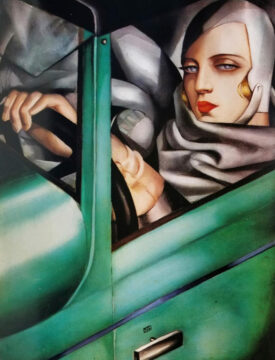
Another image was one I have admired for a long time: Tamara de Lempicka’s “Autoportrait (Self-Portrait in a Green Bugatti)” (1929), which appears above (Wikipedia has a larger image, too). As much as I like the painting, which de Lempicka did for the July 1929 cover of Die Dame, a leading women’s magazine in Germany in the first decades of the twentieth century, all my attention couldn’t quite wring out poetry. But still, a small segment of what I wrote appealed: “Her gloves grasp / the steering wheel as she drives by / with curl of hair and glamorous stare.” Maybe salvageable?
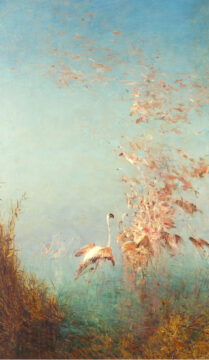
I did manage one Petrarchan sonnet as I studied Félix Ziem’s “Flight of the Pink Flamingos, Vaccarès Pond” (1890). That one I’ll probably polish up and obsess about before circulating it.
The guilt of the artist in shameless times
January 2026 has turned to one hell of a month in the world, and I particularly feel the contrast of my isolated quiet and reflection on works of art and murders in Minneapolis and the escalating cruelties, lies, and violence of the current US administration. In times like these, I asked myself through the events of the month, what worth is “slow looking” at art? What worth is a sonnet, a prose reflection, a list of points drawn from close attention to some artwork that might be thousands of years old?
There were times when I put down my pen, and thought it wasn’t worth picking up again. Five years ago, I at least recorded and fumed about the Trump putsch attempt on January 6; this year brought much amplified horrors in the US and beyond, and yet in my project I didn’t so much as acknowledge the suffering and oppression.
Mid-month a friend in Canada sent me an email bearing the subject line Fiat ars, pereat mundus—”Let there be art, though the world perish.” It’s a clever line that she, I think, cooked up from fiat iusticia et pereat mundus, a motto of Holy Roman Emperor Ferdinand I, that translates as “let there be justice, though the world perish.” The replacement of ars for iusticia jars, of course, with the result that her revised motto both cuts and soothes.
My month of attentive writing did little to foster justice, but it did, I think, fortify an essential human quality that is part of the infrastructure of justice. For human beings must attend carefully and bravely to see injustice and do justice. Simone Weil wrote in Gravity and Grace that “[t]he authentic and pure values—truth, beauty and goodness—in the activity of a human being are the result of one and the same act, a certain application of the full attention to the object. Teaching should have no aim but to prepare, by training the attention, for the possibility of such an act.” She wrote in a time of equal, perhaps greater suffering than ours.
A central problem—maybe even the largest problem—of our time is the problem of attention. Not the quantified, data-rich, digital metrics of engagement that flow from our smartphones to Silicon Valley for processing and exploitation, but the attention to the lively present and often silent qualities of human thought, companionship, community, and love. “True attention lies at the heart of personhood: reason, judgment, memory, curiosity, responsibility, the feeling of a summer day, the burying of our dead. All of these require and activate our presence,” wrote D. Graham Burnett, Alyssa Loh, and Peter Schmidt in an essay in the New York Times in January. “As for mental functions that can be measured and indexed—and ultimately bought and sold—they are precisely the kind of attention we need to escape.”
Can art lead? Can art save? I ask these questions of myself as I “do art” in my modest and usually private way. Weil’s comment about “true attention” is preceded by a sentence that reads, “The poet produces the beautiful by fixing his attention on something real. It is the same with the act of love. To know that this man who is hungry and thirsty really exists as much as I do—that is enough, the rest follows of itself.” I do not agree that “the rest follows of itself,” but rather that attention prepares and awakens. Attention is not merely meditative but a real irritant, a burr that must be heeded, a wound of sin.
Perhaps art has saved me in some fashion through what it can illumine, but my art has saved no one else, certainly not my community, not the world. And my art never will itself save. There are those who claim that art exists separate from the world in some aesthetic realm of its own (Weil is not among them); others, to the contrary, turn art into propaganda, subservient to a message that it advertises and preaches.
I cannot join either the aesthete or the propagandist parties of art. But art in some way may awaken in me a will and a power to become a better human and compatriot in a world that seems hell bent on perishing at the hands of brutes.
Art sometimes forces hands gently, perhaps, but its power is deep.
For the bibliographically curious: a smart consideration of Mayer’s Memory: Dan Chiasson, “Suspended Pleasures: A Month in the Life of Bernadette Mayer,” The New Yorker, September 7, 2020, https://www.newyorker.com/magazine/2020/09/07/inside-bernadette-mayers-time-capsule. The quotation from Emmet Gowins is included in “A Breif Anthology of Quotations” that appear at the end of the book. The Gowins quotation is on page 200. Susan Sontag, On Photography, 3. printing, A Delta Book (Dell Publishing, 1978). D. Graham Burnett et al., “The Multi-Trillion-Dollar Battle for Your Attention Is Built on a Lie,” Opinion, The New York Times, January 10, 2026, https://www.nytimes.com/2026/01/10/opinion/attention-world-war-2-technology-nazis.html. Yes, you can read Gravity and Grace on the Internet Archive: Simone Weil, Gravity and Grace, trans. Arthur Francis Wills, with Gustave Thibon (G. P. Putnam’s Sons, 1952), http://archive.org/details/gravityandgrace. My noodling about Memory and the changed media world in 2021: Mark R. DeLong, “Preliminaries,” Second Act — Re:Tooling, December 30, 2020, https://retooling.us/2020/12/26/preliminaries/.
Enjoying the content on 3QD? Help keep us going by donating now.
Footnotes
- 1Though as January weather ran through the midsection of the US, I had to bend the rules a bit. Living in the country meant that my wife and I had more preparations to come through a winter storm with some safety and comfort: log-splitting to bolster the woods supply for heat, testing and setting up the generator, preparing the animals (chickens, horses, and of course human neighbors) for the ice that was to blow through, worrying about water both in terms of its accessibility and the danger of it freezing in pipes. ↩︎
- 2The selected images and a brief essay on the project is here: https://read.markdelong.me/2026/01/05/image-word-january-2026/. ↩︎
- 3A picture of the painting is #7 on this Listicle article. ↩︎