
Nabil Salih in The Boston Review:
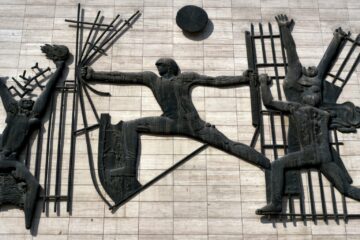 Baghdad was cloaked in its familiar shroud of darkness when, in early October, I walked the al-Shuhada Bridge across the Tigris—more a ritual for me than a pastime. Long before Walter Benjamin described the Seine as “the vast and ever-watchful mirror of Paris,” the Andalusian traveler Ibn Jubayr saw the Tigris as “a mirror shining between two frames, or like a string of pearls between two breasts.” That image of splendor has long since dissipated. On the bridge that night, I passed by an old woman in her abaya sat begging on the curb; plastic waste lined the shallow waters below.
I was headed for al-Madrasah al-Mustansiriyah, a scholarly complex that was one of the few Abbasid landmarks to have survived the thirteenth-century Mongol destruction. Inside, an event called the “Arab Architecture Festival” was taking place, hosted “under the patronage” of Prime Minister Mohammed al-Sudani, as the organizers put it, to “[celebrate] Baghdad’s designation as the Arab Capital of Tourism for 2025.” Police pickups with machine guns mounted on top stood sentinel on both ends of the bridge. Security personnel manned the venue’s entrance, Kalashnikovs in hand. Wading into the labyrinthine, lifeless souqs beyond them was discouraged in the dark. After more than two decades since its “liberation” by U.S. forces, the city still felt like it was locked in a state of latent emergency.
More here.
Enjoying the content on 3QD? Help keep us going by donating now.