
by TJ Price
It’s a few days before Christmas, but it doesn’t feel like it. The weather app I use has subtitled the forecast for the holiday with a cheeky “feels more like Spring than Christmas,” and the temperature is hovering around seventy degrees Fahrenheit. I’m visiting family down in Cape Fear, and my nephew, all of four years old, sits rapt and silent for approximately ten minutes before abruptly transforming into a firecracker of noise, babbling and shrieking, a whirligig that hurls itself at the legs of whoever happens to first verify his existence. I’m probably reading into it, but it looks for all the world to me like a sudden paroxysm of solipsistic terror—as if he has been seized by the irrational and intrusive thought that (despite the empirical evidence of nearby voices and bodies moving to and fro in the kitchen) he is feeling a kind of doubt in his own ability to adequately integrate with the rest of us.
I understand this feeling, I think. As a child, my family would bring me over to my grandmother’s house and conduct conversations that floated austerely over my head. Sometimes that height was intentional, positioned as such because they wanted it out of my reach, like the medicine they kept on the top shelf of the bathroom cabinet. Sometimes it was because they wanted to abstract complexity to the extent that it would befuddle me and discourage any continued questioning. (The joke was on them—more often than not, such behavior would only deepen my urge to decode those encryptions, even if it often led to frustratingly reductionist statements in the form of tautology like “because that’s just how it is.”) I felt the terror of being excluded then not because something secret held any kind of promise or hope, but rather signified the coming of a threat against which I was unable to prepare. If I could not have defenses mounted to face obvious menaces, how could I be on guard against proverbial Greeks bearing gifts?
I watch my nephew run around the room, but from a distance, cautious of being drawn into his maze of child-logic. It seems constructed purely of pathways which recurse, curving back toward him to feed an endless and insatiable appetite for attention. He seems to be aware of my remove and approaches me quietly, timidly, if at all. I wonder how I must appear to him, and return to memory—again, my grandmother’s house. My aunt’s husband (not quite an uncle) who sat on the couch in the living room from the moment he arrived to the moment he left. (Even in photographs, the family seemed to group around him, and though they all smiled at the camera, his gaze was fixed on the television.) I didn’t know him, didn’t interact with him. He was like a man-shaped fungus that only grew in that specific place, and only on holidays. I once saw him displaced from his usual seat during Christmas unwrapping, forced to lean against the wall, and the entire time he fidgeted, blinking more than he should have, fingers twitching at his sides, tongue flicking out to moisten his lips. (I had the sensation that, were my grandmother to have vacated that chair for whatever reason, he might’ve leapt to occupy the spot.)
To be clear: I don’t dislike children. In fact, I find their joy delightful; I’m just overly conscious of my own nerves around them, like how they say animals can sense fear. I worry that the child’s guileless knack for sussing out prevarication will find me out, call me on any one of my innumerable bluffs. Hopefully, I am not that “fungus uncle” to my nephew. I try to smile at him, to be encouraging, to interact with just enough encouragement and good intention, but the truth is that I very rarely have interest in performances which demand it—even that of children. I am largely only willing to interact with those who don’t wheedle or beg (similarly, I have no patience for hype, that poisonous hallmark of mediocrity.) Perhaps some of this instinct has its origin in contrariness for the sake of; other times I am convinced that I’m reacting to something embedded in the transmission: a disingenuous motive, or something I’ve detected in the eddying translucence of subtext. I react poorly to being asked to do things—a part of me is convinced irrevocably that I’m at fault for not having noticed in the first place. (This self-dooming prophecy brings to mind Cassandra, and I think about how doubt must have crazed {“networked with fine cracks”} her in the face of only non-believers; how that doubt must have accreted within and around her, like nacre in the tightly-pursed mouth of the oyster. {In the first books of Greek mythology I ever owned (Bulfinch’s Mythology) I read about the cursed prophet, I encountered the lines of Schiller’s poem (via Bulwer-Lytton) –“Take back the clear and awful mirror…”})
Segue: it is about twenty-four hours later, but I am in the same place. Tonight, my nephew is on a different frequency. He claims to not feel very well—a mysterious pain in his leg (not debilitating enough to keep him from bouncing on the couch cushion)—and has developed a light cough that sounds like the crunch of wrapping paper. As I get into an unexpected dialogue with my septuagenarian father-in-law about The Conversation (that slow-boil masterpiece of paranoia from the 70s), my nephew wanders into the middle of the living room, his thumb firmly suctioned between his lips. Despite our dialogue (and the underscore of banal dialogue from 1990s-era Meg Ryan vehicle You’ve Got Mail on the TV), the kid pulls out a toy and begins to engage with it. This distraction, of course, rattles at a volume that impedes any conversation, which immediately creates a mental image of Gene Hackman leaning into his earpiece, eagerly anticipating the next code phrase, when suddenly his aural surveillance is overshadowed by the violent static of a child’s toy.
My father-in-law has returned to his fuzzy cocoon, wrapped chin to toes in a blanket, his eyes fully-lidded. Hopes of a conversation involving his first-hand exposure to a world beset by Cold War tensions during his twenties are dashed. Unfortunately, most of my own family tree had been pollarded by the time I developed any curiosity regarding its branches, and regret had taken hold of the remaining limbs—like a mistletoe—that I had not spoken more to my own grandfather about his service in the Korean War.
{ [3 hours earlier] I am in a motel room, watching a show on television. A mother pulls her children close, knits her brow. “Family is forever,” she says, determined to believe her own statement despite the cataclysmic losses cratering her own past. I wonder how true it is, especially given that, onscreen, her children and husband are now vanishing in a storm of unraveling pixels. }
I wonder if my nephew clocked the conversation happening, the one about The Conversation. For a moment, I see the whole living room zoomed out, then zoomed back in, but on him as he deliberates which toy to choose. In the array: a plush in the shape of a cat; a tablet whose rheumy screen is evidence of a dead battery; and some kind of pump-action gumball machine. Pressing down repeatedly on its bulbous head yields a sudden cacophony and clatter. I try to interpret the small glint in his eye as he reaches for the gumball machine.
It was not intentional, I try to convince myself. There’s no way that the four year-old acted out of resentment, deliberately and maliciously interrupting out of a desperate need to be noticed, to remind us that he was there. It’s the post-mirror stage—understanding and acknowledging that there are other people in the world, but lacking the ability to recognize them as sovereign entities that also possess volition and agency.
“The scuttlebutt is that it’s Flu A,” comes my husband’s phlegmy warble from the next room. It’s days later, and we’ve returned from the beach. “Mom has a cough, but she had the flu shot, so the symptoms aren’t as bad. She wants to know how you’re doing.”
I’m not sick, or at least, I’ve not shown any symptoms—yet. It’s got me thinking about the spread of germs. The seemingly aleatory nature of contagion. I took no especial precautions while visiting, but I did also spend a lot less time with my nephew, directly in his company. “Letting him spit in my mouth was probably a bad choice,” laments my husband, a bit hyperbolically. But then, he and his family are much, much closer than I am with my own. (He is near-constantly in contact with his mom via text, whereas with mine I exchange messages once every week—sometimes longer. Phone calls are a weekly occurrence for him—for me, maybe once a month, if that.) If he goes longer than a month or so without seeing them, he grows fidgety and needs to visit. {Blood is thicker than water, they say, an idiom which would commonly be defined as referring to the strength of the family bond, though it’s unclear what the ‘water’ part stands for. (Don’t Google this, because it will test your faith in what you can consider truth and what is just noise on the Internet, as it did me. Does it originate from a Biblical verse, “The blood of the covenant is thicker than the water of the womb?” Is that even a legitimate translation of Scripture? Is anything real?)}
So, not sick—at least, not in the body. But I have felt myself falling ill with a case of infoflu, or information influenza. For too long a time, we have considered quantity of available information as analogous to truth. Unfortunately, as time has gone on and the quantity of available information has become exponentially larger (not to mention more readily accessible—sometimes even {seemingly} instantaneously), this has been disproven. Now, we have Merriam-Webster’s editors bestowing the honor of “Word of the Year” for 2025 to slop, due to the ubiquity of LLM-generated garbage, most of it hallucinatory. Or at least, so I’m told. I suppose I’d have no way of verifying that this was the case unless I spoke to the editors themselves, face-to-face. But then, how would I even be able to distinguish them from possible androids, powered by LLMs?
{ In a 1951 essay, Jorge Luis Borges (author of “The Library of Babel,” which posits the thought experiment of a vast library containing all possible books—and the narrative’s focus that the vast majority are nonsense) commented on a critical edition of Blaise Pascal’s Pensées. “…he expressed his feelings like this: ‘It [nature] is an infinite sphere, the center of which is everywhere, the circumference nowhere.’ That is the text of the Brunschvig edition, but the critical edition of Tourneur (Paris, 1941), which reproduces the cancellations and the hesitations of the manuscript, reveals that Pascal started to write effroyable: ‘A frightful sphere, the center of which is everywhere, and the circumference nowhere.’” }
You see, I keep interrupting myself with more information, and I don’t know what parts of it are salient and what parts are to be jettisoned. I have tried, throughout this essay, to just ‘go with the flow’ (another idiom whose provenance I cannot quote) but the more I try to do this, the more I fret about its legibility. About its substance. About what I’m “trying to say,” in the words of anyone who has ever given feedback ever to someone who is stuck in the middle of writing something. Usually, when I’m confronted with this challenge, I return to the beginning. What was my goal at the outset? So here, I look. The beginning of this was written almost a week ago, and now has barely any resemblance to the current form of this article. Not only was I in an entirely different location, but it was before Christmas.
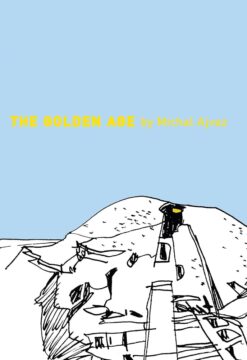
[The best part of the entire trip to see my in-laws came in the middle of the day on Tuesday, two days prior to Christmas. My husband had no work demands, and I was whiling away time by reading a bit of Czech writer Michal Ajvaz’s incredible novel The Golden Age. {The novel is a fictional travelogue divided roughly into two halves: (the first being a study of a fictional island culture who resist the common understanding of signifier/signified) the second of which is devoted largely to the creation and reading of the culture’s single Book.
Ajvaz’s narrator, in the middle of a series of nested narratives, describes the Book of the islanders as a curious artefact that has little pockets or insertions attached to every page, “concertina strips” that are lifted up and make the sound of bird’s wings whenever there is a gust of wind, followed by the sound of “murmuring, whispering, sighing” when the wind drops and they lay limp. On each of these “strips” are insertions, annotations, digressions, all added to the Book by readers who have come across it. However, before even plunging into the retelling of one of the stories found in the Book, Ajvaz’s narrator warns the reader of The Golden Age that to follow any of these digressions-on-digressions is to descend into a labyrinth from which escape may become impossible. Despite this, an islander tells the narrator that the “main thing” is “that which is incidental.” Later, mid-story, the narrator pauses to connect something in the retelling with something that happened in his own life. Unable to keep his quiet as per the relevance of digression, the narrator opines:
“I am well aware that all the bold words you have heard from me about the value of insertions and digressions have failed to convince you; you are distrustful and stubborn, dear reader, and no doubt you are preparing to skip this insertion and its savage intervention between you and the tale … You probably won’t miss anything important if you skip the next couple of chapters, but you could miss the encounter that holds the key to the entire text. The decision on which path in the labyrinth to take is yours and yours alone; whichever path you take, you do so at your own risk.”
After the retelling concludes, the narrator mentions that—as a work of art—the Book is almost certainly a failure, had been from the very beginning, but also mentions that perhaps that the islanders were even striving for that failure, to render the Book as less art, and more a parody of art.}
My husband asked me if I wanted to go for a walk. The day was balmy for near-Christmas, and a forceful breeze was coming out of the southwest. I agreed, and we went off to the small strand of beach only two blocks away from our motel. The sand was shifting and unstable under our feet up by the boardwalk, so we went closer to the waves. We talked about the beach erosion; how it was necessary to pump in sand from other beaches to “shore up” the area. If they didn’t do this, he told me, there would be no beach. (Later, I looked this up—it’s called “beach nourishment,” in a surprising turn of phrase, costing millions of dollars to pump roughly 757,000 cubic yards of sand over about 18,000 feet of beachfront.) There was no plan to our walk. We just idly took steps across the strand. There wasn’t a single other soul around. The ocean roared and foamed, falling into a hiss of static as the waves crept antlike into breakers, clawing at our feet. (I began to pick up shells. At first, I thought that the separate pieces must have been from the same shell, but that proved false as I kept gathering them. They were thick, scarred shards, like broken pottery—some pieces even thicker than my thumb—but none of them would fit together to create a whole. At first, I thought that it must have all been from the same shell, but that proved false as I kept gathering them.) We didn’t speak much. We stooped, then rose; up and down, our motions mimicked in time-lapse by the little frantic pipers bustling about the breakers. Each of us, content to comb the sand—first raking it with our eyes, then with tremulous fingers. The setting sun struck our shadows to flight from our feet, but we stayed still, hands and pockets full of shell shards, staring out at the ocean’s illimitable expanse, all the way out to where the horizon bends, past the length of perception.]
There is so much we don’t know, cannot know. Wanting to know everything is not only impossible, but perhaps even a kind of evil. “I know that I know nothing,” as the famous paradox from Sophocles goes. A mystical text written by an anonymous 14th century Christian is titled “The Cloud of Unknowing,” and it refers to a mode of religious philosophy known as the via negativa (which attempts to approach the Divine only by terms of what it is not) — insisting that God lives beyond the ken of mortals, and that in order to comprehend the Divine, one must set aside reason and knowledge. It recommends that the aspirant cultivate a “cloud of forgetting,” or temporary abandonment of all other concerns, to achieve this level of apophatic prayer.
Perhaps it is possible to know too much. We are often critical of those who “know too little,” and much has been made of the axiomatic “ignorance is bliss,” but what if it truly is? Sapere aude! goes the cry. Dare to know! But every dare comes with a potential for cost—it’s whether or not that price is exacted wherein comes the risk, and sometimes the bill is not tendered until much later. Today, however, even “unknowing” has become risky, something divisible. Donald Rumsfeld, in 2002, famously said “There are unknown unknowns,” referring to a matrix of awareness and consideration when determining outcomes. (Now, a score of years later, we even have “alternative facts,” and “truthful hyperbole,” so it’s not as though we’re exactly trending upward in efforts to refine semantic meaning.) {No wonder the other Greeks didn’t believe Cassandra when she said she knew the future, that most unknown of unknowns. I doubt they would’ve believed even without the curse of jealous Apollo.}
So, in an effort to tease out the end of this essay (from the French essayer, “to try”), I return to the beginning. I rappel (from the French rappeler, ‘to recall’) down the length of twine that I’ve left behind me, the pathway that I can follow back to the entrance of the labyrinth (unknown etymology). The reader—myself—is left standing framed in the entrance, feeling the cold breath of the depths brush against their face as they—as I—realize that the entrance is the same as the exit, and that to exit one labyrinth is only to enter another—one whose walls aren’t as easy to see.
Enjoying the content on 3QD? Help keep us going by donating now.