
Shelly Fan in Singularity Hub:
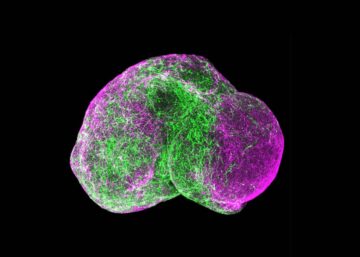 When brain organoids were introduced roughly a decade ago, they were a scientific curiosity. The pea-sized blobs of brain tissue grown from stem cells mimicked parts of the human brain, giving researchers a 3D model to study, instead of the usual flat layer of neurons in a dish. Scientists immediately realized they were special. Mini brains developed nearly the whole range of human brain cells, including neurons that sparked with electrical activity, making them an excellent way to observe and study the human brain—without the brain itself.
As the technology advanced and brain organoids matured, researchers coaxed them to grow structural layers with blood vessels roughly mimicking the cortex, the part of the brain that handles reasoning, working memory, and other high-level cognitive tasks. Parallel efforts derived organoids for other parts of the brain. Mini brains can be made from a person’s skin cells and faithfully carry the genetic mutations that could cause neurodevelopmental disorders, such as autism. The lab-grown blobs also provide a nearly infinite source of transplantable neural tissue, which in theory could help heal the brain after a stroke or other traumatic events. In early studies, organoids transplanted into rodent brains formed neural connections with resident brain cells.
More here.
Enjoying the content on 3QD? Help keep us going by donating now.