
by David Kordahl
Government secrecy makes UFO claims impossible to verify—or disprove.
When I lived in Arizona, my next-door neighbor once told me that he had seen a time machine. These types of anecdotes are not uncommon in Arizona, out on the edge of the world. At the time, I was in graduate school for physics at Arizona State, and I presumed my neighbor was either lying or confused. He had seen the time machine, he told me, behind the door of a restricted area of his former employer, a defense contractor in Tucson. I nodded politely and let it slide, much as I would for the claims from our neighborhood Mormon missionaries or the 9/11 Truthers whose stand I passed daily on my walk to the cafeteria.
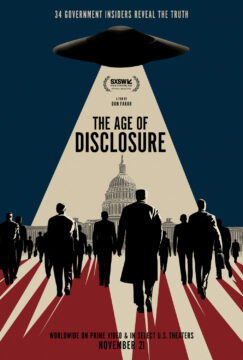
I was thinking about my old neighbor when I recently came across a clip of Joe Rogan speaking with Dan Farah, the director of a new documentary, The Age of Disclosure. If Farah is to be believed, my neighbor might indeed have seen something behind that door. The Age of Disclosure claims that crashed Unidentified Aerial Phenomena—and, yes, UAPs are just UFOs by another name—have been studied by defense contractors for some eight decades, and that failing to take them seriously poses a risk to national security.
Regular readers will know that UFOs and US government secrecy are both part of my beat here at 3QD, so I grabbed my tinfoil hat and pressed play.
The Age of Disclosure tells a story that, as many critics have noted, is by now pretty familiar, which doesn’t stop it from being pretty crazy. The vibe of the film owes much to conspiracy thrillers like The Parallax View or JFK, with frequent solemn shots of national monuments thrumming to a continuous soundtrack. A good deal of the runtime is filled by montages of dark-suited men saying things like “UAPs are real, they’re here, and they’re not human.” The movie’s poster tagline, “34 Government Insiders Reveal the Truth,” gives a good idea about what it offers: clips of military, intelligence, and congressional officials affirming, on the record and under their own names, that they think UFOs are a real concern.
This is all handsomely mounted, and the main character, the ubiquitous disclosure activist Luis Elizondo, tells us his story of discovery, which in turn expands to the broader narrative of a decades-long deception. Elizondo is a large man, a tattooed Mr. Incredible, and the tale unfolds as he walks among the monuments. He has a cryptic gravity to his delivery, always hinting he would like to say more.
Elizondo’s version of events is basically as follows. Since 1947, the year of the saucer crash at Roswell, the US military has continually studied downed UFOs and their inhabitants, as have our military rivals around the world. They—whoever they, the beings controlling the UFOs, might be—seem to have an interest in monitoring our nuclear stockpiles. (Notice how the UFOs mainly showed up shortly after the nuclear advent of 1945.) Yet officials do not have a clear idea about who they are or what threat they pose. Hence the decades of misinformation asserting there’s nothing to see, and the need for whistle-blowers like Elizondo to emerge from the shadows to let us know what’s going on.
Now, I started the last paragraph with the “saucer crash at Roswell” to hint at a problem with this streamlined narrative. People like me who have dipped a toe in the UFO literature know that Roswell is highly contested territory. Starting in the 1970s, the physicist-turned-UFO-researcher Stanton Friedman, relying on his own interviews with eyewitnesses, claimed that Roswell constituted nothing less than a “cosmic Watergate.” Over the decades, the legend of Roswell grew. By the 1990s, Roswell lore had grown sufficiently prominent that the Air Force released two reports claiming that the secrecy surrounding the crash was not because a UFO had been retrieved, but because the crashed object was part of Project Mogul, a classified balloon-based probe system designed to monitor Soviet nuclear tests.
That the Roswell crash is reported in The Age of Disclosure simply as a UFO retrieval without so much as a hint of doubt should indicate the sort of documentary this is. It is political advocacy, not neutral exploration, and it is aimed mainly at potential converts who won’t know where to push back.
But even political activists need to address their opponents’ top Google complaints, and there are a few attempts at damage control in the film. Luis Elizondo came to prominence after a 2017 article in the New York Times introduced him as the onetime leader of AATIP, the Advanced Aerospace Threat Identification Program. In that NYT article, AATIP was presented as a straightforward military effort to investigate UFO reports, but skeptical articles from The Intercept and the New York Post would later cast doubt on both Elizondo’s position and the ultimate purpose of AATIP. The Intercept alleged that Elizondo may not have had much power in AATIP, and the Post reported that AATIP itself was just a rebranding of the Advanced Aerospace Weapons System Application Program, a pet project of Senator Harry Reid whose real purpose was to investigate paranormal claims about Nevada’s famous Skinwalker Ranch.
Again, none of these asterisks are in The Age of Disclosure. In the framing of the film, the only reason doubters question Elizondo’s credibility is that they want to discredit a man who is revealing dangerous truths. Not that this is confusing. It makes sense for this production to distance itself from the wilder parts of UFOlogy. The movie strives to convey that its assertions about UFOs are well-established and credible, that the phenomena under discussion are not mere psychological projections, that such crafts can go from water to air to outer space without disturbing their surroundings, that they can go ten times faster than any human rocket, that they are endowed with capabilities of anti-gravity and instantaneous acceleration—and that all these serious men in serious suits agree.
What’s frustrating in this is the large gap between the claims being made and the evidence being presented. We are shown videos that have already been widely viewed and discussed. But several people claim to have seen much more—including recovered crafts and their drivers. So if such incontestable artifacts exist, why can’t we look at them? Why should we have to take their word for it?
What I appreciated most about The Age of Disclosure is the way that it portrays officials who are not just lying or confused (still my default assumptions) but trapped in a command structure that’s deliberately difficult to navigate. Marco Rubio—presumably interviewed before he became secretary of state—gives a striking quote about why uncertainty persists on sensitive topics:
I think there’s this assumption that presidents can walk into the Oval Office on day one and say, “All right, take me to Roswell, show me the alien bodies. I want to see the video, the autopsy, I want to see the whole thing. Open it up.” I think that really is a naive understanding of how our government works. […] Frankly, I don’t know if a president would know who to ask. You could go to the director of the CIA—nowadays, the director of national intelligence—and ask them, and even that person may not know, because those people rotate, but the people three layers underneath them that are there for thirty years—to them, it’s like, “I’ve seen people come and go. I have no obligation to tell them it exists.”
Since its release, Rubio has (understandably) distanced himself from the film’s claims, emphasizing that he has no direct knowledge of a “Legacy Program,” or of any recovered nonhuman craft in the government’s possession. Which, I suppose, is exactly the problem.
In November 2025, the US House of Representatives held a special hearing on UAPs. Many of the same figures who appear in The Age of Disclosure appeared on Capitol Hill. The themes of persistent unexplained phenomena and the need for increased transparency pervaded that hearing, just as they pervade the film.
Though disclosure advocates often discredit themselves by asserting more than they know, I agree with their aims. I, too, would like to see what (if anything) is locked in the vaults. But at this point, any revelations that emerge will be tainted by a long history of misinformation and half-truths. UFO lore functions in the American imagination like an immense Rorschach test, with our best guesses—angels or demons, psyops or hallucinations, voyagers or static—revealing where we draw the boundary between the plausible and the absurd. As for me, I find myself increasingly interested in what people claim to have seen behind restricted doors.
Enjoying the content on 3QD? Help keep us going by donating now.