
by Daniel Gauss

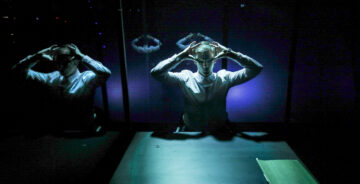
The whistleblower in The Insider is introduced to us in a glass booth, evocative of the type defendants sit in at trial in some European countries. We wait for the theater piece to begin by listening through headphones to someone singing Money (That’s What I Want). We will hear everything through headphones. The only character in front of the audience will be the whistleblower/insider and all the voices he recalls and responds to, as well as anything he says, and any other sounds, will be piped into our ears.
The insider is trapped with his own recollections, which we are privy to. How he got trapped with these painful memories, and his way out, are the purpose of this theater piece. He is in the process of remembering and reliving his interrogation by a prosecutor, and other aspects of his life relevant to the Cum-Ex financial scandal he came forward to expose to the German authorities.
Cum‑Ex was a European‑wide tax fraud scheme, carried out from the early 2000s until its exposure in the late 2010s, in which bankers and investors exploited dividend tax loopholes to siphon off billions of euros. Some investigative journalists and researchers estimate that the scheme cost European treasuries up to €55 billion in total, with losses to Germany alone estimated at more than €30 billion.
The headphones mostly bring us voices – often the voice of the prosecutor. Many of the voices are intrusive memories that the insider cannot stop because he cannot answer them adequately due to his moral shame, struggle with denial and ambiguity concerning his own motives: his motives to first object to fraud at his bank, then to participate in the fraud and then to turn the bank in. This inner turmoil may mirror the internal trial, doubt and pain that many whistleblowers endure.
A work desk and a file cabinet are also in his glass booth. The implication could be that the moment he chose to work as a tax lawyer in the banking industry, he also entered a figurative defendant’s dock (although the chances of arrest or conviction for anything would be infinitesimally small). The piece may, indeed, be questioning the extent to which his line of work might border on the criminal in its very nature, although publicly presented as an essential pillar of every economy.
Thus, the box can be a mental trap, a defendant’s booth, an office space for fraud schemes disguised as social beneficence and even the insider’s home, all at the same time. We can see right through the whistleblower’s glass home-box to the tortured, restless human animal inside. He has worked his way into his luxurious domestic enclosure through complicity in benefitting from the systematic erosion of moral and professional principles.

I mention that the box also represents his house as, at the beginning of the piece, he relives the day when police raided his abode, part of a coordinated operation across fourteen cities around the world. He tells himself, and us, that he had never been stared at in such a way before. Lower than scum, of no consequence, some object in the way of the police officers’ job, pushed aside like a nobody, a common criminal. Dirt.
They rifled through his personal belongings as if he wasn’t there. He demanded his rights in his glass home-box, and they ignored him. He thus feels the German state’s unambiguous hostility, so different from the justifications and excuses he had grown accustomed to hearing from colleagues and supervisors. Yes, his suspicions were right. Everything he did was wrong. He can see by the disgust and contempt on the officers’ faces: it was really wrong after all.
He goes on to say that he suffers from a big mouth. This, however, turns out to be one of his redeeming qualities, and we see that long before the police raid it causes him to question and internally report something that does not look right. This forces him into a high-level meeting at his bank with a big bear of a man who talks about the history of the great apes.
What follows is a Spencerian argument about survival of the fittest and the need to adapt. To survive you must “fit” your environment. That big mouth of his, betraying moral discernment, does not fit his corporate banking environment. The bear-man pontificates that if you are driving and the green light turns yellow, you speed up to beat the red light. The bear of a man tells the insider that the light is now yellow.
The insider goes along to get along. He wants to buy his child a nice tricycle. He wants to travel. After the deal with the Mephistophelean bear-man is consummated, he does travel. At a foreign nightclub he gets drunk as a skunk and accidentally cuts his wrist in such a way that he almost dies and the nurse at the hospital suspects a suicide attempt. The nurse’s name is Mary, and she speaks with a soft and sweet Scottish accent through our headphones.
Drunk out of his mind, as she is stitching him, he calls her the Virgin Mary. He tells the Virgin Mary his big secret – she is a peon, a nobody, a small fry. He can introduce her to a world that she can’t imagine. She tells him she likes her job, and he implies she is a sucker as she is caring for him.
Later another intrusive memory comes and tells him, “If the poor die, the rich die too.” It doesn’t go so far as to say that the poor can probably survive without the rich, but some of us may have come away with that conclusion as a result of this theater piece.
This is central to the piece. The honest and hardworking and poor become the suckers and the marginalized: the nobodies, the small fries. But as we learned in the pandemic, we can send the white-collar predators home to their elegant boxes where they can stream Netflix for a few months and drink tequila, but there are essential workers the world cannot function without.
These essential workers are often regarded with dismissive contempt by the highly placed, many of whom may contribute little or nothing to the public good while cloaking private enrichment in the language of civic responsibility. One of the play’s ironies is that the bear-man must cut a meeting short because he has tickets to Brecht and Weill’s The Threepenny Opera.
The common folks become the suckers and the losers and the victims in a world they ensure for everyone. I can imagine that corporate banking thieves may be secretly hoping AI renders the salt of the earth unnecessary so that only one class of white-collar criminals will inherit the earth to party bigtime, until they finally watch the planet die in a huge, spectacular eco-crash while sipping Dom Pérignon, wallowing in self-indulgence, drugs and debauchery (the values they live for).

At one point the whistle-blower must recruit some new candidates into the scheme. He asks a prospective collaborator if his conscience might get in the way. Will it bother him if fewer social programs for the elderly and fewer educational programs for children are created while he becomes rich? The recruit indicates he will not be bothered at all.
The whistleblower explains to the prosecutor that the vast majority of recruits said they would participate, and only a rare few said they would not. He theorizes that those who would not said so out of fear of being caught. That was fine as they were no threat to go to the police because the scheme was just too big, too complicated, too hard to explain and the threat of retaliation was too certain.
The prosecutor, for her part, seems to be in way over her head and the whistle blower often seems frustrated with the fact that he is there of his own volition and yet she threatens him with jail if he doesn’t sing, even though he is there to sing.
He wants to sing, but she asks him questions he feels are irrelevant and he struggles both to answer honestly and to try to connect with her, to help her understand exactly what is happening and how money is being drained from the German economy, harming social programs but making many bankers richer. Interestingly, Deutsche Welle recently ran a piece in July 2025 asserting that aspects of the Cum-Ex and Cum-Cum scams are still happening in Germany. So it seems the German government never really did “get it” fully.
So the play is partially about how easily we slip into immoral complicity, as if we are already socially primed toward it and just waiting for an opportunity to win that lottery. A couple analogies about great apes and yellow lights are all we need to sink into the cesspool and let others suffer while we prosper.
By pumping all of this into our ears, privately, a secret is being shared with us personally, and when we look around the theater, we see it is being shared with others at the same time. This is being told to us through the headphones: people tend to fail too readily when tempted to go beyond clear moral boundaries if they can benefit from doing so, even if others get harmed. One might hope that the effect of everyone in the theater hearing this, or now reading this, will mean the beginning of some kind of positive ripple-effect to correct this human flaw.

The production thus becomes an intrusive call to us that this has to stop. We cannot accept this as a part of human nature anymore. We must expose this weakness, this type of negative, anti-social socialization, and bring it into the full light of day and condemn it. This production helps bring it into the full light of day to condemn it.
The play also questions the moral compass of major banks, as so many of them tied to Cum-Ex were household names, raising the question of whether public service can often be a façade for organized theft in the banking industry. It also looks at the incompetence of the state in keeping up with the brilliant bank fraud schemes which police and prosecutors cannot seem to wrap their brains around fully.
Finally, the play explores the process of being a whistleblower. Even they accuse themselves of having big mouths and being gullible. When a whistleblower pops up, the first thing that seemingly happens is that their motives are publicly questioned and they are denounced as not being loyal to their criminal enterprise and are usually accused of being self-seeking or self-promoting. Take a look at what happened to Snowden and where he is right now.
The theater piece is an examination of one man with residual morality who can’t quite resist temptation (under some pressure) but who attempts to redeem himself and suffers for doing so and must endure a painful process of self-discovery and self-admission to change for the better. Through the headphones his memories become our memories, his life becomes our life, perhaps his guilt becomes our guilt, maybe his redemption will become ours as well.
The piece highlights a disturbing and frustrating mindset. When asked whether he would feel remorse if social service programs were cut because of his involvement in Cum-Ex, a person gleefully says he will not. This attitude must be examined more fully and put under a microscope and denounced to the high heavens.

Until we nobodies, nurses, mechanics, teachers, firefighters, restaurant workers and others, who take genuine satisfaction in work that serves others, more clearly articulate and defend our own humane and ethical values, we will continue to lack the moral leverage needed to restrain greed elsewhere. Our values have been forged in lives of care, responsibility and service and they can and should pack a punch.
This theater piece is an invitation to respond to the shared memories and accusations involving the insider with a simple refusal: “No, I wouldn’t have done that. I will not do something like that.” Such a refusal, collectively asserted, becomes a source of moral authority, an ethical standard set by all for all, one that allows us to stand higher and to demand accountability from those who exploit the public trust, even if prosecutors cannot fully understand what has even happened.
Teater Katapult was founded in 1995 by Torben Dahl in Aarhus, Denmark. The brilliant, innovative and compelling theater piece was written by Anna Skov Jensen. The December 2025 production I witnessed was performed in Hong Kong as part of the Leisure and Cultural Services Department’s “European Theatres in Resonance” at the Hong Kong Cultural Centre and directed by Johan Sarauw, with Christoffer Hvidberg Rønje as the sole performer on stage.
Rønje’s acting is circumscribed by the limits of the glass booth. Within this booth he so effectively reflects the anxiety and desperation engendered by his relived memories that we are also affected and discomfited. At times, the box serves as a place of temporary solace and quiet reflection; at others, it magnifies his despair and inner conflict.
Within this confined space, he isolates himself to confront his guilt and motives, exploring both his participation in and separation from a social evil. The box becomes a pressure chamber in which he decides whether to live with the emotions of moral failure or to release them and, newly confident in his integrity, begin anew.
He cannot leave the booth until he fully assesses his actions and the self-condemnation a conscientious person would feel after an extreme lapse of integrity. Until he abandons self-condemnation, while still accepting responsibility, and can forgive himself, he cannot move forward toward a whole life.
Confronted by the prosecutor, he is challenged to turn himself inside out, to understand himself, to purge himself of self-harming emotions and to clearly articulate the nature of the wrongdoing he participated in. Rønje becomes an actor who turns himself inside out in front of us while we hear, see and feel the moral and emotional torment his character goes through.
In this way, the glass box becomes a place of intense self-examination, highlighting both the difficulty of discerning one’s moral flaws as well as the difficulty of expressing to other flawed beings why we succumb so easily to the temptation of moral corruption and why we should not.
Enjoying the content on 3QD? Help keep us going by donating now.