
by Dilip D’Souza

On a stargazing trip between September 19 and September 23 this year, I spied a supernova.
Well, not quite. I took plenty of photographs of a spectacular night sky through the four nights I spent out in the open. Then I came home and looked through them, still filled with wonder at what I had captured. Then I read some astronomy news. Then I returned to my photographs and looked through again, this time in some frantic urgency.
Then I had to (figuratively) sit down. For there it was. The supernova. In my photograph.
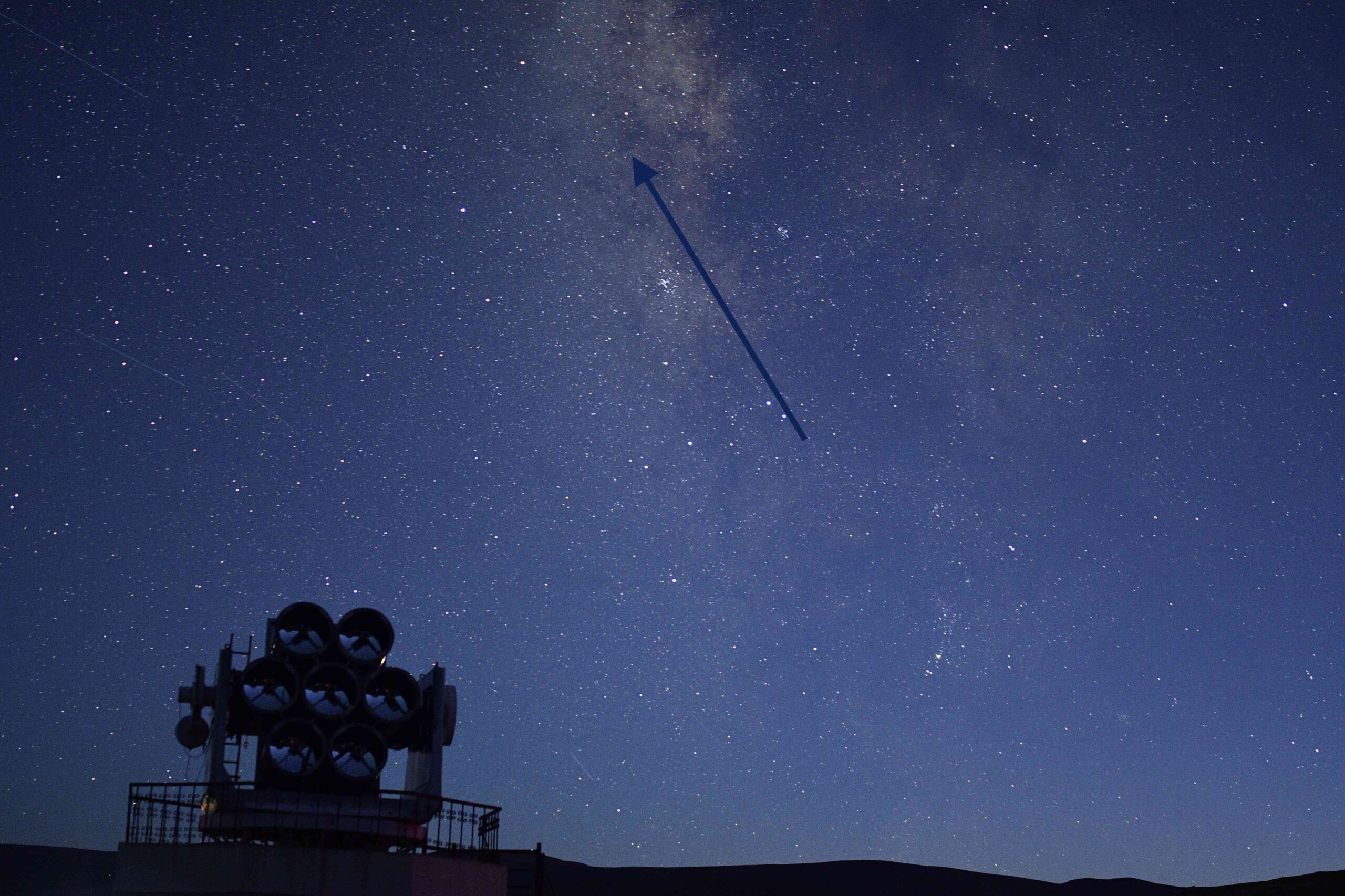
That is: On September 23, there was news that an amateur astronomer in Australia, John Seach, had discovered a supernova in Sagittarius two days earlier. In fact, and astonishingly, he had discovered two supernovae on successive days. The brighter of the two was only visible in the Southern hemisphere. But the other one was in the constellation of Sagittarius. Because I had pointed my camera at the Milky Way so often through my trip, Sagittarius was in several of my photographs.
I pored over all of them. I had several images from before September 21, and several more from after. All I needed to do was find a dot in a post-September 21 photograph that wasn’t there in a pre-September 21 photograph. You might wonder how, in images with thousands of dots – that’s how spectacular the night sky was – I could even think of finding a specific one. But the report from Australia had an image locating the supernova just “below” Sagittarius. So I knew pretty much exactly where in my photographs to look for it.
And to my amazed delight, I actually did find such a dot, precisely where I expected it. There on September 22. Not there on September 20. The supernova, on my laptop.
A few caveats.
First, a supernova, yet a mere dot? After all, a supernova is a star that ends its life in a vast explosion. In 2015, for example, astronomers discovered one that’s been named ASASSN-15lh. They estimated that this single exploded star was, at its peak, 570 billion times brighter than our Sun, and 20 times brighter than the entire Milky Way Galaxy. One star! Not an explosion you would want to be within a light year, or even a hundred, of. So why would such a cataclysm register as a mere dot?
Because it is so far from us. ASASSN-15lh was nearly 4 million light years away. The one in Sagittarius, now known as V7994 Sagittarii, is much closer – only 25,000 light years from us. Still, those are vast distances, and they will shrink even huge cataclysms to tiny dots.
Second, “find” and “discover” have slightly different meanings in such situations. John Seach certainly “found” V7994 Sagittarii, but it didn’t actually explode on that September day. Since it is 25,000 light years away, the light from the explosion took 25,000 years to reach us. Meaning, the actual explosion was that many years ago. What we see in the night sky today – whether star, comet, supernova, galaxy or more – is, in a real sense, a blast from the past. We “discover” events that, in reality, happened a long time ago.
But those are only caveats. For millions of star enthusiasts like me the world over, I’m sure, finding a supernova is a great thrill that never wanes, no pun intended.
And that brings me to VASCO. That name has a certain resonance in India, of course, especially if we are talking discovery. Vasco da Gama discovered the sea route to India in the late 15th Century. Though they had known of India for centuries, Europeans of all stripes now had easier access to this distant and infinitely enticing land. Yet consider the analogy to supernovae. The sea route was always there. What is the sense in which it was “discovered” at all?
Be that imponderable as it may, this is about a different VASCO: the “Vanishing and Appearing Sources during a Century of Observations Project” – the acronym inspired, I imagine, by the intrepid da Gama. This project owes its existence to a team of astronomers that has set out “to search for vanishing and appearing sources using existing survey data to find examples of exceptional astrophysical transients.” Why this caught my attention might be that it pretty much captures exactly what I was trying to do with my own images when I heard about V7994 Sagittarii. After all, I was using my own “survey data” to search for an “astrophysical transient” – the appearance of V7994 Sagittarii.
VASCO’s search is, of course, far broader and vastly more diligent and precise than mine. As one report put it, this project is “an effort to identify changes in the night sky across, well, a century of astronomical observations.” To give you an idea of the scale of this effort, here’s a line from VASCO’s introductory academic paper: “We … perform the first searches for vanishing objects throughout the sky by comparing 600 million objects from the US Naval Observatory Catalogue (USNO) B1.0 … with the recent Pan-STARRS Data Release-1 (DR1).”
This references two established catalogues of visible stars – USNO from 2002, DR1 from 2016. VASCO was looking for objects visible in USNO that are not in DR1, or vice versa. From 600 million objects – that astonishing number itself only about half the objects in USNO! – VASCO found “about 150,000 preliminary candidates that do not have any Pan-STARRS counterpart”. Further examination produced a list of “about 100 point sources” that appeared only in USNO, some of which might have been supernovae.
But there’s an interesting wrinkle to all this. The USNO catalogue was built by “digitizing scans of almost 7,500 photographic plates taken from various sky surveys during the interval from 1949 to 2002.” In particular, there are about 2000 plates from the Palomar Observatory Sky Survey (POSS-1) that happened between 1949 and 1958. In these plates, VASCO found several transients “exhibiting characteristics not easily accounted for by prosaic explanations”.
So what might account for them? Well, through the 1950s, the US, the late Soviet Union and Great Britain conducted over 100 above-ground nuclear tests. We know that nuclear radiation can “cause a visible glow” in the sky – the so-called Cherenkov radiation is even blue. In fact, there were several contemporary reports that “fireballs” and other bursts of light were seen in the sky after these nuclear tests. Besides, nuclear fallout might also have contaminated the plates, leaving otherwise inexplicable spots.
There’s much more in this vein that I won’t explore here. But there’s enough already for the question VASCO’s work raises: is it possible that the “nuclear age left its fingerprints on the astronomical record”? While clearly there’s a need for further research, the evidence that the VASCO team found in the POSS-1 data makes that intriguing phrasing seem at least conceivable.
And me, with this column? That my search in my photos for a supernova would have me thinking about the idea of discovery, 600 million celestial objects, nuclear tests from half a century ago, and a famous Portuguese seafarer – I mean, I was just enchanted. Then I had to write this.
I even returned to a time-lapse video I have from September 21, showing Sagittarius over a period of about two hours. Had supernova V7994 Sagittarii appeared – had I “discovered” it – in that time? No luck. Apologies, Vasco and VASCO.