
by Eric Feigenbaum
The assertion that religion is a tool for preserving social order and for organizing large-scale cooperation may vex many people for whom it represents first and foremost a spiritual path. However, just as the gap between religion and science is smaller than we commonly think, so the gap between religion and spirituality is much bigger. Religion is a deal, whereas spirituality is a journey. Religion gives a complete description of the world, and offers us a well-defined contract with predetermined goals. ‘God exists. He told us to behave in certain ways. If you obey God, you’ll be admitted to heaven. If you disobey Him, you’ll burn in hell.’ The very clarity of this deal allows society to define common norms and values that regulate human behavior. —Yuval Noah Harari in Homo Deus, A Brief History of Tomorrow, 2015
In his books Sapiens, Homo Deus, 21 Lessons for the 21st Century and Nexus, celebrated author and Professor of History Harari goes further positing spirituality is an altogether different thing. The spiritual path involves an individual quest. Seeking, learning and experiencing are part and parcel to someone finding their way to the divine.
In Harari’s view, religion was a form of governance – in essence the creation of a common platform – before secular government came about. Religion is present in hunter-gatherer societies whereas true secular government doesn’t really begin until a society reaches the agrarian stage.
Even as societies create secular governments, they don’t usually abandon religion. In fact, the most successful liberal democracies including the United States have protected freedom of religion, recognizing that the moral core and social cohesion offered by various religions benefits society as a whole. Countries that have banned religion altogether – such as the Soviet Union – found repression their only tool for keeping social order. Not the recipe for thriving or longevity.
Forty years before Homo Deus, the founders of Singapore were wrestling with how religion would impact their society. The goal was how to harness the benefits of religion without opening the door to the volatile tribalism that can also go with it.
And Singapore was not only vulnerable to tribalism but had already flirted with it several times in its colonial and transitionary days. Various flashpoints among Singapore’s Chinese (of a variety of subsets of regional cultures such as Hakka, Teochew and Cantonese), Malay and Tamil Indian took place in moments such as the Maria Hertogh Riots (sometimes referred to as the Jungle Girl Incident) of 1950 largely between Malay Muslims and the British and Dutch authorities – and the Race Riots of 1964 largely between Malay Muslims and Chinese ethnics.
Singapore’s founding fathers recognized communities with higher levels of religious adherence tended to see less crime and more social cohesion. Having people with a moral compass was a good thing. However, Singapore’s diverse population was a product of British colonialism and how and whether Singapore as an independent country could knit them all into a cohesive society remained critical questions. In 1965, when Singapore separated from the Malaysian Federation and then gained its independence from Britain, the path to a Singaporean identity was not yet clear to anyone.
With some hesitation, the Singaporean government began encouraging religion while cautioning the importance of secular government. Founding Prime Minister Lee Kuan Yew said in a 1987 speech:
A religion looks after the spiritual, moral and social well-being of its followers. But religious organizations should leave the economic-political needs of people to non-religious groups, like political parties. This is because if any religious group tries to define the socio-economic agenda of Singapore and mobilizes the grassroots by “social action programs”, other religious groups will do likewise. Once people are mobilized on socio-economic issues on the basis of religious loyalties, the consequences will be bad for all.
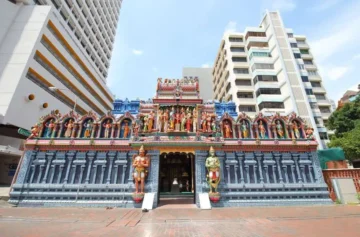
Nonetheless, from its inception, Singapore began including places of worship in its urban planning. Moreover, it seized the opportunity to turn the support of religious institutions into a way to break down cultural barriers and promote the new Singaporean identity. A requirement for government funds to build new places of worship included that they be built in neighborhoods in which their adherents were not the majority. In other words, a Taoist shrine in a Muslim-majority neighborhood, a Hindu temple in a predominantly Chinese community, a Christian church or a mosque in an Indian area. This forced crossing borders, gaining familiarity with different ethnicities and seeing people as less “other”.
If the goals were to create stronger, more conscientious and law-abiding communities, the results were a resounding success.
Dr Yaacob Ibrahim Former Minister for Community Development and Sports and Minister-in-Charge of Muslim Affairs wrote in Singapore’s 2020 edition of its Urban Systems Studies:
Today in Singapore, it is not uncommon to see different faith communities coming together to help the less fortunate in our society. It speaks well of our desire to focus on our common interests and common pursuits for the good of our greater community. Their efforts show that religion serves a social as well as a spiritual function. This helps to foster a culture of charity and voluntary work, which pulls us closer together as a community. Many have volunteered to clean up places of worship and give them a fresh coat of paint and some others have brought food and other items to those in need. There are indications that what we hold dear as a nation is now being embraced by younger Singaporeans. Hence, I am cheered to see younger Singaporeans taking the initiative to know each other’s traditions and faiths.
Some of the success may well be the Singaporean government’s even-handedness is supporting places of worship for all faiths and ethnic groups – making them all feel important and valid. Instead of stoking tribalism and division, Singapore’s inclusion of each group’s importance affirmed the Singaporean nationality and implicitly supported each religion as a moral, society-helping force.
Lee Kuan Yew’s summarized this view:
The values and traditions of Christian charity, Islamic brotherhood, Confucian ethics, and the Buddhist’s search for enlightenment, are all part of Singapore’s spiritual milieu. Everyone knows that virtue is not exclusive to any religion. As long as we preach and practice tolerance and harmony and freedom of religion, we shall continue to be at peace with ourselves and to make progress.
Singapore hasn’t had riots along religious and ethnic lines since 1969 – and even those were reactionary spill-over of events in Malaysia in which the Malay majority there was repressive to its Chinese minority causing some groups of Chinese-Singaporeans to rise up against local Malays.
Some argue Singapore’s attachment to religion and moral sentiment may be seen in its actions to help victims of the 2004 tsunami in the Indian Ocean. Aside from launching Operation Flying Eagle, Singapore’s largest-ever military action to bring relief and rescue aid to Thailand and Indonesia, Singaporeans gave more than S$89 million (roughly $53 million USD at that time) in private cash donations. From their closets, supermarkets and pharmacies, Singaporeans also sent more than 1500 tons of in-kind donations worth an estimated S$4 million ($2.37 million USD).
As the years wore on and Singapore saw the success of its policies of promoting religion as a stabilizing force within the framework of a secular state, Lee Kuan Yew became less reticent in his support. In fact, he took up the position that the secular states with too secular a population faced the danger of a decaying moral fabric.
However different the various religions, this government is in favor of a man believing in something [rather] than believing in nothing. I would rather have a Muslim, a devout Hindu, than a permissive atheist. And it is because of the problem of atheism in the West that they are in trouble.
Enjoying the content on 3QD? Help keep us going by donating now.