
by Derek Neal
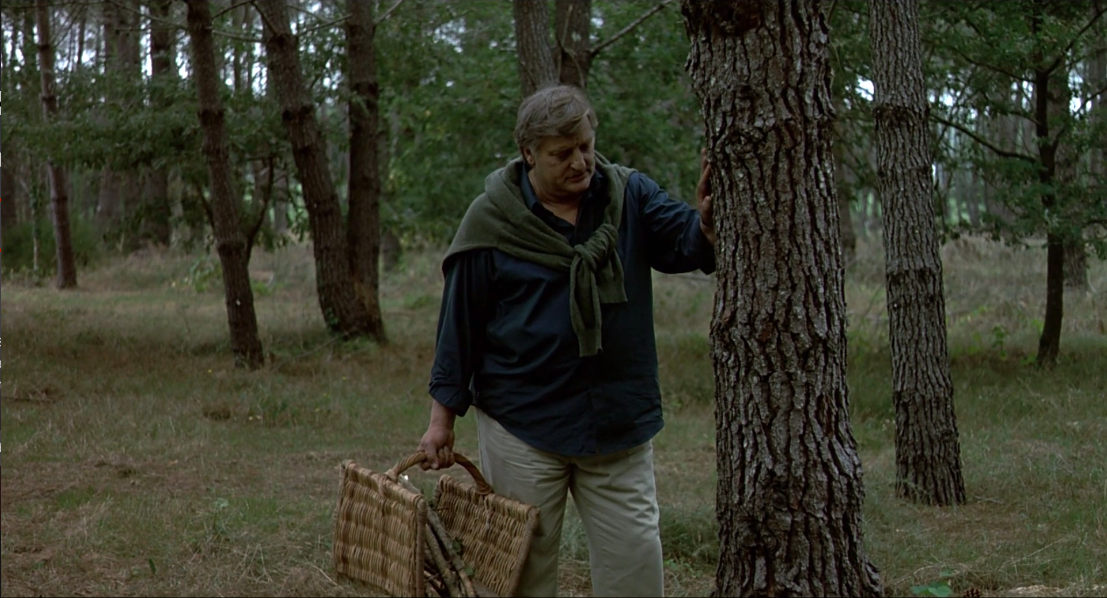
If one on the goals of art is to wake us up, to remind us what it is to be alive, one of the main ways of doing this is by bringing us as close to death as possible. This is why suicide is such a fruitful and, paradoxically, invigorating artistic subject. For the suicidal character approaching death, sensations are heightened, and life becomes fecund and tactile. One scene that captures this is in Francois Ozon’s Under the Sand (2000), just before Charlotte Rampling’s husband (Bruno Cremer) disappears into the ocean while she naps on the beach. The film never explains the husband’s disappearance—never confirms that it’s suicide—but the evening prior, the camera follows Cremer as he gathers firewood in the forest surrounding their vacation home.
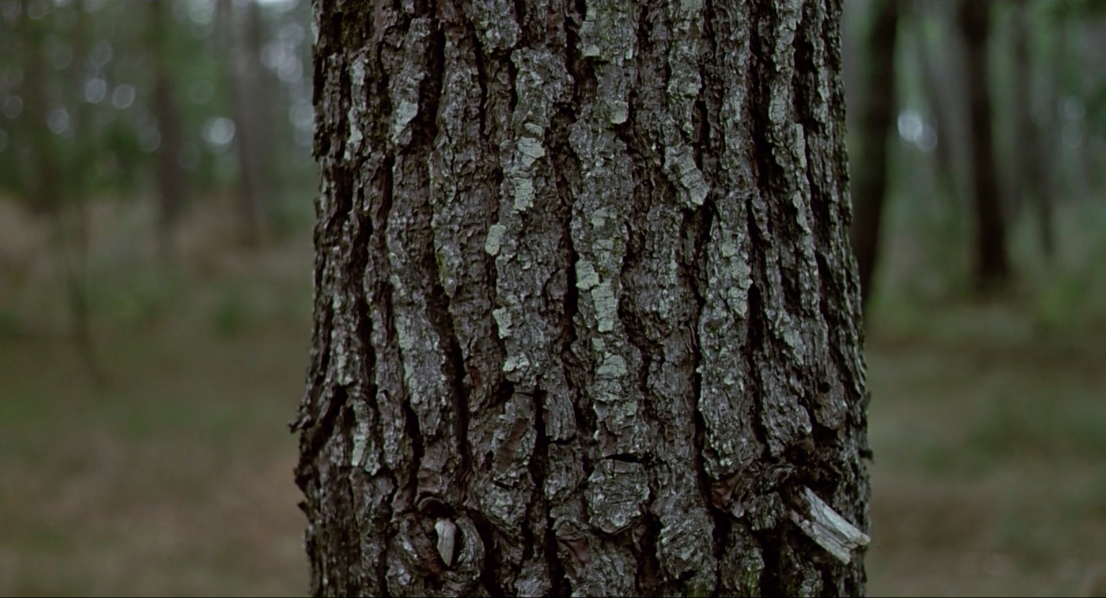
He picks up a few sticks, then pauses at a tree and feels its bark, runs his hand down its trunk, as if he wants to feel the rough surface one more time before dying. The camera follows him as he passes behind another tree, then something unexpected happens: the shot stops on the tree while Cremer passes out of view, lingering in sharp focus on the nooks and crannies of the tree bark, showing the viewer just how wondrous a tree is, if only we could stop to see it. This is also a great example of Deleuze’s concept of “time-image,” when a film emphasizes time or duration rather than the movement of characters and plot. We then return to Cremer, who has crouched down and turned over a rotting log. Hundreds of ants scurry around—so much life, right there!—in juxtaposition to Cremer, alone in the forest.
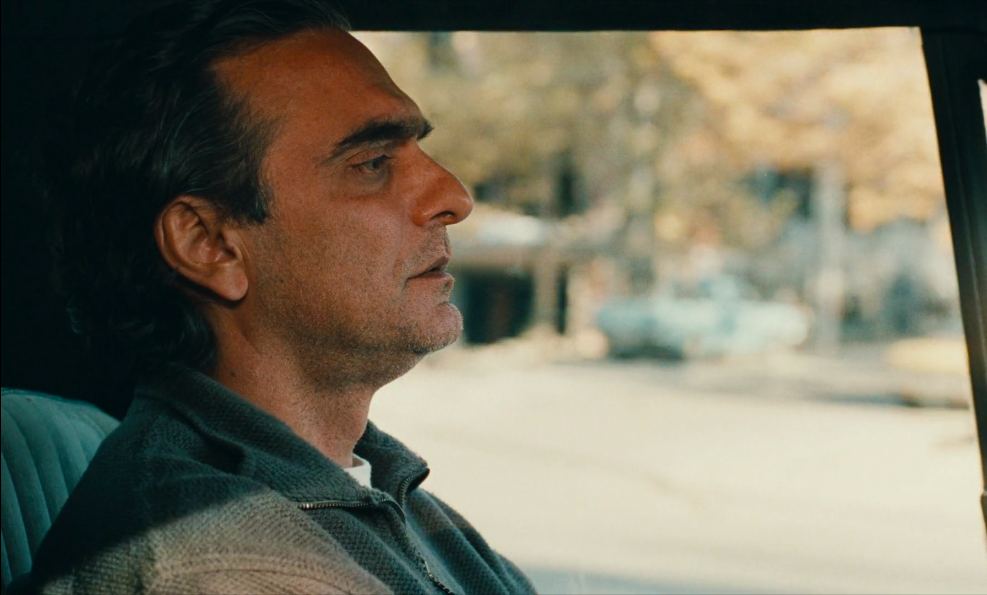
This contrast of the isolated individual and the group is a recurring theme in Abbas Kiarostami’s Taste of Cherry (1997) as well. Paul Schrader famously imagined a man in a yellow cab as a symbol of loneliness and alienation, but Kiarostami took this idea even further—what if an entire movie was just a man in a car, driving around? That’s Taste of Cherry. The film is a series of vignettes as the main character (Homayoun Ershadi) motors around the outskirts of Tehran picking up one passenger after another, not as a taxi driver, but in search of a person he can convince to do a special job.
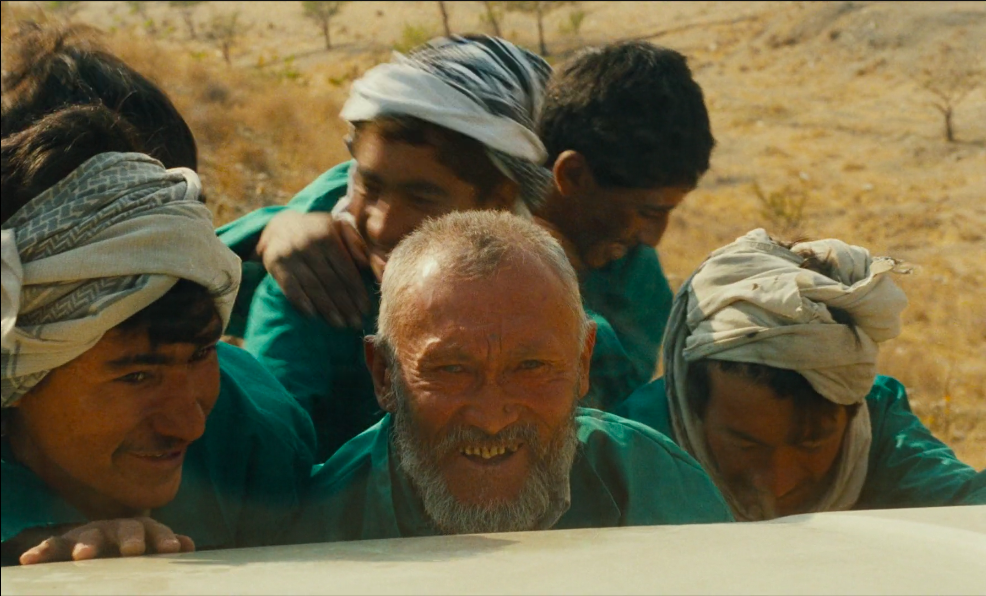
Here’s the sequence of characters who interact with Ershadi: A group of laborers looking for day work, a man fixing a date in a phone booth, two children, a man collecting plastic bags from a construction site, a teenage boy on his way to the army barracks, a security guard at a construction site, a seminarist, a taxidermist at a museum.
Each character’s situation contrasts with that of Ershadi. We see that they are tethered to life in one way or another, whereas Ershadi, for reasons that are never explained in the film, is not. He has money, a car, and a strikingly handsome face (to my mind, a mix of Oscar Isaac and Bruno Ganz), but no one to whom he can turn in his time of need, which is why he’s picking up strangers from the side of the road. In the first scene, we look at Ershadi through the windshield of his car (a typical Kiarostami shot) or from inside his car, as the camera alternates with shots of the laborers standing around outside his window. Beyond the confines of the car there’s a sense of life, an energy from which Ershadi is cut off. The laborers are in groups of three or four, scattered around, smoking, talking, waiting, and they stare at the camera as Ershadi drives by, meaning they stare at us, the viewer. We are put in the position of Ershadi, and it feels as if we, too, are isolated from the raw life outside of the car.
The later interactions continue to play with this tension of the individual and the collective. The man in the phone booth—another symbol of isolation—is on the phone planning to meet his girlfriend at a museum (later we see them at the museum, when the woman asks Ershadi to take their picture); the children are in an abandoned car, but together (“playing cars” they say); the man collecting bags is doing so to earn money for his family; the teenage boy is a member of the army, but when Ershadi finds him he’s been separated from his group; the security guard is alone in an outpost that can only be reached by a ladder, but his friend the seminarist is visiting him; the seminarist is outside the seminary; the taxidermist—the first person to agree to Ershadi’s request—does so because he needs to pay for his son’s medical treatment. Each character exists on a spectrum: on one end, there’s Ershadi, the supremely isolated individual, and on the other, there are groups that would seek to suppress one’s identity in the service of the collective. Kiarostami enjoys showing us these groups—there are frequent shots of soldiers in training, running as a group and chanting, and there are images of schoolchildren, too, running laps around a blacktop for gym class.
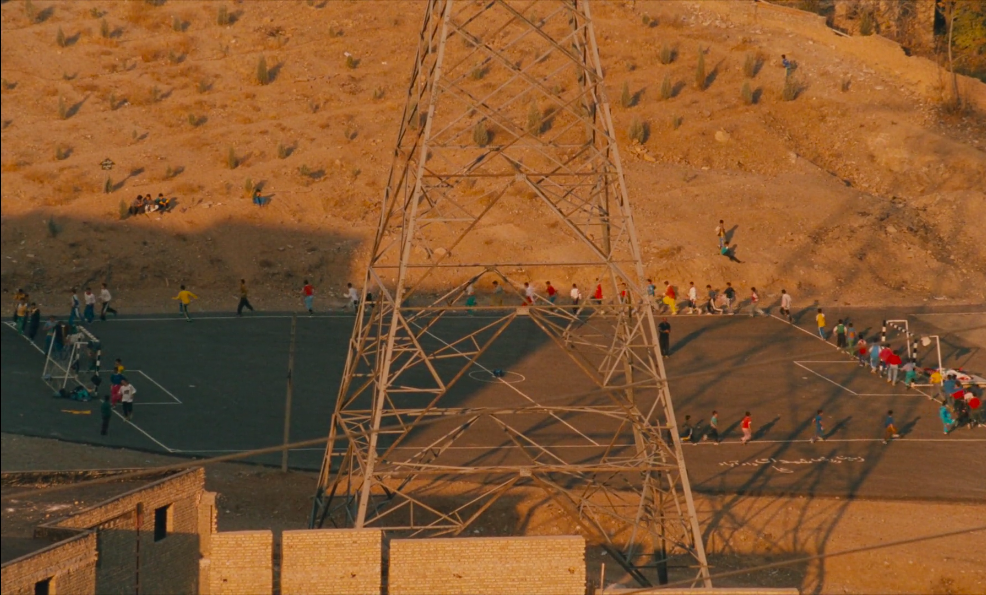
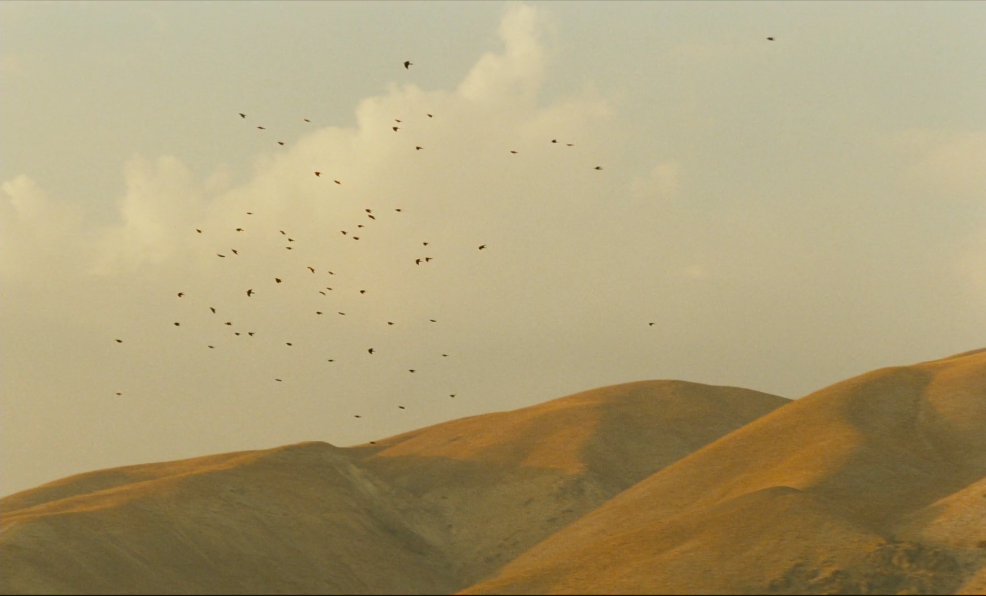
Ershadi tells the young soldier that military service was “the best time of my life. I met my closest friends there.” He begins to reminiscence about the maneuvers they would do and how they would chant with the major: “One! Two! Three! Four!” He implores the boy to count as well, which he does, timidly. It’s a playful and touching moment, but it’s also clear—that period of Ershadi’s life is over, his access no longer permitted to this place in society. When the boy finally learns of the “special job” he’s been recruited for—burying Ershadi in a hole after he overdoses on sleeping pills off the side of the road, or, alternatively, pulling him out of the hole if he’s still breathing—he runs off down the hillside, eager to rejoin his unit and leave the crazy stranger behind. Ershadi looks up to the sky and, just like Cremer in Under the Sun staring at the scurrying ants, sees a group of around thirty birds dipping and diving in the air. The camera lingers—Kiarostami’s camera always lingers—and then we cut back to Ershadi’s gaze, which seems to say, if only I could be a bird in the sky, doing bird things with other birds, how easy life would be. Visually, the shot reminds us of the other group shots in the film—the training soldiers, the running children—indicating that humans gather in groups and do human things, too, but Ershadi has forgotten how to do this.
I mentioned Bruno Ganz before, and I was specifically thinking of Ganz in Wings of Desire (1987), wherein he plays an angel who decides to become a mortal human so that he can fully experience life. The theme is the one we’ve been exploring—to appreciate life, one must also accept death. When Ganz transitions from angel to human, the first thing he does is buy coffee from a street vendor. Because it’s cold, he warms his hands on the cup, then rubs his hands together for a long time. He’s never “felt” hands before—never known what it’s like to physically touch something—and he realizes it feels good, especially on a cold day. I was reminded of this when, in the scene with the security guard, Ershadi continually rubs his hands together. It’s an unnatural movement, perhaps a sign of nervousness, but as a visual symbol existing within the tradition of international, auteur cinema, I am sure other viewers have watched this scene and thought of Wings of Desire. Ershadi—like Ganz, like Cremer—is on the border between life and death, and his hands feel good. “When your hands are cold, you rub them together,” another former angel (Peter Falk) tells Ganz earlier in the film. “You see, that’s good. That feels good.”
Taste of Cherry ends with Ershadi in his makeshift grave by the side of the road, but we never find out if he dies or is saved by the taxidermist. The screen fades to black, then brightens again as we see grainy footage of the movie being made. Cameras are in the scene, as is Kiarostami as he directs the soldiers, telling them they can stop running and chanting. This is another classic Kiarostami move—inserting himself into the film, removing the suspension of disbelief, and breaking the fourth wall, to use the accepted term. This decision upset some critics; Roger Ebert panned the film and called the final scene a “tiresome distancing strategy to remind us we are watching a movie,” but for anyone familiar with Kiarostami’s films, we know we can’t simply accept this shot as “truth” whereas the preceding scenes are “fiction.” In Close-Up (1990), Kiarostami similarly included grainy courtroom footage that was meant to be understood as the documenting of a real trial, but it was later revealed that certain courtroom scenes were fabrications made to appear as reality (in other words, exactly what a movie does). Viewed this way, the final scene is not a break from the preceding film, but another step deeper into the world of the film itself.
If we look closely at this scene, we see Ershadi handing Kiarostami a cigarette. But it’s more than that—he lights it, takes a puff to get it started, then hands it over to the director, who puts it in his mouth. In the background, the soldiers run and chant in unison. This is not simply “behind the scenes” footage, rather, it is the first time in the movie Ershadi has achieved connection with another human being, and it can only happen after he has put himself in his grave, fully prepared to die. The passing of the cigarette may have been a spontaneous moment captured on film, or it may have been devised by Kiarostami; in either case, this shot was selected and put into the film in lieu of others. And is Ershadi himself here, still acting as “Mr. Badii,” or, perhaps, acting as himself? It’s impossible to say.
Throughout this essay, I’ve been referring to the actors by their names (Cremer, Ganz, Ershadi) rather than by the roles they play, and that choice has been intentional. When we talk about a movie, we don’t usually remember the names of characters, but we remember the actors, and certain actors are often said to be “born to play a role” because we feel that they have some affinity with the character they portray. In the case of Ershadi, he was seen by Kiarostami sitting in traffic one day. He had never acted before. One imagines Kiarostami seeing his face and coming up with the idea for Taste of Cherry on the spot.1 While writing this essay, I came across a truly incredible short story on the topic of Ershadi’s face: https://www.newyorker.com/magazine/2018/03/05/seeing-ershadi Ershadi had lived in Canada from 1979 to 1990, then returned to Iran after divorcing from his wife. His children continued to live in Canada. At one point in the film, he vaguely gestures at what’s gone wrong in his life: “When you hurt others, isn’t that a sin? Hurting your family, your friends, hurting yourself.” I can’t help but feel that Ershadi’s personal life and the role he plays in Taste of Cherry have some deep connection; the way he seems a man out of time, a rootless wanderer, must, I think, connect to his life story. Or maybe this is just more Kiarostami sleight of hand.
***
Enjoying the content on 3QD? Help keep us going by donating now.
Footnotes
- 1While writing this essay, I came across a truly incredible short story on the topic of Ershadi’s face: https://www.newyorker.com/magazine/2018/03/05/seeing-ershadi