
by Laurie Sheck
1.
It has been over 200 years since Mary Shelley began writing Frankenstein in the stormy summer of 1816. Although she was only eighteen, she had already lost one child just days after giving birth; her second child, William, was a few months old. By the time Frankenstein was published, in 1818, Mary had given birth to a third child, Clara Everina, who would live for a little more than a year. It was within this context of rapid cycling between birth and death, welcoming and loss, joy and pain, that Frankenstein came into being. Mary’s own mother, the writer Mary Wollestonecraft, had died thirteen days after Mary’s birth.
The first edition was published anonymously on January 1, 1818, by the small London publishing house, Lackington, Hughes, Harding, Mavor & Jones, with a dedication to Mary’s father, the writer and political philosopher William Godwin, and an unsigned preface by Mary’s husband, Percy Shelley.
The reviews, though mixed, could be searingly negative. Most of them assumed the author was a man. Several conjectured the author was Percy Shelley himself.
“Our readers will guess from this summary, what a tissue of horrible and disgusting absurdity this work presents…Our taste and our judgment revolt at this kind of writing…it inculcates no lesson of conduct, manners or morality…it fatigues the feelings without understanding; it gratuitously harasses the heart….” The review ends wondering whether “the head or heart of this author is the most diseased.” (The Quarterly Review, January 1818).
A review in La Belle Assemble, was more positive, “This is a very bold fiction.” So was Walter Scott’s review in Blackwood’s Edinburgh Magazine where he pronounced the book, “An extraordinary tale, in which the author seems to us to disclose uncommon powers of poetic imagination,” though he found the self-education of the Monster, “improbable and overstrained.”
Although The Edinburgh Magazine found the Monster to be “a very amiable personage” it encouraged the anonymous author to “study the established order of nature as it appears…than to continue to revolt our feelings by hazardous innovations.”
The British Critic also referred to the “diseased” and “wandering imagination” of the author and suggested the writer “might be disciplined to something better.” “The writer of it is, we understand, a female: this is an aggravation of that which is the prevailing fault of the novel.”
2.
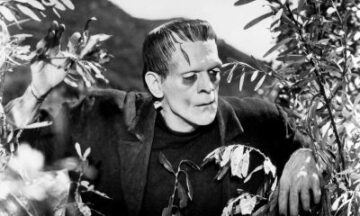
Always when I think of it, what stays with me most deeply is the Monster’s searching, isolate voice. How beautiful it is. How pained and thoughtful. Though his maker, Victor Frankenstein, and the sea captain, Walton, dwell on the hideousness of the Monster’s physical appearance, it is his monologues, full of longing and loneliness, that remain most powerful. The eloquent, wounded voice of the outsider, the rejected, the shunned, the despised.
“My form is a filthy type of yours,” he says of himself, with heartbreaking directness. Having been abandoned by his maker at the moment of his “birth”, he has been left to wander through the woods alone, cold and exposed, foraging for berries and wondering who he is and how to understand the world around him.
“I was still cold when under one of the trees I found a cloak…all was confused, I felt light, hunger, and thirst and darkness.”
Yet even in his fear and confusion, he experiences wonder. “I was delighted when I first discovered that a pleasant sound, which often saluted my ears, proceeded from the throats of the little winged animals who had often interrupted the light from my eyes.”
Eventually he finds a makeshift shelter beside a cottage where he learns language and reading by overhearing the cottagers inside. By that time he has come to understand that his appearance repulses all who see him: his “watery eyes that seemed almost the same color as the dun-white sockets in which they were set,” his “shriveled complexion and straight black lips”, his monstrous size, his hand “in color and apparent texture like that of a mummy.”
He is able to observe and hear the cottagers through a hole in the wall that keeps him from their sight.
Later he finds a satchel of books in the forest and through his reading learns more about the strange race that has made him and yet shuns and fears him. “Increase of knowledge only discovered to me more clearly what a wretched outcast I was.” This knowledge brings him an almost unbearable sorrow.
Each time I close the book, what stays most feelingly in my mind is not the Monster who murders, but the Monster who asks amid the unanswering, rejecting world, “Who was I? What was I? Whence did I come?” Who lay on his bed of straw and could not sleep. Who says from the depths of his heart, “I am solitary and abhorred.”
3.
What is a monster?
In his essay on Frankenstein, Peter Brooks describes it this way: “A monster is that which cannot be placed in any taxonomic schemes devised by the human mind to understand and order nature. It exceeds the very basis of classification…it is an excess of signification, a strange byproduct or leftover of the process of making meaning.”
How frightening to be such a being. A byproduct and leftover of the making of meaning. How lonely and unseen.
The word monster is derived from the Latin monstrum which signifies a portent or omen, and which itself derives from the verb monere, meaning “to warn”. Though innocent and open at first, the monster comes to understand he was born into the prison of this word.
This word of haunting and recoil. As when Victor Frankenstein, recounting how the Monster tracked him down and begged him to hear him out, refers to his creation as “this filthy mass that moved and talked.”
What comforts and certainties does a monster, by his very being, call into question? What complacencies shatter when he speaks? In what ways does his very existence destabilize the known? His beating heart, his thoughts, his breaths. What happens to comfort in the face of his sorrow and his isolation?
4.
In 1831, Alexis de Tocqueville, then a young magistrate in France, accompanied by his friend Gustave de Beaumont, traveled to the United States under the auspices of the French Ministry of the Interior, to study the American penitentiary system.
Their report, On the Penitentiary System in the United States and its Application to France, contains devastating observations on the practice of solitary confinement. The report focuses on two prisons in particular: Eastern State Penitentiary in Pennsylvania and Auburn Prison in New York. Eastern State employed a system of total isolation, “The convict, once thrown into his cell, remains there without interruption…He is separated from the whole world…” whereas at Auburn the prisoners worked side by side during the day but were entirely prohibited from speaking or even looking at one another. At night they were locked in solitary cells. “They are united but no moral connection exists among them. They see without knowing each other….their bodies are together but their souls are separated.”
The two young writers noted the catastrophic effects on the prisoners, “This absolute solitude, if nothing interrupts it, is beyond the strength of man; it destroys the criminal without intermission and without pity; it does not reform, it kills.”
These effects were also brought painfully to life by Charles Dickens when, a decade later, he too visited America and wrote about Eastern State Penitentiary in his American Notes. Of prisoners in solitary confinement he writes, “He never hears of wife and children; home or friends; the life or death of any single creature. His name, his crime, and term of suffering, are unknown, even to the officer who delivers him his daily food…He is a man buried alive.”
The guards describe to him the consequences of prolonged isolation: “…a complete derangement of the nervous system. They can’t sign their names to the book; sometimes can’t even hold a pen; look about them without knowing why, or where they are; and sometimes get up and sit down twenty times in a minute…Sometimes they stagger as if they were drunk.”
Mary Shelley’s Monster moved through the forests and fields of the world, no walls confined him, but he lived in isolation all the same.
5.
“No one is immune from wanting a master narrative, from wanting to be comforted by coherence.”—Teresa Godwin Phelps
6.
In her book, Ethical Loneliness, the philosopher Jill Stauffer writes about the experience of suffering and being abandoned by humanity. How this particular loneliness occurs when a traumatic experience, such as living through the Holocaust, is followed by the state of being refused a hearing; one’s experience goes unheard. It is “the experience of having been abandoned by humanity compounded by the experience of not being heard.”
“Ethical loneliness is the isolation one feels when one, as a violated person or as one member of a persecuted group, has been abandoned by humanity, or by those who have power over life’s possibilities. It is a condition undergone by persons who have been unjustly treated and dehumanized by human beings and political structures, who emerge from that injustice only to find that the surrounding world will not listen and cannot properly hear their testimony…on their own terms.”
Emmanuel Levinas: “The other who exposes himself in the face…and is destitute…is the poor one for whom I can do all and to whom I owe all.”
“The face is the extreme precariousness of the other.”
The Monster: “I entreat you to hear me before you give vent to your hatred…I am thy creature….I ought to be thy Adam, but I am rather the fallen angel, whom thou drivest from joy for no misdeed….”
“How can I move thee? Will no entreaties cause thee to turn a favorable eye upon thy creature…my soul glowed with love…”
7.
At the end of Mary Shelley’s book, the Monster is “borne away by the waves and lost in darkness and distance.”
Where is he now? What words would he speak if we could hear him?