
Steven Greenblatt in Harvard Magazine:
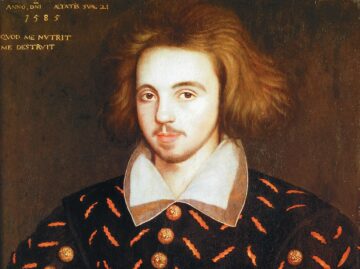 He was a radical, the inventor of blank verse, a master of internal monologue, and a victim of murder. This was the English playwright Christopher Marlowe, a contemporary and rival of William Shakespeare—and perhaps the Bard’s key creative influence. At 14, young Marlowe—the son of a poor Canterbury cobbler—won a scholarship to the prestigious King’s School, becoming the first in his family to receive a formal education. He excelled, went on to the University of Cambridge, and there studied the great works of antiquity, from Virgil’s Aeneid to Ovid’s Metamorphoses. Where his classmates saw musty mandatory reading, Marlowe found something else: worlds of ecstatic violence and erotic excess, of vengeful outcasts and capricious gods, worlds that upended the Christian moral order in which he was raised.
After graduation, Marlowe faced an uncertain future—unlike his wealthy classmates, his education didn’t secure for him a place in society. So, he decided to take a risk, moving to London to try his hand at an unstable, disreputable profession: writing for the stage.
More here.
Enjoying the content on 3QD? Help keep us going by donating now.