
by Jeroen Bouterse
 In Timur Vermes’ best-selling novel Er ist wieder da (‘He’s back’), Adolf Hitler wakes up in Berlin. Somewhat disoriented after discovering the year is 2011, he soon finds his way to the public eye again: he is understandably regarded as a skilled Hitler impersonator, an excellent ironic act for a 21st-century comedy show. His handlers don’t mind the fact that he never breaks character.
Clips make it to YouTube, and the ‘Führer’ becomes a beloved persona. After humiliating the ineffectual leader of a far-right fringe party, he is assaulted by skinheads. Politicians express their sympathies, a book deal follows. The novel ends with its main character at the head of an up-and-coming party, whose slogan is: Es war nicht alles schlecht – “it wasn’t all bad”.
Vermes puts Hitler in a Germany that believes it is finally able to laugh at him, or at itself through him. Commercial media encourage his popularity, which at first seems tongue-in-cheek but gradually turns out to be more than that. The country is unprepared for his literal-minded and violent racist madness – and for the traction it subtly gathers, the threads in our own discourse that it starts to pull on again. Everyone thinks they know Hitler, but fails to recognize him when he is among us now.
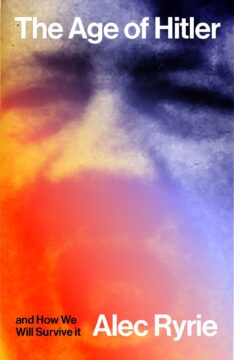
I thought of this story again as I read historian Alec Ryrie’s new book The Age of Hitler and How We Will Survive It. Ryrie’s thesis is that after the Second World War, the Atlantic and European world placed Hitler at the center of the Western value system (as its negative mirror image). This went at the cost of another historical figure, whose return we have similarly stopped expecting: in the nineteenth and early twentieth century, Jesus had represented a moral authority that was deeply felt not just by Christians, but also by free-thinkers and atheists. In the mid-twentieth century, Nazism became the new moral absolute. This model lasted for decades, but Ryrie discerns a new cultural shift, one that is happening now. With the age of Atlantic hegemony, the ‘age of Hitler’ is coming to an end too. What lies beyond it is still up for grabs.
‘We will be alone’
Ryrie is tentatively optimistic about what the next synthesis could be, even though his own moral intuitions and sensibilities are fully of the age of Hitler. “I feel in my bones”, he writes, “the conviction that Nazism is the modern embodiment of evil. […] So the prospect of those bedrock values shifting beneath our feet is frightening. But it is plainly happening.” One of the things that make Ryrie such a perceptive cultural historian is that he is contextualizing and historicizing his own deepest commitments. Even as a Christian, he observes, the narrative of Christ’s self-sacrifice does not affect him with the same immediacy as stories set against the narrative of the “true religion” of our culture: the Second World War.
That war is red-shifting, receding into the past, both because of the simple passage of time and because of the cultural and political changes that are reshaping our present. The prospect that we lose our connection with it indeed frightens me. I often think of words Angela Merkel spoke in 2018: “We will be alone, the generations born after the Second World War”. The then-chancellor warned the German Bundestag that there would be ever fewer Zeitzeugen – people who had experienced the Nazi regime firsthand (literally ‘time-witnesses’). We would have to draw our lessons for ourselves.
The political context was a controversy over the United Nations Global Compact for Migration. Merkel reminded her audience that one of the causes of the Second World War had been the failure of international cooperation after the First, and that both the United Nations and the original treaties for the protection of refugees had grown in the aftermath of the war that Germany started. Her appeal to what Ryrie calls “the sacred story” could still count on the support of a large majority, but not on that of the representatives of a new far-right party. The Alternative für Deutschland opposed the Migration Pact, and found Germany’s fretting over the past unnecessary.
Direct attacks on the ‘sacred story’ by some of its leaders – the Holocaust monument in Berlin was a disgrace; not all members of the SS had been criminals – mostly failed to gain traction. Those incursions were obvious, and broadly and easily condemned. Refugee migration proved to be a more effective wedge issue: even mainstream parties came to see the internationalism and respect for human rights at the core of the West’s self-definition as a bit of a burden. Shortly before the 2025 federal elections, front-runner Friedrich Merz tested the taboo against relying on far-right votes in the Bundestag, accepting their support for a motion demanding stricter immigration laws. He was immediately faced with large-scale protests and criticized by fellow Christian Democrats. He also went on to win the elections and become the current chancellor – but the cordon sanitaire had held for now.
To me, both episodes are evidence that the values of the ‘age of Hitler’ are worth affirming: though their hold on public opinion and politics has weakened considerably, they still function to keep dangerous forces at bay. Ryrie’s argument is interesting because he takes seriously the rise of anti-democratic and nationalistic politics – “monsters that we were told had stakes driven through their hearts stir and shamble back into life”. At the same time, he is looking at the end of the post-war era in an almost welcoming way: “it is indeed time to leave the age of Hitler behind us.” Why?
Pure evil
One reason is that Ryrie believes the lessons we have taken from the Second World War come with significant flaws and blind spots. For one, National Socialism has driven other and older crimes to the periphery of our vision: imperialism, slavery, or present-day forms of oppression that don’t look similar enough to that of the Nazis. On the Left, a wider view of racial oppression and other forms of exclusion, encompassing more historical reference points, is now gradually decentering the genocide committed by the Nazis. Ryrie is not sure how to think about that, but suggests it is not necessarily a bad thing. This progressive push for inclusion fits within the logic of the era of human rights, although Ryrie suspects it may have divided and weakened that consensus. It is one reason he believes a new synthesis between progressive values and older, ‘conservative’ or religious values is necessary.
Ryrie also sees risks in taking your world-historical lessons from a world-historically exceptional constellation. We know that appeasement failed in the 1930s, and it has become tempting to err on the side of escalation instead. As a Brit, the Suez crisis, the Falklands War, and the invasion of Iraq in 2003 come to Ryrie’s mind – as does the entire Cold War. He sees the ‘logic of anti-appeasement’ in the response to Vladimir Putin’s invasion of Ukraine, too. We are always convinced that whoever is given an inch will go on to take a mile, because our main mental model is the memory of the 1930s. There are good reasons to deter or punish aggression, and Ryrie does not mean to leave Ukraine to its fate; but in our obsession with Hitler, we forget how unusual his maximalist ambitions were.
The Second World War was also atypical in resulting in complete and unconditional surrender and the acceptance of the post-war order by the defeated country. One of the lessons drawn was “that evil can be defeated by force if you oppose it wholeheartedly enough”. This, too, is often not the case; and the idea that violence is a good thing, provided the aims are noble, has been applied too eagerly to Ryrie’s taste. The West needs to remember that wars generally don’t purify, but poison. Like Thomas Wells did on this website a few years ago, Ryrie even asks whether even the American Civil War was worth it, intolerable though the institution of slavery was. We have, in Ryrie’s eyes, centered something in our narrative that, even though it may sometimes be the lesser evil, is still intrinsically evil.
We have done so because war was what vanquished what we conceive of as the worst evil: Hitler. In replacing Jesus with Hitler as our moral reference point, “we have replaced a positive exemplar with a negative one.” We have also personified evil, and think of it as ‘pure’: there are baddies and they need to be beaten. But – here Ryrie’s historical sermon borrows a little bit from his theology – evil is hardly ever pure. It is often impersonal, and hardly ever embodied in something or someone that you can just kill. When even during Covid, the primary historical paradigm for a coordinated response to a deadly threat remained the Second World War, it hardly helped to make the correct calls.
Transcending the culture wars?
There is a dialectical logic to Ryrie’s cultural history: Christianity-centered ethics failed to prevent the horrors of National Socialism, and Western culture moved away from it, towards a universalist kind of humanism that seemed a more perfect opposite of Nazi ideology. After unfolding further, this ethical system is now suffering from over-stretch, trying to achieve too much with too few allies; it is losing the culture wars. In the last two chapters, Ryrie tries to look ahead at what a ‘new synthesis’ could look like. A historian of the Reformation, he knows a thing or two about deep cultural ruptures, and he believes we will find our way out: “I think some sort of resolution to this struggle is almost inevitable.” He addresses his last two chapters to progressive secularists and conservative traditionalists respectively.
Progressive secularists need to understand how dire their situation is, and should consider tapping into older, “rooted traditions” – Ryrie is primarily thinking of Christianity, but other options are available. Now that pluralism and universalism are weakening, we should add some serious particular commitments into the mix. We can’t just hover above the world deciding how it ought to be – we need to tether ourselves to it. That is, we need to attach ourselves to older wisdom and ethics, provided we do so in a reflective and critical manner.
‘Conservative traditionalists’ – Ryrie is thinking of Christian supporters of the politics of Trump, Orbán, Meloni or Putin – need to realize that these illiberal movements do not respect, but weaponize their tradition and identity. “The religious Right is hollowing itself out” by letting itself be more about politics than religion. It needs to regain a deeper, more confident sense of itself, to engage more with the moral lessons of the twentieth century, and to find room for humility over a ‘my tribe right or wrong’-attitude. “The traditions that prosper in this century will be those which find ways of transcending the culture wars”, Ryrie says.
His message to progressive secularists was slightly harder for me to hear, or less convincing, than his message to conservative traditionalists; but I appreciate the honest effort. Tactically, I agree that with some open-mindedness progressives and conservatives should be able to find each other, and realize that in the long run, they have a common interest in liberal democracy. My worry is that this is not a new synthesis that can finally start taking shape, as Ryrie hopes; but rather an old and fading one. The European Union was built by coalitions of social democrats, liberals, and crucially Christian democrats. It was the shared support of these ideologies for liberal democracy that constituted the postwar consensus in the West. Their alliance belonged to the ‘age of Hitler’ all along, and it is dwindling with it.
In the ‘sacred story’ of the rise, terror, and defeat of National Socialism, the parallels would not be with the genocide and world war in which that story ends, but with the crumbling of political support for the Weimar republic with which it begins. Hitler’s takeover is historically unique, but not in a way that undermines the lessons naturally drawn from it. The story of the disintegration of democracy in Germany holds a special warning for the West: a reminder that it can happen here, that there is no necessity, no exceptionalism that immunizes us against it.
If anything, those lessons remain underappreciated because Hitler’s party was an outlier in many other ways, and its reign so insanely murderous. Whenever I wonder why ‘people’ can’t see that X or Y is ‘exactly like 1933’, the correct answer is that obviously it is not exactly like that, because that is not how history works. The premise of Timur Vermes’ novel is openly and comically anachronistic. Literally speaking, the exact same thing can’t come back. Still, in a more abstract sense, something is back. Nationalism, xenophobia, racism, the undermining of the free press, of the rule of law, of international cooperation, of fair elections, the power grab of one party through the executive branch, oppression and threats against opponents, minorities and outsiders, the unscrupulous use of lies and propaganda – all of that has never been really gone, and a lot of it has become a lot more prominent in Western politics, with significant popular support.
At its zenith, the ‘age of Hitler’ may have served as a brake on these temptations. Now, at its end, the mental models it left us with make it harder to see the present dangers in their proper proportions. This is where Vermes’ fiction and Ryrie’s history meet each other: our obsession with the story of Nazi Germany stands in the way of its own moral. We know the time and place of National Socialism too well.
The proper response may indeed be to decenter it, adding more diverse, more precise historical references. Ezra Klein recently proposed to read the crackdown on left-wing speech by the Trump government in parallel not with the Nazi response to the Reichstag fire, but with the Red Scare of the 1950s. That seems like a wise suggestion. It is probably healthy, now that the old taboos are rapidly losing their force, to cease relying on them as heavily as we did.
Realizing, with Ryrie, that “the anti-Nazi story cannot do all the work we are asking of it”, is both tactically important and culturally necessary. Ryrie’s book is to be applauded for its self-searching and forward-looking nature; for some, it may even carry some therapeutic value. For myself, I realized rather how attached I remain to the age whose end Ryrie is heralding. I am grieving for what we are losing, and worried about what is ahead. That new synthesis had better come soon.