
by Dilip D’Souza
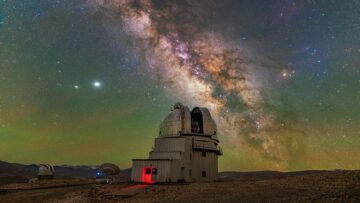 The Hanle Dark Sky Reserve is a spectacular spot in Ladakh, in the north of India. It’s surrounded by snow-capped mountains, and at 14000 feet, it’s well above the treeline. So the mountains and the surroundings are utterly barren. Yet that barrenness seems only to enhance the beauty of the Reserve.
But as the name might suggest, it is a place where you see some incredible night skies, and that’s really why it is spectacular. Last night was partly cloudy, but I saw the Milky Way arcing high above my head, as well as plenty of stars I would never see at home in Bombay. The dark sky is the reason there are two large optical telescopes here, operated by the Indian Institute of Astrophysics (IIA), in Bangalore.
And under that dark sky last night, taking several photographs of the stars that I’m inordinately pleased with, I also had plenty of time to ruminate. At one point, it was probably being at this IIA facility that had me thinking briefly – of all things – of a temple in Ayodhya. That’s the temple to Lord Ram, consecrated by the Prime Minister in January last year.
One day a few months later, a shaft of sunlight fell directly on the idol of Lord Ram in that temple, making for a gorgeous sight. At the time, I was reminded of a photograph I have somewhere, that I took in a cavern at the ancient fort of Masada, in Israel. A man stands there, reading a book, and there’s a shaft of sunlight directly on him, just like Lord Ram in Ayodhya. While that photograph owed everything to a hole in the roof of the cavern, the sunbeam in Ayodhya was a little more complex.
Of course it still needs a hole for sunlight to stream through. But once that happens, a clever positioning of mirrors and lenses directs the light onto Lord Ram – yes, far more impressive than my photograph from Masada. And when it happened for the first time last year, it was followed live by the Prime Minister and plenty of other Indians, plenty of whom applauded this triumph of Indian science.
Which is the connection to the Indian Institute of Astrophysics. It was the IIA that designed and built the mechanism that directs the sunbeam.
One of the country’s seniormost scientists – Abhay Karandikar, who got Masters and PhD degrees from the Indian Institute of Technology in Kanpur, a man who is now Secretary of India’s Department of Science and Technology – this scientist put out a series of tweets about this achievement, lauding the IIA’s ingenuity and expertise. “For more technical audience”, said Karandikar, “here is the sun light transportation principle.” An accompanying diagram showed this principle, and it is labeled “Periscope with Mirrors & Lenses”.
Indeed: this is a periscope.
There are details in the diagram: One mirror (“M1”) “shifts position every year (19 year cycle)”, and another (“M4”) is “flat”, and there’s “no tracking for Sun in East-West direction”, and other notations and sketches of components … but with all that, this is still a periscope.
Now I don’t at all intend to belittle this periscope. What an idea, to land a sunbeam directly on Lord Ram, and on a specific day, and do it with spot-on precision.
Yet, yet … For one thing: all over the world, our long-ago ancestors worked out the motion of the sun so that they could predict eclipses, for example. Or that you can make a hole somewhere so that at a particular time on a particular day, the sun shines directly through it. This familiarity with the sun is so intrinsic to the human experience that it even appears in the Tintin book “Prisoners of the Sun”. It’s because Tintin finds out about an impending eclipse that he can save himself and his friends from being put to death.
For another thing: a periscope is basic science we all learned as children. Possibly you even built one for yourself, as a school assignment. Me, I always marvelled at how submarines use more or less the same mechanism – mirrors in a tube that reflect light in given directions – for their periscopes. There are telescopes – like many at Hanle as I write this – that do similar reflections, sometimes using lenses instead of mirrors.
Meaning, all this is basic, solid, science – and much of it that school students will understand. It’s at the core of plenty of other more esoteric, advanced, complicated scientific endeavour. Meaning, a professional research scientist needs to understand the basics, certainly. But that’s not really what she will pursue in her daily work.
My point here is, once you know about the motion of the sun, and how mirrors and lenses change the direction in which light travels, none of what happened in Ayodhya is intrinsically difficult. It is, essentially, high-school level science.
Which means that the mechanism to direct a beam onto Lord Ram in Ayodhya is really an experiment in basic science akin to those you explored in school. Clever in concept, precision and execution, without doubt. A fine way to celebrate the God millions of Indian revere, certainly. But is this advanced science? A technological breakthrough? Is it a triumph of Indian science?
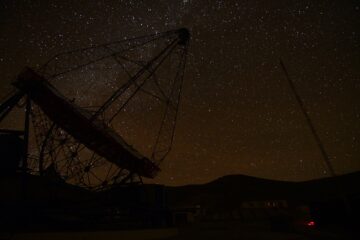
That last question, because this is a country that has plenty of remarkable scientific achievements to its credit. Where I am in Hanle is itself an example. The idea of exploiting the scientific value of a dark sky is a tribute to Indian science all by itself. That’s why this spot is home to the imposing MACE (Major Atmospheric Cherenkov Experiment) telescope. It is Asia’s largest and the world’s highest imaging Cherenkov telescope, capable of detecting high-energy gamma rays from objects like black holes. It does this using the cosmic phenomenon known as Cherenkov radiation. (What all that means, another time.) And who designed, built and inaugurated MACE last year? India’s own Bhabha Atomic Research Centre (BARC). It is now part of the Indian Astronomical Observatory in Hanle, the high-altitude station of the (same) Indian Institute of Astrophysics.
Or – staying with telescopes – there’s the Giant Metrewave Radio Telescope (GMRT) near Nashik. In 2016, it helped detect low-frequency gravitational waves for the first time – waves whose existence Albert Einstein predicted over a century ago. Doing so, the GMRT helped open “a new window of exploration in astrophysics, as well as deepened the conception of the Universe.” (This report).
So: sitting here in Hanle, I promise I’m not running down periscopes and well-directed sunbeams. I am saying just this much: please let’s celebrate and applaud science.