
Marta Figlerowicz at the Paris Review:
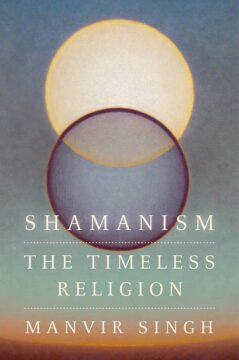 Shamanism defines religion as a yin-yang battle between its “shamanic” and “institutional” elements. The chaotic forces of individual prophecy, possession, and inspiration give rise to formal religious rituals and doctrines, which in turn constrict those same forces. Singh argues for an extreme broadening of what “shamanism” refers to. It encompasses not only Siberian and Pan-American Indigenous practices, whose similarities (and potentially shared Asian origins) have long been acknowledged, but also a broad and much more transcultural spectrum of phenomena including charisma, possession, mounting, glossolalia, dream journeying, catching the holy spirit, trance, and other things. These phenomena all involve inducing special states of consciousness in the “shaman,” their audience, or both, in order to communicate with the beyond: to speak with gods and ancestors, to see the future, or to discover one’s spirit animal.
Singh’s broadening of the conceptual sphere of what “shamanism” means is exciting. Hebrew prophets were shamans, he argues; so was Jesus. So were the ancestral early humans who etched drawings of hybrid human-animal beasts into caves secreted in the French countryside; so are the hedge fund managers of Wall Street and the New Age shamanistas of Burning Man.
more here.
Enjoying the content on 3QD? Help keep us going by donating now.