
by Thomas R. Wells

Many climate activists claim to believe that climate change is an existential threat to humanity if not the entire biosphere. This is the justification for groups like Extinction Rebellion to engage not only in demonstrations and civil disobedience to raise awareness of the issue and persuade fellow citizens to demand action, but also blocking and disruptive actions aimed at coercing governments and businesses to speed up the transition to net zero.
My point is simple. If you actually believe that climate change is an existential danger, then you should be demanding something that could actually save us from that danger. In the real world rich democracies are not a big enough part of the problem for their governments’ carbon policy choices to make much of a difference. The only climate saving action they could plausibly take is to develop effective and responsibly deployable geoengineering technologies. If climate activists genuinely believe they have a duty to save us from climate change, that is what they should be demanding.
I. The Climate Emergency Justifies Extreme Measures
Many climate activists claim to believe that the survival of humanity itself is at stake. In such a ‘supreme emergency‘, they argue, various otherwise immoral actions such as violating laws and the values and principles of democratic citizenship are justified – even morally required – in order to force the people in power to do what is necessary to save the world. For the purposes of this argument I will not challenge whether climate change presents such a supreme emergency. Instead I will work backwards. The justification for these activists self-appointed right to coerce democratic government depends on the effectiveness of what they demand. This is something they don’t appear to have realised.
Let me first lay out what I see as the justification for the democratically obscene behaviour of environmentalist activist groups like Extinction Rebellion.
Premise 1: The continuing acceleration of climate change due to greenhouse emissions poses a significant threat to the survival of humanity, which is the worst possible thing that could happen
Premise 2: Preventing the worst possible thing from happening is a higher goal that supersedes many other moral obligations and values (aka ‘supreme emergency’)
Premise 3: All kinds of actions that would normally be morally wrong (such as coercing democratic governments) become morally required if they would contribute effectively to preventing the worst possible thing from happening
Conclusion: Preventing climate change from ending humanity requires taking actions that would normally be morally wrong
Environmentalist groups like Extinction Rebellion have appointed themselves the guardians of humanity, with the concomitant moral duty to protect the rest of us from putting the continued existence of humanity at risk. This justifies attempts not merely to persuade fellow citizens but – in a clear breach of democratic values and principles – to coerce democratic governments and other institutions to obey the will of a minority. The key moral principle of democratic citizenship is setting aside your own sense of moral righteousness – your belief that society should be governed according to your values and principles – in order to respect the equal moral reality of everyone else in the only possible way: counting. But, since the counting might come out the wrong way on this crucial case, these climate activists have taken it on themselves to try to impose their conception of the right and the good on everyone else (by coercing the government to do what they demand rather than what voters seem to prefer).
Unfortunately such coercive efforts do not fulfill the effectiveness requirement of Premise 3 so long as they are only directed to the rather strange goals that groups like Extinction Rebellion presently demand from governments:
- Declare a climate emergency
- Act now (?) to achieve Net Zero
- Abandon liberal democracy for a system of carefully managed focus groups (?!)
Only one of these is about action, and it is extremely vague when you consider that this is supposed to be an emergency.
Perhaps this should not be surprising. Coercive climate activism can only really operate in liberal democracies, which tend to be rich and have a high tolerance for principled dissent. If they tried to coerce other kinds of government, like those of China or India, they would quickly be murdered or imprisoned. But the rich democracies have been reducing their greenhouse gas emissions for decades. Maybe they could go a bit faster, but it is hard to see that making much difference to the global outcome. Global greenhouse gas emissions now overwhelmingly come from countries that are not rich democracies, and hence have little to do with the decisions of the governments that these activist groups are trying to coerce. Thus, what these activists currently demand from their governments can never succeed in achieving their goal of saving the world from climate change.
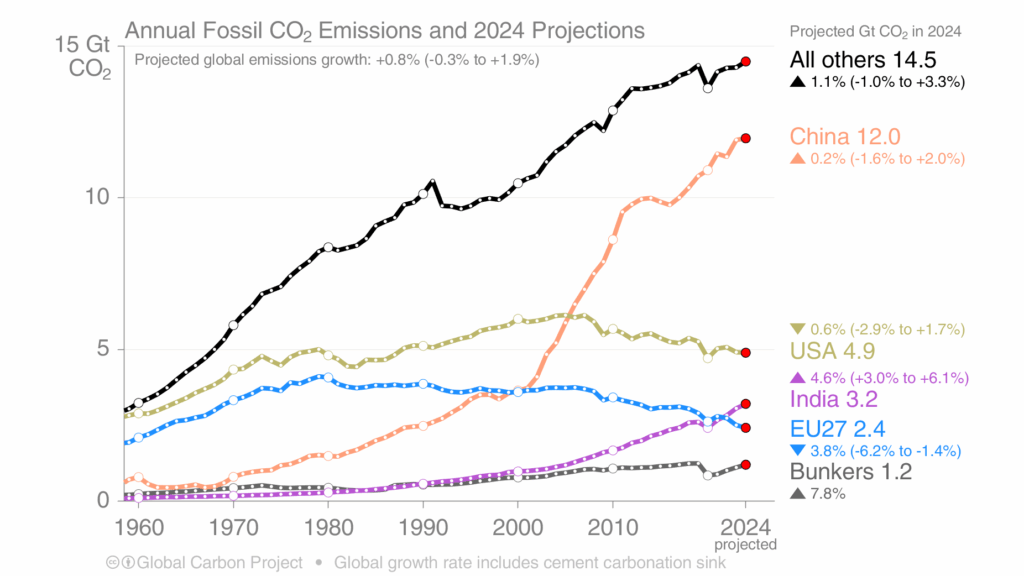
It is true that the governments of rich democracies could make additional indirect contributions to reducing greenhouse gas emissions. This is especially because a lot of the emissions by non-rich countries come from their high reliance on coal to support the expansion of electricity supply that accompanies economic development. One can support these countries’ right to development without supporting their right to base it on coal, and create various helpful (green technology diffusion) and coercive (carbon taxes on imports) policies to guide it in a direction that does less harm to the climate.
But of course these are not the kind of ‘actions’ that coercive climate protest groups have in mind. Also, it must be admitted that their effectiveness depends on the choices of other governments with their own differing motivations; and, even if they did fully succeed, they would merely slow the pace of growth of global emissions rather than reduce the quantity of greenhouse gases in the atmosphere that ending climate change would require.
The problem then is this. Environmental activists believe they have a moral duty to break laws and the conventional moral values and principles of democratic citizenship in order to coerce their governments into taking effective actions to save humanity from the existential danger of climate change. But none of the actions they are demanding their governments do would actually be effective in achieving this goal. This is because they are focused on accelerating greenhouse gas reductions by a handful of countries that make up a fast declining share of emissions. Climate change mitigation is a global problem that cannot be solved by one or a few rich democracies. (Actually it cannot be ‘solved’ at all, only better or worse managed – see further.)
This means that climate activists’ own argument for their self-appointed duty to coerce democratic governments has failed. Even if they are correct that climate change is an existential threat that justifies taking immoral actions to prevent, the demands they are currently trying to impose on their fellow citizens cannot be justified by that principle. Their crimes against democracy are real. Their claims that their crimes will help save the world are implausible fantasies. They leave us with the original problem of accelerating climate change, plus a new threat to the values and functioning of democracy (to add to all the others we already have).
2. The Right Thing to Demand is Geoengineering
Even if the world is in existential danger that cannot justify coercing democratic governments to achieve net zero more quickly. Is there any demand that it could justify?
We are looking for something that meets 3 key requirements:
- It is something that would actually prevent the supposed existential danger posed by climate change
- It is something that the governments of rich country democracies could actually achieve (alone or in cooperation with a few others)
- It is something these governments would be unlikely to undertake without coercive (anti-democratic) pressure
I think there is something that meets all the requirements: geoengineering.
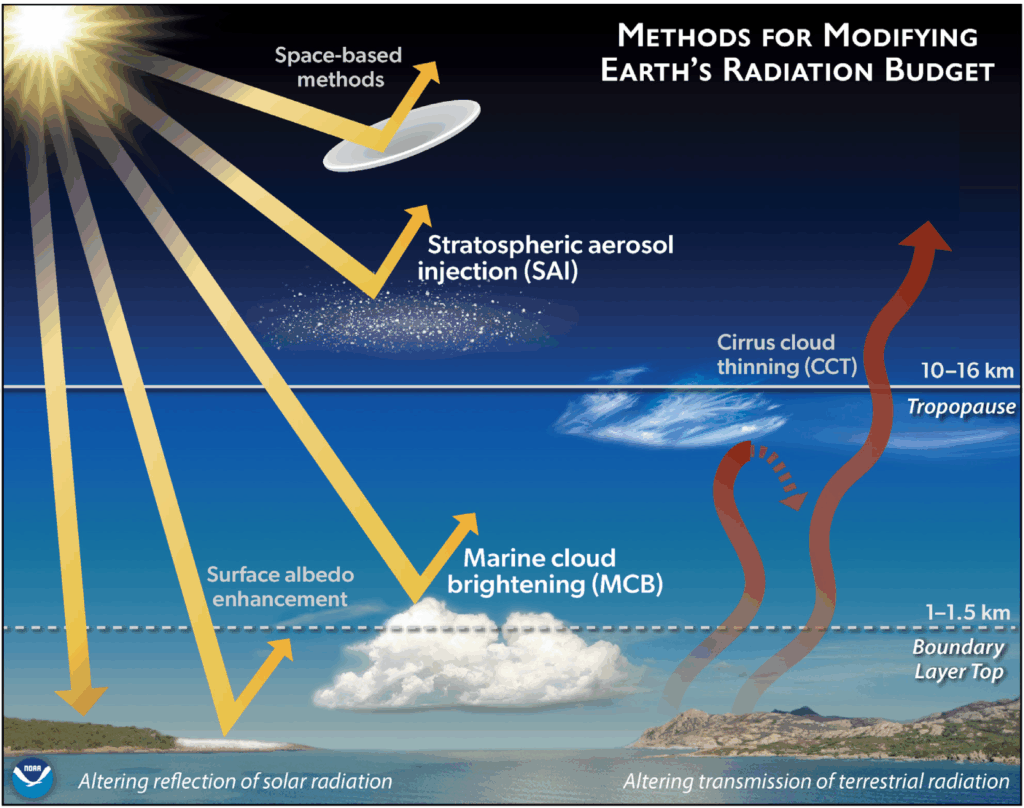
Greenhouse gas emissions from human activities cause a decrease in the amount of heat that escapes into space. The resulting temperature increases disrupt regional climate systems. Reducing greenhouse gas emissions doesn’t reduce global temperature; it merely slows down the rate that it continues to increase. Carbon dioxide molecules in particular have a small warming effect each, but persist in the atmosphere for decades to centuries – so significant further global warming is already inevitable however successful we are at reducing global emissions in the coming decades. Actually stopping the temperature from rising would require a different kind of intervention to reduce the amount of sunlight reaching the Earth’s surface or increasing the amount of heat from the surface that escapes into space.
And so we come to geoengineering, specifically solar radiation modification. There are multiple plausible technologies that could pause or even reverse the rise in global temperature that drives climate change, and do so within months of implementation. (See further, this recent UNEP report.) The front runner – stratospheric aerosol injection – mimics the fairly well-understood effects of volcanic eruptions and would be quite cheap – $20 billion or so per year to lower temperature by 1ºC (a rounding error for global GDP or that of major economies). Its low cost and relative technological simplicity means that many countries could even deploy it unilaterally, avoiding the global collective action problem on which conventional climate change mitigation efforts have so far failed to overcome (previously). It is thus eminently achievable by the kind of governments that climate activists are most focused on coercing.
It is true that even the stratospheric aerosol injection approach is not yet well enough understood in terms either of its feasibility at global scale and extended time-periods, or of its unwanted side-effects, especially in terms of the degree and distribution of the climate disruptions it would inevitably create. A massive research programme is required to find ways to maximise its effectiveness while minimising and preparing for those side-effects. Some kind of international governance structure is also needed for the project’s accountability and hence legitimacy and security against (geo)political risk. Hence the estimated 10 years or so before it could responsibly be deployed.
Even if deployed responsibly the world would certainly pay a significant price for trying to geoengineer our way out of the immediate dangers of climate change. Is this a reason for climate activists to reject it?
Not if they truly believe that climate change presents humanity with a ‘supreme emergency’. Remember, this is supposed to justify suspending otherwise significant moral values and principles, which would seem to include principles like ‘do no harm’. Compare with the medically correct treatment of a patient with an aggressive cancer. Dosing them with toxic chemicals and radiation might well be the best thing we could do for them, and hence the right thing to do, despite the significant harms inflicted by such life-saving treatment. If the world will die anyway without intervention, then even dangerous and harmful interventions are justified. (There is at least no plausible danger of exchanging one existential risk for another: an advantage of most proposed solar radiation modification techniques is that they can quickly be turned down or off if the treatment turns out to be worse than the disease.)
Other reasons that climate activists might think they have to reject geoengineering fall to the same challenge. For example, the conservation movement’s traditional commitment to reducing humanity’s interventions in the natural world. Or psychologistic claims about moral hazard: that the world will stop trying so hard to reduce greenhouse gas emissions once the pressure is off. Or the fact that other emissions related problems – particularly ocean acidification – will continue to get worse since they don’t operate through the temperature effect. However plausible these might be, they dwindle into insignificance when compared to the existential challenge that the activists themselves have identified. In a supreme emergency, this kind of climate activist declaims, the usual moral values and principles can and must be set aside. This surely applies to their own moral values and principles too. To oppose something that could actually save the world for such reasons would be an insupportable act of self-indulgence and hypocrisy.
Finally let us come back to the question of why climate activists should substitute geoengineering for their previous demands. The inevitable harms of geoengineering create powerful disincentives for the governments of rich democracies to take up this enormous opportunity to save the world. Taking it on would be a massive responsibility that would absorb a huge share of their administrative and political resources. Pathologically risk-averse governments would find themselves on the hook for complaints and compensation claims from every country and group who think they have suffered a harm, while receiving little to no thanks for their service. And so on.
These political disincentives create a gap between what democratic governments know they ought to do, and what they will actually do. Here finally is a constructive role for coercive, righteousness-driven climate activism, to provide an internal push to carry governments over that gap. (Climate activists could also engage their other – democratically virtuous – skills of persuasion to help build politically significant support for geoengineering among their fellow citizens.)
Thus, my conclusion: Any climate activist who genuinely believes that humanity’s existence is at risk from climate change ought to campaign for their government to develop feasible and responsibly deployable geoengineering technologies. If they believe further that the existential danger of climate change justifies anti-democratic efforts to coerce their government into doing ‘the right thing’, then geoengineering is that right thing. To demand anything less effective would be to admit that they don’t really believe that climate change is an existential threat.
***
Thomas Wells teaches philosophy in the Netherlands and blogs at The Philosopher’s Beard.
Enjoying the content on 3QD? Help keep us going by donating now.