
Andrea Lius in The Scientist:
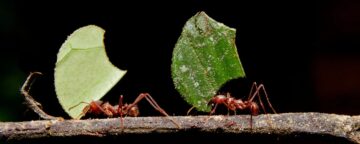 Some ants within the colony patrol the neighborhood to protect the nest from intruders, while others stay inside to care for the young. Various molecular mechanisms, from hormone and neuropeptide signaling to gene transcription and epigenetics, underlie these behaviors—some of which are highly conserved in evolution.1,2
…Ant colonies typically consist of queen and worker castes. In some species, such as the carpenter and leafcutter ants, the latter is further divided into multiple subcastes, which scientists can tell apart based on the animals’ size and behavior. Berger’s team previously studied subcaste-specific behavior in carpenter ants, where they found that a hormone called JH3 regulates behavior in the two worker subcastes: Major, the large “soldiers”, and Minor, their smaller counterparts that forage food and nurse the young.4 Next, Berger wanted to understand the molecular bases of behavior in a more complex species: the leafcutter ants.
“The leafcutters are the epitome of the most sophisticated ant system,” Berger said.
More here.
Enjoying the content on 3QD? Help keep us going by donating now.