
by Peter Topolewski
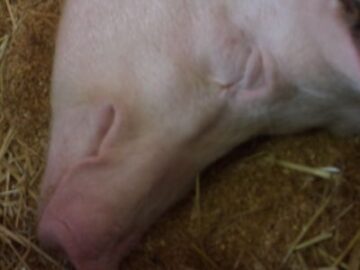 The 2020 documentary Gunda captures a stage in the life of a barnyard sow and her brood. The director, Viktor Kossakovsky, embarked on this mission to at least in part remind “us of the inherent value of life and the mystery of all animal consciousness, including our own.” It would be foolhardy to expect a real-life version of Wilbur from Charlotte’s Web, and anything resembling Babe would be a stretch. As we do have a tendency to humanize our animals, maybe there was a chance the film would come out like an extended video from The Dodo, where animals cooperate with warm hearts and easily recognized intentionality.
Wrong.
Like most wildlife documentaries, Gunda doesn’t show humans. Unlike most wildlife documentaries, it also lacks a narrator. Interestingly, however, at points throughout you can almost hear the voice of Werner Herzog from his own documentary Grizzly Man. That film tells the story of Tim Treadwell, a man who dealt with his life’s problems by spending summers among Alaska’s grizzlies. Where in the movements and faces of grizzlies Treadwell saw personality and intent, Herzog saw “no kinship, no understanding, no mercy. I see only the overwhelming indifference of nature.”
Why do Herzog’s words hover over Gunda? Isn’t all life connected, as the synopsis to Gunda implies? Yes, it is. All of life on our dear planet is linked and interdependent. If the web breaks, none of us, from the smallest to the largest, will find salvation moving to another planet.
But connection is not the message that came out of Gunda. At least not when viewed in 2025.
The film is less a following of the titular character and her piglets, and more a detached observation. You get the impression Kossakovsky often planted the camera and left it. There are many extended shots. One scene fixed on chickens confronting a fence made them appear completely other-worldly. And the feeling that lingered was how strange and different these animals are from us humans. How boring their lives are. How repetitive and how barren of meaning.
There is drama, though it’s difficult to imagine Gunda appreciated it, or had any sense of it, even when it was of her own making. Early on, Gunda kills—accidentally or intentionally, it’s impossible to say—a piglet. It was a straggler, maybe the runt. That’s a reminder to us viewers: the world is merciless.
Kossakovsky hammers the message home near the end, when any hope this family might live long, comfortable lives in their spacious keep is crushed. People, never shown only suggested by the barns and tractors, are the culprits. We unleash our technology for the mechanical, scalable, and unrelenting process of snatching the piglets from the sow. Life is cruel.
This 2020 film has reached into the present because it’s this cruel world we humans like to invoke to explain “harsh realities”. People today, as we have always, show a fondness for this one particular connection to the rest of nature. That it’s tough out there. It’s dog eat dog. The world—including the people in it—are indifferent and cold at heart.
It’s true, the world is full of harsh realities. Bullets bring the miracle of life to an end. Russian rockets raining down in Ukraine turn homes to rubble and bodies to pieces. Drug cartels terrorize Mexico with public torture. Gangs in North America run businesses to transmogrify people into shells of themselves from the inside out. Government forces deployed for dogma and photo-ops rip families apart. From a distance, these are abstractions. On the ground in Kharkiv, Culiacán, Vancouver, and Los Angeles they are brutally specific to an address, a time, a soul.
The perpetrators make the case that they are mere participants in this cruel world, responsible only to the extent they’re the adults. They are the brave ones willing to face the truth, to face the facts. If they didn’t do it, someone else would. That’s life.
A tempting theory, but it’s story telling.
We know what happened to Gunda’s piglets. We don’t get to see how she lived out her life. She might have gone on missing the young ones hauled away from her; she might have had more and never given that doomed farrow a second thought.
We do know Gunda never dreamt of mounting an opera. She never investigated ways to mitigate cellular instability. Same as we know no artic fox is going to decide to stop eating voles, and orcas are not going to start taking pity on seals.
But we could decide to stop eating pigs. And cows, fish, and chickens, too.
We could also decide to stop dropping bombs on Ukraine.
It’s lazy, saying we are animals without acknowledging our connection to nature at large and to each other, without admitting nature is not pure indifference, without owning up that we are also different from our animal cousins. No pig piloted a spacecraft, after all.
But we’re all lazy, sometimes.
What if we took Putin’s view and followed it right to the end? What if we went along with his way of thinking, of rationalizing the death and horror he has brought to Chechnya and Ukraine and his own “beloved” Russia? Through those eyes, what does an ideal world look like? How much ash and debris and how much blood and how many kidnapped children are enough to be happy?
When does a cartel leader in Mexico, or a gangster in Canada, have enough money, guns, and victims? When does he say, yep, I’m good now?
What if we couldn’t imagine a world where there was an alternative to cruelty? Only then, when we can’t imagine anything else, only then is reality as harsh as they describe.
That hasn’t happened. Possibility isn’t closed off to us. We have film makers like Kossakovsky showing us, we have painters and writers and scientists and volunteers showing us, reminding us, we’re human, we are not cruel and indifferent. We have kinship. We have understanding. We have mercy.
As long as we have those, we can imagine something else, something better. And one thing people have shown is that if they can imagine it, they can build it.
***
Enjoying the content on 3QD? Help keep us going by donating now.