
by Michael Liss
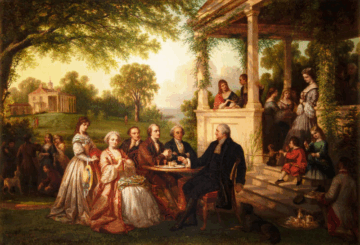
George Washington and his wife Martha were committed eaters and generous hosts. A meal was a serious affair: fine China, glassware and cutlery, a variety of spirits, wines, and champagne, soups and souffles, trifles, crisps, tortes, any number of things pulled or plucked from the soil or vines, harvested from the bays and rivers, or trapped, shot, or simply domesticated and destined for the table.
The couple preferred English-style cooking and apparently were fond of meat pies. For a Christmas meal one year, their kitchen turned out a family favorite—a cover-the-bases delicacy that called for a bushel of flour for crust, stuffed with five different types of boiled fowl—pigeon, partridge, duck, goose, turkey—all baked on high heat for four hours. I’m not sure what that might be called—perhaps “pipparduckoosekey”?
Of course, none of these monumental affairs began with George and Martha doing any of that pulling, plucking, sowing, reaping, boiling, or broiling. Nor setting the table, clearing it afterwards, washing up, polishing the silver, drying the China, or putting it away. The Washingtons had “staff” for that, quite a large staff, in fact.
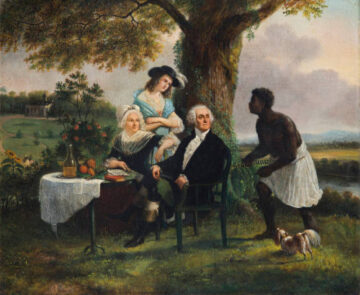
George and Martha kept slaves—per the Mount Vernon website, at the time of George’s death, there were 317 on the plantation. There is nothing to indicate Washington was a particularly difficult master, and Mount Vernon was in temperate Virginia, not some swampy, snake-and-insect-ridden killing field in South Carolina, but the “Peculiar Institution” was certainly vibrant enough there. As one might expect, the staff didn’t enjoy quite the same creature comforts as the Washingtons did. Again, from the website:
The standard slave quarter on Mount Vernon’s five farms was a rough one-room log structure with a wooden chimney, measuring about 225 square feet. Some dwellings were slightly larger and divided into two rooms, each housing a different family. As many as eight people could be crowded into a single room. They slept on pallets or on the dirt floor.
History is complex and contradictory, isn’t it? Certainly, one that demands you put inconvenient parts aside so as to appreciate the more celebratory. Still, this is George Washington, so let’s talk about the Father of Our Country’s personal qualities. No doubt he was uncommonly brave, an oak for the thin reed of independence to lash onto. He was incorruptible, rigidly self-disciplined, and, as Parson Weems reminds us, even as a boy, honest in trees and axes.
He was also aloof, arrogant, immensely snobby, prickly, prideful, and, according to his political enemies (and he certainly had a number in his second term), a doddering old man under the malignant influence of Alexander Hamilton. Hindsight tells us that none of that matters very much when evaluating his immense, “indispensable” contributions to American independence, on the battlefield, by influencing the country to adopt a Constitutional structure, and by bringing legitimacy to the office he held for eight years.
Complex and contradictory, but still a great man. Let’s move on to Thomas Jefferson, a schemer, whisperer, adulterer—and enslaver who, as much as he claimed he detested the institution, did not free his slaves upon his death, but in fact mortgaged them. That same man penned our indispensable words, co-founded a political party that dominated the first quarter of the 19th century, and was a gifted diplomat, a craftsman of prose of the highest order, and a man who pressed for the Bill of Rights—surely the Silver medalist in the Founders Olympics. Our third President (and irritated he had to wait so long). That undeniably great man, who had some nearly unforgivable flaws. Except we did forgive those flaws and still venerate his memory. As we should.
I could add Abraham Lincoln, or Teddy Roosevelt, FDR, or any other American political figure who materially contributed to the success of this nation, and the same thing would be true. They all had an appetite for the job, but all were human, all made mistakes, all did things they had to have regrets for, or for which we have regrets on their behalf. JFK, who adroitly handed the Cuban Missile Crisis, and utterly bungled The Bay of Pigs. Truman, who correctly made what could be argued was the most consequential decision any President has had to make, but also, in 1947, helped create the infrastructure for what is now the American Security State. Are you sure you have a genuine, practical right of privacy? You don’t, and you can blame Harry a bit for it.
There’s an old saying that 100 Senators look in the mirror in the morning and see 100 Presidents. You need ego—a lot of it. Do you think Truman didn’t have it, because he was an aww-shucks kind of guy and he’d been a happy Senator who “inherited” the job from FDR? No, he had it—the feeling in his gut that no one else could do the job he could—and he showed it every minute of his whistle-stop tour against Dewey in 1948.
That people lust for the Presidency, that they reach as hard as they can for it, doesn’t necessarily make them able, or the better choice—even if they take the prize. The responsibilities of the office come at you fast. It’s not all state dinners and staged bill-signings and Easter egg rolls. The grandeur of the job, the immense power vested in the job, the orbs and scepters and toys that come with the job, carry expectations. Americans want a guy (so far, all we’ve had are guys) they can have a beer with, but he ought to look good in a dinner jacket. He represents us—he’s the face of America abroad, the center of attention wherever he goes, whether it’s for a parade or a funeral. His dignity is ours. His judgment is ours. His accomplishments and his failures are ours.
It’s a strange thing, our kind of democracy. We demand our individual liberties, yet weirdly cede part of them and even our futures to someone we’ve likely never met by granting that person enormous power to make life-altering decisions for us. He, in turn, acts almost without constraint, extending himself by using the surprisingly modern invention of the staff system—an Eisenhower innovation brought from his time in the military. So, when you think fondly of a President, what you are also doing is admiring his ability to choose the right people who can execute on his vision. The actual method of “execution” may be a bit seamy, so it’s best to turn away and just accept the results.
How to reconcile that in light of Teddy Roosevelt’s words: “Character, in the long run, is the decisive factor in the life of an individual and of nations alike”? We reconcile it by ignoring what we cannot explain. The fact is, we generally don’t judge Presidents by their character—we judge them by their effectiveness and their ability to deliver on what we care about. It’s our own hypocrisy, not theirs, when we wrap them in false virtue to make us feel better about applauding the ends no matter what the means.
That hypocrisy co-exists uneasily with another question: what do we expect from our institutions? If we can’t be brave, can’t stand up for ourselves, who can? This may come as news to some in the current environment, but there are in fact three branches of government, supposedly co-equal.
“Supposedly” is my word. “Co-equal” shouldn’t be coming with qualifiers, but that never has been entirely true. Presidents (including Washington, Jefferson, Lincoln, TR and FDR) have always strained against the reins and, on any number of occasions, their co-equal branches have given ground. The modern Presidency is a far more powerful office than it was in Washington’s time, and, regardless of what anyone associated with the Federalist Society might tell you, a far more powerful office than many of the Founders anticipated—or would have approved of. We know this because they didn’t in the drafting. They debated, at length, the scope of the Executive Branch’s authority; they were mindful that the job had to be big enough for George Washington to take; they turned aside a serious effort to vest authority over war and peace, foreign affairs, and pardons in the legislature, and a more quixotic one to have a triumvirate, with each region getting a “President.” They lobbied, they compromised, they installed “checks and balances,”came up with something they could agree to and was “ratifiable,” and it was done. Nowhere does a concept of a Presidency without limits appear—in fact, the opposite is true. Take a look at Articles I and III of the Constitution, and you find a number of “sole powers” that are clearly not in the President’s purview.
We declared independence from one King, and we weren’t prepared to adopt another. When the Federalist Party presumed too much power, another political party, the Democratic-Republicans, was created, and, by 1800, the public was ready for it. Thomas Jefferson’s victory over John Adams was called “The Revolution of 1800”—a sharp turn away from the Federalists’ more conservative, more monarchical, less democratic course. A comprehensive revolution it was—within just a few years, much of the Federalist Party became extinct.
That was more than 200 years ago. Time to talk about the present. Whatever your feelings about Donald Trump might be, you’d have to concede a historical fact: never before has one President arrogated to himself as much authority as Trump. I say that not as an insult, but as an expression of reality. His staff, a group that was selected for personal loyalty, accepts no limits other than those Trump himself puts on them. There is no prior model, in war or peace, that allows for this amount of reach. Amplifying this power, in a manner feared by the Founders, is the complete unwillingness for anyone to say no to Trump or his lieutenants. That includes an utterly servile GOP-controlled House and Senate, which have stood back from their Constitutional duties to allow Trump carte blanche. It also includes the conservative bloc on the Supreme Court, which, in its eagerness to participate in a conservative revolution, uses every procedural tool at its disposal to advance his agenda, and then puts a bow on it with Opinions that seem to have been taken from a different Constitutional Bible. SCOTUS isn’t attempting to constrain Executive Branch overreach; rather, it seems intent on barring the door to challenges to it.
Unfair to Trump? I think he would revel in it. He likes being the bad boy, likes breaking the rules. His base loves it—it’s great for the cameras, and Trump picks people who look good on TV while defending him to the maximum. There have been whispers of some small slippage, an occasional arched eyebrow from his side, but that’s as far as it goes. Get out of line like Thom Tillis and start polishing your resume, because there’s not going to be any room at the Mar-a-Lago inn.
What’s interesting about Trump is how different he is from any other President. They might have exceeded their authority, and fought Congress or the Court on one or two fronts. Trump juggles a dozen or more brawls at the same time. The Project 2025 playbook is in use, and the authors must be turning handstands in glee over such a pervasive flooding of the zone.
How pervasive? I did a private, unscientific poll. I subscribe to several publications and are on email lists of others that send out “breaking news” emails. Last week, on Wednesday July 9th, for a period of 15 hours, beginning at 6:00 a.m. and ending at 9:00 p.m., I did a count of all the emails that came in to just one address. I culled out the junk and solicitations, including political ones, the Substack pieces, and any email from a news organization that was just a compilation of recent articles. Below is what I was left with:
1. 6:17 a.m., Washington Post: Early Brief: “The profound implications of Trump’s evolving relationship with Putin”
2. 6:32 a.m., Washington Post: Politics A.M.: “Trump combats TACO reputation as White House extends tariff deadline”
3. 10:08 a.m., Washington Post: Trending Now: “Trump’s moves on immigration, Ukraine and the Epstein case are roiling the MAGA base”
4. 11:48 a.m., WSJ News Alert: “U.S. Measles Cases Climb to 33-Year High”
5. 11:16 a.m., NYT: Breaking News: “Measles cases hit record high, 25 years after U.S. eliminated the disease”
6. 12:41 p.m., The Athletic: “Can the NFL overcome Trump’s anti-Canada rhetoric?”
7. 4:22 p.m., NYT: Breaking News: “Supreme Court won’t revive aggressive Florida immigration law”
8. 4:26 p.m., Washington Post: The 5-Minute Fix: “Explaining the Epstein files”
9. 4:50 p.m., WSJ News Alert: “U.S. Pushes More African Countries to Accept Deported Migrants”
10. 5:12 p.m., NYT: Breaking News: “Comey tracked by Secret Service after post critical of Trump”
11. 6:13 p.m., Barron’s: “Trump Slaps Brazil With 50% Tariff; Cites Treatment of Bolsonaro”
12. 6:24 p.m., WSJ News Alert: “Trump Threatens 50% Brazil Tariff, Citing Bolsonaro Trial”
13. 7:49 p.m., NYT: Breaking News: “Trump threatens Brazil with 50 percent tariffs as he assails prosecution of Bolsonaro”
To sum up, 15 hours, Immigration, Tariffs, Putin, Epstein, Comey, Ukraine, Measles, an apparently-never-ending crusade against Canada and its impact on both NFL football and local businesses. Topping it off is the bizarre spectacle of Trump’s using America’s economic power to interfere with a sovereign country’s right to prosecute a Trump buddy/ideological soulmate.
That’s one day’s headlines. Part of one day. Every “crisis” entirely personal, initiated by Trump, without logic other than that he has an itch to scratch and apparently unlimited authority to scratch it. Other Presidents have flexed on emergent issues—real-world, must-be-taken-on issues. Trump hungers for targets and when he’s temporarily bored with one, finds a new one, instigates a fight, and then throws gasoline on it
What wasn’t in my July 9th headlines? Deadly Floods, the Big Bogus Bill, Trump’s insistence that he can impound funds previously authorized by Congress, mass firings in critical agencies, assorted Biblical plagues, threats to arrest local politicians, the use of Marines on American soil, the ongoing assault on elite institutions of higher learning, and lie-detector tests for FBI agents to confirm their unblemished loyalty to Kash Patel. Thrown into this “gumbo” of Trump targeting was a gem suitable for SNL—the astonishing forced disappearance of workers from American farms and slaughterhouses and the Administration’s plans to ameliorate the issue: either give those workers exemptions (enraging the immigration hardliners), or, as suggested by Trump’s Agriculture Secretary, Brooke Rollins, the simple remedy of replacing deported workers with American ones fulfilling their work obligations under the new Medicaid requirements.
It’s almost a parody, but it’s deadly serious as well. Trump doesn’t win over and over simply because he leverages public assets for private gain, dealing out spoils and punishment to attain political goals. He also wins because of the deep emotional tie he has to his base, one that he and his spokespeople play on continuously. This, from former conservative personality and now Chief of Protocol of the United States, Monica Crowley:
A new birth of freedom is exactly what we’re experiencing right now, because our current president is a direct inheritor of the founders’ heroic character—a profoundly brave man driven by the noble fight for American freedom, guided by the hand of God.
How does one oppose a President “guided by the hand of God”? How do we reinstall the guardrails our Constitution and over 200 years of precedents have laid down? I’ve rewritten this section three times and finally found myself influenced by an acute observer who, while re-reading William Shirer, found a connection to England’s Prime Minister Neville Chamberlain and France’s Édouard Daladier’s performance at Munich in 1938: the world depended on the two of them to save it, and they did not. The Democrats, for their utter inability to recognize a threat and devise a thoughtful way of combatting both Trump and the issues that he exploits, stand in the shoes of Chamberlain and Daladier.
That has to come to an end. We can mock the servility of even the smartest and most tempered of Republicans (I have), but it’s not up to Republicans to risk their careers by getting in the way of a threshing machine, unless their constituents demand it of them. The duty—and it is a duty—to oppose Trump’s utter disregard of Constitutional norms, to say nothing of the policy damage he creates, falls primarily to Democrats. The Party needs to create a multi-faceted response to Trump. It needs to win off-year elections in New Jersey and Virginia, make a serious run in several special elections, and have a comprehensive strategy in place and operating for the Midterms. Show sane, balanced Republicans (there are some) that there is a price for silence or enabling wrongs, and maybe a few will oppose the most egregious Trump acts.
But if we don’t, if all we do is whine, then we are emulating Chamberlain, and history tells us that nothing—nothing at all could be worse.
Monica Crowley talks about Trump “being guided by the hand of God.” It’s not clear to me that the Almighty has a position on solar panels or Bolsonaro, so I’m going to refer to a sage, Hillel the Elder, instead.
If I am not for myself, who is for me? And if I am only for myself, what am I? And if not now, when?
Enjoying the content on 3QD? Help keep us going by donating now.