
by Christopher Hall
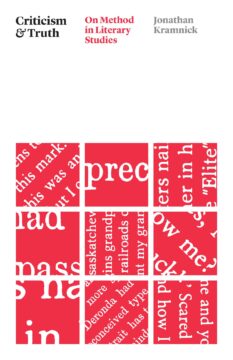 It is now close to 20 years since I completed my Ph.D. in English, and, truth be told, I’m still not exactly sure what I accomplished in doing so. There was, of course, the mundane concern about what I was thinking in spending so many of what ought to have been my most productive years preparing to work in a field not exactly busting at the seams with jobs (this was true back then, and the situation has, as we know, become even worse). But I’ve never been good with practical concerns; being addicted to uselessness, I like my problems to be more epistemic. I am still plagued with a question: Could I say that what I had written in my thesis was, in any particular sense, “true?” Had I not, in fact, made it all up, and if pressed to prove that I hadn’t, what evidence could I bring in my favour? Was what I saw actually “in” the text I was studying?
These were concerns that no doubt had their origin in my set of personal neuroses. I had, in fact, done pretty much everything that was required of me. I had made close readings of text, found hidden parallels and contradictions, looked at the minutiae of the language used and connected those to the overall structure of the text. I had used and responded to previous criticism of the work. I had found analogues of the language in the text in previously written works, some not to that point discovered. I had, in short, done the work, and my committee seemed confident enough to sanction the addition of some letters behind my name.
But still. What “truth value” did my work hold? It could not, reasonably, be “replicated” – literary studies do not proceed by trying to discover if a given reader could come to the same conclusions I did independently. There was no p-value, no null hypothesis for me to overcome. None of the trappings of scientific solidity – which, fair enough, can have their own issues – were available to me. I knew, and know, that asking for such levels of evidence is pointless and counter-productive in literary criticism. But it seemed – and to some degree still seems – to me that between science and “making stuff up” there lies no graduated approach to truth – merely a massive abyss. It remains the case that we have difficultly articulating how non-scientific disciplines say things that are true without needing the scientific method to do so.
Jonathan Kramnick’s 2023 book Criticism and Truth is one of a series of recent attempts to do precisely that, and in it there is much to praise. The institutional pressures which are slowly – much less slowly nowadays – strangling the humanities risk the loss of specific methods of generating knowledge. This method, in literary studies, is close reading, and it is a method that is distinct from anything else in the academy. Literary studies may borrow from other disciplines, like history, anthropology, or data science, but at their core lies this specific way of doing things that cannot be reduced to a sub-type of any other discipline. Kramnick wants to articulate the nature of that practice, and so demonstrate its value to an outside world that very much finds literary criticism arcane and gelatinously impressionistic. I am in full sympathy with this effort, but the path Kramnick takes in his articulation is, frankly, an odd one, and I’m not at all convinced that it could or would do much to shed light on the exact nature of literary critical method for those skeptical of its value.
For one thing, Kramnick denies that close reading is actually reading. It is writing, he says, and a very particular form of writing:
When we model close reading as a type of reading, we remain within a visual and contemplative framework, understanding it to happen when eyes fix on words and then transmit a code to the thinking mind. “I look and think.” This model of laborious, visual concentration is clearly seductive, both solemn and scholarly at once, but it loses the dimension of the practice better understood as craft. It loses how close reading is an expert practice of writing prose and making text, of weaving one’s words with words that precede and shape them. (35)
He then proceeds to, essentially, do close readings of some close readings from other critics. This practice of quotation – of “weaving” as Kramnick has it – is at the center of what he thinks critical practice should be. He also thinks that good critical writing should “mimic” the writing of the author under study, and proceeds, not very convincingly to my thinking, to find examples of this in doing his critical readings. (He discusses other methods, like summary, and is careful to assert that these do not constitute the whole of literary critical method.)
Nevertheless, finding as much as Kramnick does in the practice of proper grammatical integration of a quote is at least a little strange, but the bigger issue for me comes with the total orientation towards writing as the critical act. While I cannot object to Kramnick’s assertion that good criticism ought to reside in good writing, this is an ought to rather than a must be. A bad writer may still be able to articulate something worthwhile, something apt, about a given work. Skill in reading is, simply put, not the same things as skill in writing. For one thing, to say otherwise would be to reject out of hand all of the papers written under the auspices of Continental gods, the ones which read as if a French-English dictionary has been assaulted by a buzzsaw and then hurriedly reassembled. (You might be thinking you’d be fine with such a rejection, and I sympathise, but the point remains.) Worse, it seems to be a corollary of Kramnick’s line of thinking that good writing cannot contain bad readings – so, whatever a good, grammatically skilled writer asserts must be true, which our experience of reading literary criticism does not always confirm. And “good writing” in Kramnick takes, as I have noted, a somewhat peculiar form. I do not think it is at all wise to try to write like Shakespeare of Joyce when writing about either, and I know for a fact that, if I attempted to do so, the results would be embarrassing, irrespective of what I had to say about either author. Kramnick evidently wants criticism to meet with, and to a degree share status with, literary art, and while he’s not the first to claim this for it, he does nothing to temper the inherent hubris in such an assertion.
I find Kramnick’s attempt to divorce critical reading from contemplation – from, in fact, reading – to be both dubious and unnecessary. To interlock written skill and criticism so deeply is to further alienate the critical act from what really must be taken as its fundamental moment – that of recognition. This is the point where we see – and yes, I feel confident in asserting that criticism is more visual than tactile – a connection between this element in a text and that one that suggests to us some interwoven scaffolding of structure within the work, one which can’t be delineated by any “baseline” or “literal” reading. If we can put that moment in writing, so much the better, but I don’t see how, if we fail to do so, the moment ceases to exist. This is to institutionalise the act of criticism, to render alien an act which ought to be familiar to anybody who has seen something beyond the simplest interpretation of what the words in the text are saying. We lose much, especially our ability to defend the practice to the lay audience, if we suggest that it resides exclusively within the purview of those with the talent and time to write.
Close reading will still have to centre on the practice of reading, not writing, for what I take to be a simple reason: just as scientific empiricism evolves directly out of our sensory lives, close reading must evolve out of what, aside from speech, is for most people the central experience of our linguistic lives. For most who wish to challenge themselves in their reading habits, this experience resides in the effort to comprehend, find parallels and divergences, understand contexts and subtexts, etc. The original nature of scientific enquiry is available to all, even if the highest practice of it can only be done by individuals with the talent and means for doing so; the same is true for literary criticism. We begin students in science by telling them not to take the world as a given; we begin students in criticism by telling them to also not do so with texts. A fundamental elitism emerges in Kramnick’s argument; if we are trying to articulate why literary criticism deserves preservation, we had best not start with saying that critics need to meet such high levels of written aptitude, or else they aren’t actually doing “criticism” at all. (It is odd, given his argument, that Kramnick ends his book with a chapter on “public humanities.” But when he examines instances of criticism outside the academy, he again looks for the hallmarks of critical writing he thinks are significant.) However abstruse critical practice may be, is there really such an unbridgeable gap between criticism and the everyday act of reading? No such gap, I would argue, exists between the child who discovers that seeds become trees and the practice of botanical science.
Kramnick asserts that he does not want to delve too deeply into the nature of close reading, that his goal is simply to outline it as a professional practice, know-how, and skill. But if we are going to discuss some kind of know-how, oughtn’t we begin by saying what that know-how actually knows? None of the techniques Kramnick discusses – quotation, mimicry, what Kramnick calls “free indirect critical style” – seem to me to be fundamental to the act of perception that must be the basis of close reading, of seeing something within the text not available to a cursory inspection. I am not convinced that, by leapfrogging over a bedrock definition, Kramnick has delivered to us the fundamentals of the skill involved in literary critical method. It may certainly be true that we may skip over hard problems to make worthwhile assertions about other emergent problems, but the hard problem remains behind us, staring us down.
Kramnick repeatedly asserts that critics are not just “making it up,” and chides those like Stanley Fish who say, essentially, that they are. When it comes time for Kramnick to discuss the question of whether a particular reading is “true” or not, he says that he only knows this to be the case by the particular skills the authors demonstrate in writing. He repeatedly uses the word “apt” to describe the readings he likes, and indeed, it’s this “aptness” which I think stands as the hallmark of a piece of criticism well-done. For Kramnick, this “aptness” makes any question of the “truth” of a given reading irrelevant; a reading is true if it is apt. This aptness inheres entirely within the scope of practice: “As an appraisal of quality, therefore, the judgment of criticism is at one and the same time of craft aesthetics and craft epistemology” (91). Kramnick denies that criticism is a “metalanguage” – it is not descriptive of a state of affairs in the object language, but rather an aesthetic performance of its own. Again, this definition seems to me to have skipped over a few steps. For one thing, Kramnick makes criticism “a social activity, even in its most solitary instances” (93) and so strips away the validity of the insights of the private reader. So that moment when you thought you noticed something in the sonnet or novel is not criticism until you write it down and some community judges it to be apt. Well, as a community of one, this certainly jars against my sense of what criticism actually does, and renders the act of reading altogether too crowded for my tastes. Kramnick may say his claims are not to be conflated with Fish’s “interpretive communities,” but the inevitable sense is that he comes back to the idea that a given interpretation is valid because a cadre of university professors say it is.
We do desperately need some kind of coherent definition of literary critical method (not everyone agrees with this, but to me it is self-evident), but this is not the way to go about it. The definition of aptness as embedded in the skill used in the critic’s writing is simply too divorced from the foundation acts of reading and recognition, which naturally are not engaged in by critics only. At the most basic definition, a critique is “apt” because it exposes something we immediately understand to be a part of the text we are reading, that the critic has uncovered a lattice of structural beams within the work which, once seen, are “there” in the text in a way that seems inevitable. But we also know what it’s like to encounter a reading which we feel to be a “stretch.” Kramnick mentions this, but doesn’t elaborate much on what happens when a critic fails. In this case we think the critic has made an imposition, has imported something into the text which doesn’t match up, doesn’t belong there. Putting post-structuralist noodling on the nature of such knowledge aside, one type of reading exposes a structure, the other imposes it. A fundamental explanation of the nature of literary critical method would focus on the difference between this “aptness” and “stretchiness” of a reading, even if in the end, as Kramnick acknowledges, we can do no better than to continue to call them something akin to “feelings” rather than absolute knowledge. (It is to be hoped, however, that the distance between “what I feel” and “what I know” could at least be a little shortened.) So a kind of literary-critical null hypothesis would emerge; a “stretchy” reading simply fails to reveal an actual connection between Element A and Element B. It may very well be that this simply indicates that the critic has failed in some crucial element of performance, but the center of that performance is an assertion of fitness that exists independent of written skill. The line between finding out and making it up may be thin at times, but even if we are barred from using the categories of “true” and “false” in literary enquiry, that’s no reason to think we need to abandon any hope of distinction. Saying for certain what is “in” text may never be possible, but we are free to peruse the territory. We leave good criticism thinking we have found something out about the text; we leave bad criticism thinking we have found something out about the critic.
Kramnick, again, has to be applauded for at least making such an attempt. Even as English departments undergo crude amputation, literary criticism should not go the way of phrenology. There is something to appreciate, almost a medieval sense of comfortable and even rustic simplicity, in Kramnick’s focus on criticism as craft and skill. As AI comes to replace, and thus obliterate, both the practices of reading and writing, as we find ourselves ever distanced from a sense that the world contains rich objects of implicate order worthy of the closest attention, there may emerge a cohort of independent artisanal readers eager to preserve what is nearly lost – and it may even be the case that they are in demand.
***
Enjoying the content on 3QD? Help keep us going by donating now.