
by Derek Neal
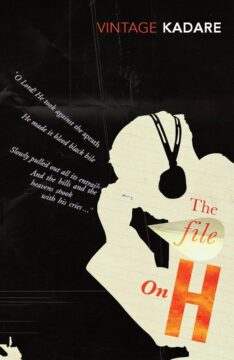 The File on H is a novel written in 1981 by the Albanian author Ismail Kadare. When a reader finishes the Vintage Classics edition, they turn the page to find a “Translator’s Note” mentioning a five-minute meeting between Kadare and Albert Lord, the researcher and scholar responsible, along with Milman Parry, for settling “The Homeric Question” and proving that The Iliad and The Odyssey are oral poems rather than textual creations. As The File on H retells a fictionalized version of Parry and Lord’s trips to the Balkans to record oral poets in the 1930’s, this meeting from 1979 is characterized as the genesis of the novel, the spark of inspiration that led Kadare to reimagine their journey, replacing primarily Serbo-Croatian singing poets in Yugoslavia with Albanian bards in the mountains of Albania.
This anecdote is repeated in almost every article one finds on the novel, scholarly or popular. Perhaps it is simply too good of a story to pass up—the American meets the Albanian, who, trapped in a communist dictatorship, knows nothing of the research and scholarship going on outside his country’s borders. On one of the few trips when he’s allowed to leave the country, a special privilege granted to culturally important Albanians, he meets an American who enlightens him about the history of his own country, but they’re only given a few minutes before the Albanian has to return to his isolated nation, forced to reconstitute the conversation in novelistic form.
It is ironic that what seems to be a piece of gossip, a possibly apocryphal tale, would attach itself to the story of The File on H, which ultimately deals with the implications of the transition from an oral world to a literate one. These types of tales change each time they get passed on from one person to another, but once they are set down in writing, they become fixed. The official account becomes codified—Kadare wrote this novel because of his conversation with Albert Lord in 1979. And maybe he did. But if this is the case, one wonders how his characterization of Lord and Parry’s findings, how his articulation of the difference in the oral worldview and the literate worldview, are so accurate in his novelization. Surely Lord couldn’t have told him of his in-depth findings on the composition of oral poetry in just a few minutes. What one forgets, however, is that the world Lord and Parry were discovering was already Kadare’s world.
When Lord writes about the oral bards in The Singer of Tales (1960), what is to him a vestige of a long-lost world that existed thousands of years ago is for Kadare a world that he may have known firsthand. Lord visited Albania, too, to record oral poets, and Kadare, born in 1936, could have heard the singers that Lord and Parry travelled to see, not for research, but for pleasure. In The Singer of Tales, Lord characterizes the performances of oral poets and underlines that they were not involved in “high art,” but entertainment and business (or more accurately, he shows how these realms are inseparable):
Epic poetry in Yugoslavia is sung on a variety of occasions. It forms, at the present time, or until very recently,1It’s unclear if Lord is referring to the dates of the recordings, the 1930’s, or closer to the publication of the book, 1960 the chief entertainment of the adult male population in the villages and small towns. In the country villages, where the houses are often widely separated, a gathering may be held at one of the houses during a period of leisure from the work in the field…[this] holds as well for the more compact villages and for towns, where the men gather in the coffee house (kafana) or in the tavern […]. Frequently the tavern is also an inn, a “han,” and here the drivers will spend the night. Many of these men are also singers and the carriers of tradition from one district to another […]. In market centers…market day…will be the busiest day in the han or in the kafana…This is a good opportunity for the singer because, although his audience may not be stable, it does have money and is willing to reward him for his pains. He is not really a professional, but his audience does buy him drinks, and if he is good they will give him a little money for the entertainment he has given them.
This is the world with which Kadare may have been familiar. In an interview with French magazine L’express, Kadare mentions that in his native city of Gjirokastër, “cafes were very popular,” and he reminisces about going to cafes with his classmates as a young teenager, which for them were “a sign of freedom” in relation to Communism, which he characterizes as hostile to cafe culture. But it’s difficult to say if the cafes Kadare mentions were similar to the ones that Lord writes about in Yugoslavia. Gjirokastër is a small city (the information I could find indicated a population of about 12,000 in 1950), whereas Lord clearly writes about more rural areas. Nevertheless, in that same interview Kadare contrasts the cafe culture in Gjirokastër with that of Tirana, the capital, saying that the Tirana cafes were “snobbish” and took inspiration from Europe with their names such as “Le Flore” and “Bella Venezia,” suggesting that the Gjirokastër cafes may have been more traditional.
Whether or not Kadare had direct experience with the sort of cafes and inns that Lord writes about, he certainly had an appreciation for epic poetry and an understanding that his own novels were connected to it. In an “Art of Fiction” interview with The Paris Review from 1998, he makes this point clearly, noting that for Albanian literature, “its sources are essentially oral,” while also mentioning that “the era of epic poetry is over” but the novel “is still very young.” Consider, for a moment, what it means to make the point that “the era of epic poetry is over” in 1998. This would be unlikely for a “Western” writer, for whom this era would have been over for hundreds of years, but for Kadare, it’s still something to consider2One source I found mentioned that singers of epic poetry could be found in Kosovo and northern Albania as late as 2011 http://www.elsie.de/pdf/articles/A2011KengeKreshnikesh.pdf because it serves to illuminate the form of the novel. The interviewer and Kadare go back and forth a few times, with Kadare showing that his understanding of literature is wide and deep, while the interviewer seems mostly concerned with niche genres of 20th century literature.
When Kadare says the novel is “still very young,” the interviewer exclaims that “the death of the novel has been foretold for fifty years!” Kadare dismisses this by saying that “there are always people who talk a lot of nonsense!” before noting that “if the novel is to replace the two important genres of epic poetry—which has disappeared—and of tragedy—which continues—then it has barely begun, and has still two thousand years of life left.” The interviewer recognizes that Kadare has incorporated Greek tragedy into his novels (Kadare agrees with this), and the interviewer then says that “the novel has since divided into many genres [since Don Quixote].” Kadare rejects this: “Not at all! […] I think that in the history of literature there has been only one decisive change: the passage from orality to writing […]. They say that contemporary literature is very dynamic because it is influenced by the cinema, the television, the speed of communication. But the opposite is true!” (Kadare then claims the Iliad is more dynamic than contemporary literature.) The interviewer insists once more on certain changes and developments in literature, saying that “there have been literary events, such as modernism—Joyce, Kafka…” to which Kadare replies, “Kafka was very classical, so was Joyce. When Joyce became really modernist, in Finnegan’s Wake, he failed. He went too far and no one likes that book […]. All this noise about innovations, new genres, is idle. There is real literature, and then there is the rest.” Perhaps Kadare himself goes too far here, but it’s clear from these remarks that he has an appreciation for the history of literature in all its forms and a better understanding of the continuities in written literature than the interviewer does. This explains some of Kadare’s style, which often mixes folklore, realism, mythology, and satire. His books, which he would surely count as “real literature,” are also highly entertaining and comic, and because of his historical understanding, he doesn’t see this as a contradiction.
Part 2 will look at specific examples of orality and literacy in the text of “The File on H.”
Enjoying the content on 3QD? Help keep us going by donating now.
Footnotes
- 1It’s unclear if Lord is referring to the dates of the recordings, the 1930’s, or closer to the publication of the book, 1960 ↩︎
- 2One source I found mentioned that singers of epic poetry could be found in Kosovo and northern Albania as late as 2011 http://www.elsie.de/pdf/articles/A2011KengeKreshnikesh.pdf ↩︎