
by Priya Malhotra
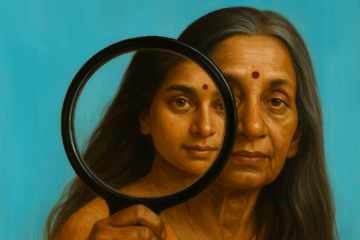
When I typically envisioned a woman in her seventies, I—like many of us—pictured someone wrinkled and bent—not just physically, but also mentally and emotionally. I imagined someone dimmed, only to fade further with time. A woman well past the best years of her life, wearied by disappointments, melancholy with regrets for cherished things that never came to fruition, and weighed down by the realization that those longings would likely never be fulfilled. She was someone who tucked those yearnings away, lest they resurface as reminders of everything she had lost. Old age, I believed, was a time of decline—the deterioration of one’s faculties, the shedding of one’s dreams, a slow march toward the inevitable.
But then I moved to India and witnessed how my cousin Rashmi (name changed for privacy) lived—and aged—and every depressing notion I had about growing old was upended.
At 71, Rashmi radiates a resplendent glow that’s nothing short of infectious. Her hair is fully grey and she wears it with grace. Her skin bears the spots and textures of age, her body sags in places—but her spirit sings. The way she moves through life with joy and poise is more inspiring than I can describe.
“Aging is a gift,” she tells me. “So many people don’t get to that point. It’s not afforded to everybody. Aging can be great—but there’s a caveat. You need to be in good health.”
It’s not Botox or anti-aging creams that keep her youthful. It’s her innate, almost childlike sense of wonder. And like a child, she delights in the infinite delights of the world. She’ll bubble with enthusiasm over intricately embroidered linen table mats or latticework crafted in a dusty Delhi storefront. She’s equally enraptured by the grandeur of a centuries-old dome or a Caravaggio masterpiece. In her eyes, the world is even more magical now than it was thirty years ago.
“Then, I took it all for granted,” she says. “Now I don’t. Youth gives you a sense of immortality—you think you’ll always have time to enjoy life’s enchantments. But as you get older, there’s this wonderful urgency to enjoy them now.”
She acknowledges that the body begins to bear the weight of time, but she sees aging as a time of liberation and expansion—mentally, emotionally, spiritually. “By that time, you’re not raising kids or running off to work or trying to prove anything. You have space. You invest in yourself. You stop scrambling. You’re more comfortable in your skin. You care less about what other people think. When I was younger, I had so much more on my plate.”
And with that space comes reflection. Rashmi describes aging as a gradual awakening—a sharpening of self-awareness. She began to examine her belief systems more deliberately. Were they hers? Or inherited by osmosis from family, religion, society? As the years passed, her awareness expanded, and with it, her capacity to question and choose.
“Expansive”—that’s the word that always comes to mind when I think of Rashmi. She transcends limits. She’s endlessly curious. Rather than saying, “Been there, done that,” she’s still seeking, learning, and engaging. I’m continually surprised by her ability to see every side of a story and never rush to judgment. She embraces divergent views, unfamiliar customs, and cultural complexities with a largesse of spirit that allows others to feel seen and safe—even when she disagrees.
She reminds me of Draupadi’s sari in the epic Mahabharata—the sari that became infinite when Duryodhana tried to disrobe her. Rashmi, too, seems to unfold endlessly, revealing new dimensions just when you think you’ve grasped the whole.
She also brings to mind Walt Whitman’s lines:
Do I contradict myself?
Very well then I contradict myself,
(I am large, I contain multitudes.)
And her expansiveness isn’t only of this world. Deeply grounded in yoga and meditation, I often see her spirit soaring to cosmic, celestial heights—beyond body, beyond mind—while fully aware of how fleeting and small each human life really is. In her presence, she feels like a universe unto herself, growing vaster with time.
Rashmi’s passion for travel is one of the many ways she keeps stretching her understanding of the world. She began exploring as a stewardess for Air India in the 1970s, and her wanderlust hasn’t dimmed. In the past 18 months alone, she has visited Uzbekistan, Georgia, and Morocco.
“The light in Morocco was brilliant,” she gushed. “There’s this incredible nexus of North African, Mediterranean, and Atlantic cultures. The artists are phenomenal, the souks dazzling. Isn’t it magical to bring another part of the world alive?”
Her husband teases her: “Which of the hundred countries you haven’t been to would you like to visit next?”
Rashmi’s life hasn’t been free of hardship. The most transformative challenge came when she became the mother of a child with special needs—a responsibility that would require lifelong parenting. At the time, she was overwhelmed by anxiety and self-doubt. But slowly, she persevered. She found her footing. She has raised her son with extraordinary patience, love, and understanding.
“What I thought would be my greatest challenge became my greatest gift,” she says. “I didn’t know I had this in me. It’s been the most meaningful part of my life. He’s stretched me in ways I couldn’t have imagined and brought people into my life who’ve inspired me beyond words.”
Watching Rashmi is like watching someone swim through life—not frantically or fearfully, but with grace and rhythm. Her joy is not performative. It stems from simple things: her garden, a lush Eden of palms and flowering vines reminiscent of a Henri Rousseau painting. She practices yoga, gets regular massages, cooks with imagination, reads voraciously, watches films with discernment, and invests deeply in the people she loves.
Even the smallest things enchant her. “Joy,” she says, “is sitting on a bench and watching the dappled light on a tree. The sun slanting on green grass.”
What makes her most inspiring, though, is her mindset—utterly devoid of the disillusionment or cynicism we often associate with growing older. She believes happiness is a discipline, a choice. One earned through decades of reflection and editing one’s own mental scripts. She recalls once asking a friend, “How’s life treating you?” And she replied, “The question isn’t how life’s treating me, but how I’m treating life.”
To Rashmi, most of our internal narratives are just constructs. Stories. And she gently interrogates hers every day. “Is this thought serving me?” she asks. “If not, I throw it in the trash.”
Her perspective didn’t arrive at 71 like some divine reward. It was cultivated. Slowly, deliberately. Over time. Like music practiced over years until it builds into a crescendo. This kind of aging is not accidental. It’s a life lived with intention.
But Rashmi is quick to temper the praise.
“I’m far from perfect,” she says. “Don’t put me on a pedestal. You’re only as good as your last challenge. I certainly don’t have everything figured out.”
She might not have put all the pieces together yet—but the picture she’s painted is enough to shift how I see aging: not as erosion, but as arrival. And kudos to that.
***
Enjoying the content on 3QD? Help keep us going by donating now.